Your forearms are working on every single pulling, gripping, and carrying movement you do. But if you never train them directly, they become the weak link that holds everything else back.
A weak grip means you drop the bar before your back or legs are finished working. It means your deadlift stalls not because your posterior chain gave out, but because your fingers opened up. It means you reach for straps on weights you should be able to hold.
This guide covers the 10 best forearm exercises for grip strength and size, two complete forearm workout routines, and a straightforward programming approach so you can start building stronger forearms this week.
TL;DR
TL;DR
- Forearms control grip strength, wrist stability, and overall lifting performance
- Train both wrist flexors (underside) and wrist extensors (top) for balanced development
- The 10 best exercises: wrist curls, reverse wrist curls, farmer's walks, dead hangs, plate pinch holds, towel pull-ups, reverse curls, hammer curls, behind-the-back wrist curls, and gripper squeezes
- Train forearms 2-3x per week at the end of your sessions, 6-10 total sets per week
- Use the free workout planner to add forearm work into your existing program
Why Forearm Training Matters
Your forearm muscles are responsible for everything your hands do. Gripping a barbell, holding dumbbells, carrying groceries, opening jars. Every time you grab something and hold on, your forearms are doing the work.
Grip is the bottleneck for most lifters. Your back can handle more weight on rows. Your legs can pull heavier on deadlifts. But if your grip gives out first, those bigger muscles never get fully stimulated. Training forearms directly removes that bottleneck and lets you push harder on every compound lift.
Forearm size responds to direct training. Plenty of lifters rely on indirect work from rows, deadlifts, and pull-ups to grow their forearms. That works to a point. But if you want forearms that actually fill out your sleeves, you need targeted exercises that isolate the wrist flexors, wrist extensors, and brachioradialis.
Injury prevention matters too. Weak forearms and grip muscles contribute to elbow pain, wrist pain, and tendinitis. Strengthening the small muscles around your wrist and elbow joint keeps those areas healthy as your compound lifts get heavier. If you are following a progressive overload approach (and you should be), your forearms need to keep pace.
The forearm has over 20 muscles packed into a small area. They break down into two main groups:
- Wrist flexors (underside of forearm): Curl your wrist toward your palm. Trained by wrist curls and gripping exercises.
- Wrist extensors (top of forearm): Extend your wrist backward. Trained by reverse wrist curls and reverse curls.
You need to hit both groups for complete development and to avoid imbalances.
10 Best Forearm Exercises
1. Barbell Wrist Curl
Primary Muscles: Wrist flexors (flexor carpi radialis, flexor carpi ulnaris, palmaris longus)
Why it matters: The wrist curl is the most direct way to isolate and overload the wrist flexors. These are the muscles that close your hand and create the thick, meaty underside of your forearm.
Coaching Cues:
- Sit on a bench and rest your forearms on your thighs, wrists hanging just past your knees, palms facing up.
- Let the barbell roll down to your fingertips, then curl it back up by flexing your wrists.
- Keep the movement slow and controlled. No jerking or bouncing.
- Use a full range of motion. Let the wrist extend fully at the bottom before curling back up.
Start light. 20-30 reps with a manageable weight will create a deep burn that heavier sets cannot match. These muscles respond well to higher rep ranges.
2. Barbell Reverse Wrist Curl
Primary Muscles: Wrist extensors (extensor carpi radialis, extensor carpi ulnaris, extensor digitorum)
Why it matters: The reverse wrist curl targets the top of the forearm, the muscles most lifters completely ignore. These muscles are smaller and weaker than the flexors, but they are critical for wrist stability and preventing elbow tendinitis.
Coaching Cues:
- Same setup as the wrist curl, but flip your hands so palms face down.
- Curl the barbell upward by extending your wrists, squeezing at the top.
- Use significantly less weight than regular wrist curls. The extensors are much weaker.
- Keep your forearms pinned to your thighs throughout the entire set.
If you have ever had pain on the outside of your elbow, weak wrist extensors are often the cause. This exercise fixes that.
3. Farmer's Walk
Primary Muscles: Entire forearm, traps, core, grip endurance
Why it matters: The farmer's walk is the most functional grip exercise you can do. It trains your forearms to hold heavy weight for extended time under load, which directly transfers to your performance on deadlifts, rows, and carries. It also crushes your traps and core.
Coaching Cues:
- Pick up heavy dumbbells or farmer's walk handles. Use the heaviest weight you can hold for 30-40 seconds.
- Stand tall with shoulders pulled back and down. Do not let the weight pull you forward.
- Walk with short, controlled steps. Keep your core braced the entire time.
- Squeeze the handles as hard as you can. Do not let them slide into your fingertips.
Farmer's walks are a staple in every serious strength program for a reason. If you only add one forearm exercise to your routine, make it this one. For more barbell and dumbbell compound work, check out our barbell workout guide.
4. Dead Hang
Primary Muscles: Finger flexors, wrist flexors, grip endurance
Why it matters: Dead hangs build the kind of grip endurance that keeps the bar in your hands during heavy sets of rows, deadlifts, and shrugs. They also decompress the spine and stretch the shoulders, making them a great recovery tool.
Coaching Cues:
- Grab a pull-up bar with an overhand grip, shoulder-width apart.
- Hang with straight arms, feet off the ground, shoulders engaged (not shrugging up to your ears).
- Hold for as long as possible. Aim for 30-60 seconds to start.
- When that gets easy, try single-arm hangs or add weight with a dip belt.
Dead hangs are brutally simple and brutally effective. Your forearms will be screaming after 45 seconds if you have never done them before.
5. Plate Pinch Hold
Primary Muscles: Thumb flexors, finger adductors, pinch grip
Why it matters: Most grip exercises train crush grip (closing your fist). The plate pinch trains pinch grip, which uses your thumb in opposition to your fingers. This is a completely different grip pattern that builds thickness in the thenar muscles at the base of your thumb and the inner forearm.
Coaching Cues:
- Place two weight plates together smooth-side-out (start with two 10 lb plates).
- Pinch them between your thumb and fingers, lift off the ground.
- Hold for 20-30 seconds per hand. Switch sides.
- Progressively add thinner or heavier plates as your pinch grip improves.
This exercise looks easy until you try it. The pinch grip fatigues fast and exposes a grip weakness that most lifters did not know they had.
6. Towel Pull-Up
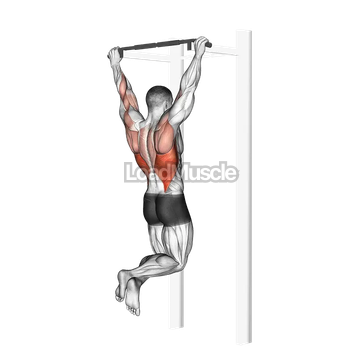
Primary Muscles: Forearms (wrist flexors, finger flexors), lats, biceps
Why it matters: Take a standard pull-up and make the grip surface thicker and unstable. That is what a towel pull-up does. The thick, soft grip forces your forearms to work significantly harder than a regular bar, turning every rep into a forearm exercise on top of a back exercise.
Coaching Cues:
- Drape two towels over a pull-up bar, one for each hand.
- Grab the ends of each towel and perform pull-ups.
- Squeeze the towels as hard as you can throughout the movement.
- If full pull-ups are too difficult with the towels, start with towel dead hangs to build grip first.
Towel pull-ups are a favorite of rock climbers and grapplers. They build the kind of real-world grip strength that no machine can replicate. For more upper body pull variations, browse our exercise library.
7. Barbell Reverse Curl
Primary Muscles: Brachioradialis, wrist extensors, biceps
Why it matters: The reverse curl is like a standard barbell curl but with an overhand grip. This shifts the workload from the biceps to the brachioradialis, the thick muscle that runs along the top of your forearm. Building this muscle adds visible width to your forearm and fills the gap between your bicep and your wrist.
Coaching Cues:
- Stand holding a barbell with an overhand (pronated) grip, shoulder-width apart.
- Curl the bar up, keeping your elbows pinned to your sides.
- Lower under control. Do not let the bar drop.
- Use lighter weight than your regular barbell curls. Your forearms will be the limiting factor.
The reverse curl is one of the most underrated arm exercises. If you want forearms that look strong, this is the movement to prioritize. Pair it with standard curls for complete arm development. See our bigger arms guide for full bicep and tricep programming.
8. Dumbbell Seated Hammer Curl
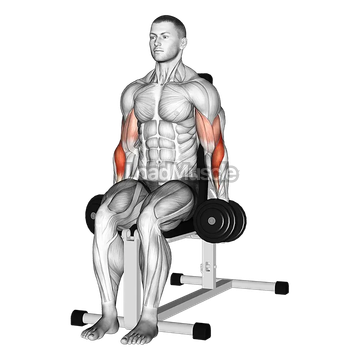
Primary Muscles: Brachioradialis, brachialis, biceps
Why it matters: The hammer curl uses a neutral grip (palms facing each other) which puts your forearm in a mechanically stronger position. This lets you go heavier than reverse curls while still hammering the brachioradialis. It also builds the brachialis, the muscle that pushes your bicep peak up and adds thickness to your arm.
Coaching Cues:
- Sit on a bench holding a dumbbell in each hand, palms facing your body.
- Curl both dumbbells up toward your shoulders without rotating your wrists.
- Squeeze at the top and lower slowly. Control the negative.
- Keep your elbows stationary. No swinging.
Hammer curls are a staple in every serious arm routine because they hit the forearms, brachialis, and biceps all at once. Three muscles in one movement.
9. Behind-the-Back Barbell Wrist Curl
Primary Muscles: Wrist flexors, finger flexors
Why it matters: This is a wrist curl variation that allows for a longer range of motion and a stronger contraction at the top. Standing behind-the-back puts the forearm in a slightly different position than the seated version, which can recruit muscle fibers that the standard wrist curl misses.
Coaching Cues:
- Stand holding a barbell behind your back with an underhand grip (palms facing away from you).
- Let the bar roll down to your fingertips, then curl it up by flexing your wrists and closing your fingers.
- Keep your arms straight. Only your wrists and fingers move.
- Use a smith machine or ask a partner to hand you the bar if the setup feels awkward.
This was a favorite exercise of old-school bodybuilders. The stretch at the bottom when the bar rolls into your fingertips creates a stimulus that seated wrist curls cannot fully replicate.
10. Gripper Squeeze
Primary Muscles: Finger flexors, crush grip, wrist flexors
Why it matters: Hand grippers train crush grip, the ability to close your hand forcefully against resistance. This is the most sport-specific type of grip for most lifters. A stronger crush grip means a tighter hold on every barbell, dumbbell, and cable attachment you touch.
Coaching Cues:
- Choose a gripper resistance you can close for 8-12 reps with effort.
- Place the gripper deep in your palm, not in your fingertips.
- Squeeze it fully closed, hold the squeeze for a full second, then release slowly.
- Train both hands equally, even if one is stronger.
Start with a lighter gripper than you think you need. Ego gripping with a resistance you cannot fully close teaches your nervous system bad movement patterns. Close it cleanly for reps before moving up.
Forearm Workout Routine
Here are two forearm routines you can add to the end of any training session. Pick the one that fits your setup.
Option A: Gym Forearm Workout
| Exercise | Sets x Reps | Rest |
|---|---|---|
| Farmer's Walk | 3 x 40 sec | 90s |
| Barbell Wrist Curl | 3 x 15-20 | 60s |
| Barbell Reverse Wrist Curl | 3 x 15-20 | 60s |
| Barbell Reverse Curl (overhand grip) | 3 x 10-12 | 60s |
| Plate Pinch Hold | 2 x 30 sec | 60s |
Option B: Home / Minimal Equipment Forearm Workout
| Exercise | Sets x Reps | Rest |
|---|---|---|
| Dead Hang | 3 x max hold | 90s |
| Towel Pull-Up (or Towel Hang) | 3 x max reps | 90s |
| Dumbbell Seated Hammer Curl | 3 x 12-15 | 60s |
| Gripper Squeeze | 3 x 10-12 per hand | 60s |
| Behind-the-Back Wrist Curl (dumbbell) | 3 x 15-20 | 60s |
Both routines take 15-20 minutes. Tack them on after your main training and you will see results within a few weeks. Check our workout routines page for full programs that you can pair this forearm work with.
How Often to Train Forearms
2-3 times per week is the sweet spot for most lifters. The forearms are built for endurance (they work all day gripping things), so they recover faster than larger muscle groups. But they still need adequate rest between sessions.
Aim for 6-10 direct sets per week. That is enough volume to drive growth without burning out the small muscles and tendons around the wrist and elbow. If you are already doing a lot of heavy pulling (deadlifts, rows, pull-ups), you are on the lower end. If your program is mostly pressing and machines, aim for the higher end.
Best time to train forearms: at the end of your session. Never train forearms before heavy compound work. If your grip is pre-fatigued, your deadlifts, rows, and pull-ups will all suffer. Save the direct forearm work for the last 15-20 minutes of your workout.
Here is a simple weekly approach:
- Monday (after pull day): Wrist curls, reverse wrist curls, farmer's walks (6 sets total)
- Wednesday (after push day): Dead hangs, plate pinch holds (4 sets total)
- Friday (after legs): Hammer curls, reverse curls, gripper work (6 sets total)
That gives you roughly 16 sets of direct forearm work per week, plus all the indirect grip training from your compounds. For most people, that is more than enough. If you are new to forearm training, start with 6-8 sets per week and build up over 4-6 weeks.
For a complete breakdown of how to add accessory work into different training splits, read our cable machine exercise guide which covers similar programming principles.
FAQ
Can I build forearms without weights?
Yes. Dead hangs, towel pull-ups, and bodyweight grip exercises build serious forearm strength. Rock climbers have some of the strongest forearms in the world and they rarely touch a barbell wrist curl. That said, adding resistance (wrist curls, farmer's walks, grippers) accelerates the process if you have access to equipment.
Should I use straps or train my grip raw?
Both. Use straps on your heaviest sets of deadlifts and rows so your grip does not limit the stimulus to your back, legs, and traps. Then do your direct forearm training without straps. This gives you the best of both worlds: maximum training stimulus on compounds plus dedicated grip development. Think of straps as a tool, not a crutch.
How long does it take to see forearm growth?
Most people notice visible forearm growth after 6-8 weeks of consistent direct training. The forearms are a small muscle group with a high percentage of slow-twitch fibers, so they respond best to high reps and frequent training. Be patient and trust the process. Measure your forearms every 4 weeks to track progress objectively.
Is forearm size mostly genetic?
Genetics play a role in your wrist circumference and muscle insertion points, which affect how "full" your forearms look. You cannot change your bone structure. But the actual muscle tissue responds to training just like any other body part. Even lifters with thin wrists can build impressive forearms with consistent direct work. Genetics set the ceiling, but most people are nowhere near their ceiling.
Can forearm training help with elbow pain?
Often, yes. Many cases of lateral epicondylitis (tennis elbow) and medial epicondylitis (golfer's elbow) are caused by weak or imbalanced forearm muscles. Strengthening both the wrist flexors and extensors with controlled, progressive loading can reduce or eliminate elbow pain over time. If you have acute pain, see a professional first. But adding reverse wrist curls and light wrist curls is a common rehab protocol for chronic elbow issues.
Do deadlifts and rows train forearms enough?
For grip strength, heavy pulls provide a solid baseline. But for forearm size, they are usually not enough. Compound pulls train grip endurance (holding on to the bar), but they do not take the wrist flexors or extensors through a full range of motion. If forearm size is a goal, you need direct wrist curl and reverse curl variations on top of your pulling work.
Add Forearm Work to Your Plan
Strong forearms are not optional if you are serious about lifting. They improve your grip on every exercise, protect your elbows and wrists from injury, and add visible size that makes your entire arm look more complete.
The exercises and routines in this guide give you everything you need. Pick 3-4 exercises, hit them 2-3 times per week at the end of your sessions, and apply progressive overload just like you would with any other muscle group.
Use the free workout planner to build a complete training program that includes forearm work alongside your main lifts. Or download the LoadMuscle app to log your forearm exercises, track your grip strength over time, and follow a structured plan that keeps you progressing.
For a complete arm session including biceps and triceps, check our dumbbell arm workout. Browse our full exercise library for more forearm and arm variations with demos and coaching cues.