There is a fine line between training hard and training too much. Overtraining is one of the most misunderstood concepts in fitness, and it can quietly derail your progress for weeks or even months before you realize what is happening. Whether you are a beginner pushing through every session or an experienced lifter chasing a new personal record, understanding overtraining is critical to long-term success.
The truth is, more is not always better. Your body needs time to adapt, repair, and grow stronger. When you consistently exceed your recovery capacity, performance declines, injuries creep in, and motivation evaporates. This guide will help you recognize the warning signs, understand the root causes, and build a plan that keeps you progressing without burning out.
TL;DR
TL;DR
- Overtraining syndrome is a chronic state of performance decline caused by excessive training without adequate recovery.
- Overreaching is short-term and reversible. Overtraining is prolonged and can take weeks or months to recover from.
- Watch for 12 key signs including persistent fatigue, declining strength, elevated resting heart rate, mood changes, and frequent illness.
- Common causes include too much volume, insufficient rest, poor nutrition, and accumulated life stress.
- Recovery strategies include deload weeks, complete rest, sleep optimization, and nutrition adjustments.
- Smart programming and periodization are the best defenses against overtraining.
- Use the Free Workout Planner to build a balanced program with built-in recovery.
What Is Overtraining Syndrome?
Overtraining syndrome (OTS) is a condition that occurs when the body is subjected to more training stress than it can recover from over an extended period. It is not just feeling tired after a hard workout. OTS is a systemic breakdown that affects your physical performance, hormonal balance, immune function, and mental health simultaneously.
The key word is chronic. Everyone has bad training days. Everyone feels sore after a tough session. But overtraining syndrome develops over weeks and months of accumulated fatigue that outpaces your body's ability to repair and adapt. Research published in the British Journal of Sports Medicine describes OTS as a maladaptation to excessive exercise without sufficient rest, resulting in long-term performance decrements and related physiological and psychological symptoms.
What makes OTS particularly dangerous is that it often feels like a plateau at first. You might assume you need to train harder, add more volume, or push through the fatigue. That instinct makes things worse. Recognizing the difference between normal training fatigue and the early stages of overtraining is one of the most valuable skills any lifter can develop.

Overreaching vs Overtraining
These two terms are often used interchangeably, but they represent very different situations. Understanding the distinction can save you from turning a manageable dip in performance into a months-long setback.
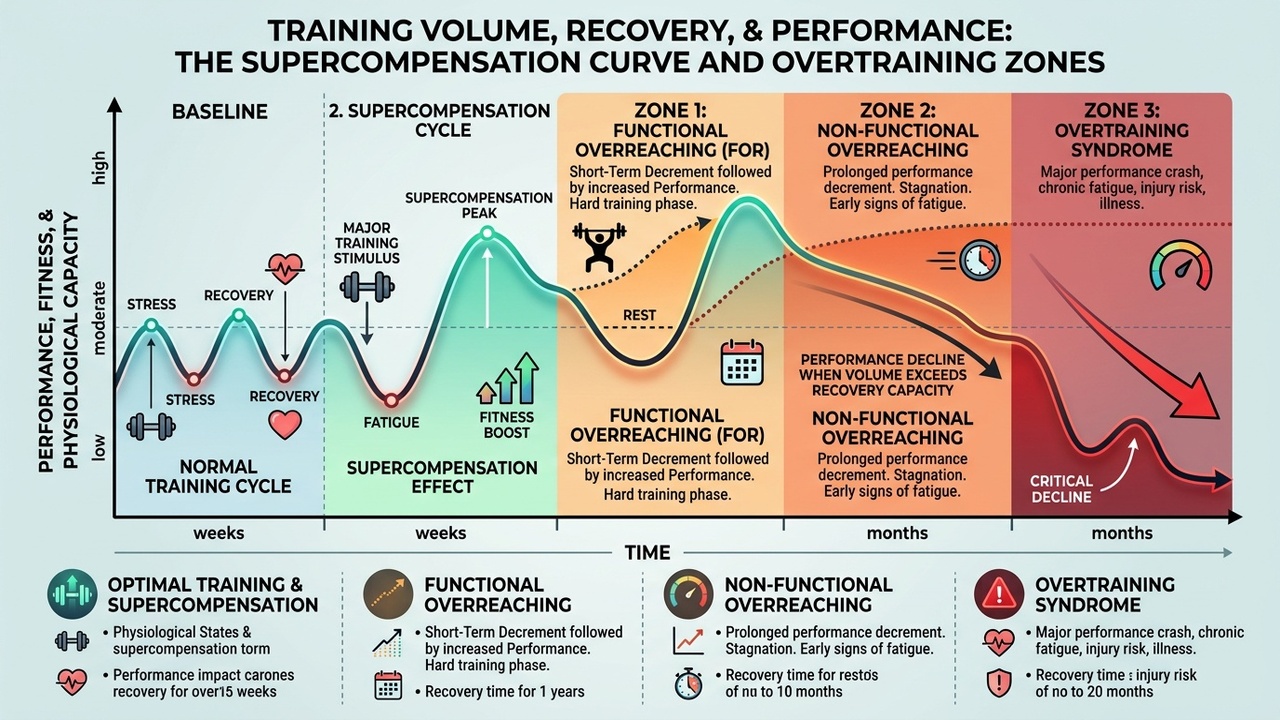
Functional overreaching is a planned, short-term increase in training stress that temporarily reduces performance. When followed by adequate rest, it leads to a supercompensation effect where you come back stronger. Many well-designed programs intentionally include overreaching phases. This is normal and productive.
Non-functional overreaching occurs when training stress exceeds recovery capacity for a slightly longer period, typically one to three weeks. Performance drops are more pronounced, and recovery takes longer, usually one to two weeks of reduced training. This is a warning sign.
Overtraining syndrome is the extreme end of the spectrum. It involves months of accumulated fatigue that lead to persistent performance decline, hormonal disruption, immune suppression, and psychological symptoms. Recovery from OTS can take weeks to months, and in severe cases, athletes have needed several months away from training entirely.
The progression is a continuum: functional overreaching leads to non-functional overreaching, which leads to overtraining syndrome. The earlier you catch yourself on this spectrum, the faster you recover. If you are interested in how to structure training intensity properly, our guide on progressive overload covers the principles of smart progression.
12 Signs of Overtraining
Recognizing overtraining early is crucial. Here is a comprehensive checklist of the most common symptoms. If you are experiencing five or more of these consistently for two weeks or longer, you may be in a state of non-functional overreaching or early overtraining.
- Persistent fatigue that does not improve with sleep
- Declining strength or inability to hit previous working weights
- Elevated resting heart rate (5-10+ beats above baseline)
- Increased frequency of illness (colds, infections)
- Persistent muscle soreness lasting more than 72 hours
- Disrupted sleep or insomnia despite physical exhaustion
- Loss of appetite or unexplained weight changes
- Decreased motivation to train
- Irritability, anxiety, or mood swings
- Stalled or regressing progress over multiple weeks
- Nagging joint pain or recurring minor injuries
- Decreased coordination or feeling "off" during lifts
Physical Signs
The physical symptoms of overtraining tend to be the most noticeable. Persistent muscle soreness that does not resolve within the normal 48-72 hour window is one of the earliest red flags. Your muscles are telling you they have not finished repairing before being stressed again.
An elevated resting heart rate is another reliable indicator. Your heart rate at rest reflects your autonomic nervous system's state. When you are overtrained, your sympathetic nervous system (fight-or-flight response) stays chronically elevated. Track your resting heart rate each morning before getting out of bed. A consistent increase of five or more beats per minute above your baseline suggests accumulated fatigue.
Frequent illness is a hallmark of overtraining. Intense exercise temporarily suppresses immune function, a phenomenon known as the "open window" theory. When you do not allow enough recovery between sessions, these temporary dips in immunity stack up, leaving you vulnerable to upper respiratory infections and other illnesses. If you are catching every cold that goes around, your training load may be the culprit.
For a deeper understanding of how rest and recovery work together, check out our guide on rest days and recovery.
Performance Signs
Performance decline is the defining characteristic of overtraining. If you are consistently unable to match weights, reps, or speeds that you previously handled comfortably, something is wrong.
Strength regression is particularly telling. A bad day happens to everyone. But if you cannot hit your working sets at weights you managed two or three weeks ago, and this pattern continues across multiple sessions, it is not a bad day. It is a trend. Your muscles, nervous system, and connective tissues are not recovering fast enough to support the demands you are placing on them.
Stalled progress is often confused with hitting a strength plateau. The difference is that a true plateau occurs when your body has adapted to a specific stimulus and needs a new one. Overtraining regression occurs even when you are providing progressive stimulus. Your body simply cannot keep up with the recovery demands.
Decreased coordination and feeling "off" during lifts is a central nervous system symptom. Your brain controls motor patterns, and when the CNS is fatigued, your technique suffers. This is also when injury risk spikes, because your body cannot stabilize and move loads with the precision it normally does.
Mental and Emotional Signs
Overtraining does not just affect your body. It significantly impacts your mental state. The psychological symptoms are often the ones that get dismissed, but they can be just as debilitating as the physical ones.
Loss of training motivation is one of the most common early signs. If you used to look forward to your workouts and now you are dreading them or making excuses to skip, pay attention. This is not laziness. It is your brain's way of telling you that the stress-to-recovery ratio is off balance.
Irritability, anxiety, and mood swings are driven by hormonal changes associated with overtraining. Chronically elevated cortisol suppresses serotonin and dopamine production, leading to mood disturbances that extend well beyond the gym. You might find yourself snapping at people, feeling unusually anxious, or experiencing general emotional flatness.
Sleep disruption is both a symptom and a cause of overtraining. Elevated cortisol and sympathetic nervous system activity make it difficult to fall asleep or stay asleep, even though you are physically exhausted. This creates a vicious cycle: poor sleep impairs recovery, which worsens overtraining, which further disrupts sleep.
What Causes Overtraining?
Overtraining is rarely caused by a single factor. It is almost always the result of multiple stressors stacking up over time. Understanding these causes helps you address the root problem rather than just treating symptoms.
Too Much Volume
Training volume, the total amount of work you do (sets x reps x weight), is the primary driver of overtraining. Research consistently shows that volume is the main variable that determines both adaptation and fatigue accumulation. When you consistently exceed your maximum recoverable volume (MRV), fatigue accumulates faster than your body can clear it.
The problem is that MRV is highly individual. It depends on your training age, genetics, recovery practices, nutrition, sleep, and life stress. What is sustainable for one person may be far too much for another. A common mistake is copying the training volume of advanced athletes or social media influencers without considering that their recovery capacity is vastly different from yours.
Insufficient Recovery
Even a perfectly designed program can lead to overtraining if recovery is neglected. Recovery is not just about taking rest days. It encompasses sleep quality and duration, stress management, nutrition timing, and active recovery practices.
Many lifters train five or six days per week without adjusting their lifestyle to support that frequency. They sleep six hours, eat inconsistently, and carry high levels of work or personal stress. The training itself might be reasonable in isolation, but when combined with everything else, total stress exceeds total recovery capacity. Our guide on planning workouts for weight loss without overtraining covers how to balance training demands with recovery needs.
Poor Nutrition
Your body cannot repair what it is not given the raw materials to rebuild. Insufficient calorie intake, inadequate protein consumption, and poor micronutrient status all impair recovery and increase overtraining risk.
Caloric deficits deserve special attention here. If you are training at a high volume while also cutting calories to lose weight, you are simultaneously increasing demand and reducing supply. This combination is one of the fastest paths to overtraining. Research suggests that athletes in energy deficits need to reduce training volume by 30-50% compared to what they handle when eating at maintenance or in a surplus.
Protein intake directly affects muscle protein synthesis rates. Consuming less than 1.6 grams per kilogram of body weight per day while training intensely compromises your ability to repair muscle tissue between sessions. Micronutrient deficiencies, particularly in iron, vitamin D, magnesium, and zinc, further impair recovery processes.
Life Stress
Your body does not distinguish between physical stress from training and psychological stress from work, relationships, finances, or lack of sleep. All stress activates the same hypothalamic-pituitary-adrenal (HPA) axis and elevates the same cortisol response.
This means that a lifter going through a high-stress period at work, dealing with family issues, or sleeping poorly has a significantly reduced capacity for training stress. The total stress load matters, not just the training component. During high-stress periods in life, reducing training volume and intensity is not a sign of weakness. It is intelligent programming.
How to Recover from Overtraining
If you suspect you are overtrained, the first step is acknowledging it. Many lifters resist backing off because they fear losing progress. The reality is that continuing to push through overtraining guarantees you will lose progress. Strategic recovery is how you get back on track.
Deload Weeks
A deload week is a planned reduction in training volume and/or intensity, typically lasting one week. During a deload, you reduce your working sets by 40-60%, drop your working weights to 50-70% of your normal loads, or both. You still train, but at a level that promotes recovery rather than creating additional fatigue.
Deload weeks are the first line of defense against non-functional overreaching. If you catch the problem early, a single deload week may be enough to restore performance. The key is to actually commit to the reduced workload. Many lifters "deload" on paper but still push hard in the gym, which defeats the purpose.
Complete Rest
For more advanced cases of overtraining, a deload may not be sufficient. Complete rest, meaning zero structured training for one to two weeks, may be necessary. This can be psychologically difficult for dedicated lifters, but it is sometimes the only path back to baseline.
During complete rest, light activity like walking, gentle stretching, or swimming is fine and even encouraged. The goal is to eliminate the structured training stimulus while staying loosely active to promote blood flow and maintain basic movement patterns. You will not lose significant muscle or strength in one to two weeks. Research shows that muscle mass is largely preserved for up to three weeks of detraining, and any strength losses are primarily neural (and quickly regained).
Sleep Optimization
Sleep is the single most powerful recovery tool available to you. During deep sleep, your body releases growth hormone, repairs tissue, consolidates motor learning, and restores hormonal balance. If you are recovering from overtraining, sleep should be treated as a non-negotiable priority.
Aim for seven to nine hours of quality sleep per night. Create a consistent sleep schedule, even on weekends. Minimize screen exposure for at least 30 minutes before bed. Keep your bedroom cool, dark, and quiet. If you struggle with sleep quality, consider limiting caffeine after noon and avoiding intense training within four hours of bedtime.
Nutrition Adjustments
During recovery from overtraining, your body needs abundant resources to repair accumulated damage. This is not the time to be in a caloric deficit. Eat at maintenance calories or a slight surplus to support recovery processes.
Prioritize protein intake at 1.6 to 2.2 grams per kilogram of body weight daily, distributed across four to five meals. Increase your intake of anti-inflammatory foods: fatty fish, berries, leafy greens, nuts, and seeds. Stay well hydrated. Consider supplementing with vitamin D, magnesium, and omega-3 fatty acids if your diet is lacking in these areas.
How to Prevent Overtraining
Prevention is always better than treatment. The following strategies will help you train hard while staying on the right side of the overtraining line.
Smart Programming
The foundation of overtraining prevention is a well-structured training program. This means matching your training volume and intensity to your current recovery capacity, not to some idealized version of what you think you should be doing.
Start with the minimum effective volume (MEV) for each muscle group and progress gradually. For most lifters, 10-20 working sets per muscle group per week is the productive range. Begin at the lower end and increase only when you are recovering well and making progress. Use the Free Workout Planner to build a program that matches your experience level and available recovery time.
Include at least one to two full rest days per week. Structure your training split so that individual muscle groups get at least 48 hours of recovery between direct training sessions. Avoid training to absolute failure on every set. Reserve true failure for the last set of an exercise, or use it sparingly throughout the week.
Auto-Regulation
Auto-regulation means adjusting your training in real time based on how you feel and perform on any given day. Rather than rigidly following predetermined numbers, you use objective and subjective feedback to guide your decisions.
Rate of perceived exertion (RPE) is the most accessible auto-regulation tool. Before each working set, assess how many reps you have "in reserve" (RIR). Most productive training should fall in the RPE 7-9 range, meaning you have one to three reps left before failure. If your RPE is consistently higher than planned for the same weights, it is a signal that fatigue is accumulating.
Track your resting heart rate, sleep quality, mood, and appetite daily. These metrics create a recovery profile that helps you spot downward trends before they become problems. On days when multiple indicators are in the red, scale back your session. On days when everything feels great, you can push a little harder.
Periodization
Periodization is the systematic planning of training over time to manage fatigue and maximize adaptation. Rather than training at the same intensity and volume indefinitely, you cycle through phases of higher and lower stress.
The simplest form is linear periodization with planned deload weeks. Train progressively for three to five weeks, then take a scheduled deload week where volume drops by 40-60%. This creates a wave pattern of stress and recovery that prevents chronic fatigue accumulation. For a detailed look at how to structure progressive training, see our progressive overload guide.
Block periodization, where you focus on specific qualities (hypertrophy, strength, power) in distinct training blocks, is another effective approach. Each block has a defined duration and is followed by a transition or deload period. This method is particularly useful for intermediate and advanced lifters who need more structured variation.
Listening to Your Body
This sounds simple, but it is the skill that separates lifters who train for decades from those who burn out in a few years. Listening to your body means paying attention to the signals it sends and responding appropriately.
Learn the difference between productive discomfort and warning signs. Muscle burn during a set is normal. Sharp joint pain is not. Feeling tired after a hard week is expected. Feeling exhausted after a deload week is a red flag. Mild motivation fluctuations are human. Dreading every single session for weeks is a problem.
Keep a training journal that includes not just your sets, reps, and weights, but also your energy level, mood, sleep quality, and any aches or pains. Over time, patterns emerge that help you predict when you are approaching your limits. This self-awareness, combined with smart programming, is the most effective overtraining prevention strategy there is.

How AI Planners Help Prevent Overtraining
One of the biggest challenges in preventing overtraining is objectively assessing your own training load. When you are designing your own program, it is easy to let ego, enthusiasm, or habit push volume higher than it should be. This is where AI-powered workout planners offer a genuine advantage.
An AI planner like LoadMuscle's Free Workout Planner builds programs based on your inputs: training experience, available days, equipment, and goals. It calculates appropriate volume for each muscle group, ensures balanced distribution across the training week, and builds in recovery time between sessions targeting the same muscles.
The algorithm accounts for total weekly volume, training frequency per body part, and exercise selection to create a program that sits within productive training ranges. It removes the guesswork that leads many self-programming lifters to exceed their recovery capacity. You still need to manage sleep, nutrition, and life stress on your own, but having a structurally sound program is the foundation everything else builds on.
For lifters who have experienced overtraining before or who are prone to doing too much, an AI planner provides an objective check on their programming instincts. It is much harder to overtrain when your program is designed with appropriate volume boundaries from the start.
FAQ
How long does it take to recover from overtraining syndrome? Recovery from true overtraining syndrome can take anywhere from several weeks to several months, depending on severity. Mild cases caught early may resolve with one to two weeks of reduced training, while severe cases can require two to three months of significantly reduced activity. The key factor is how long you were in an overtrained state before you addressed it.
Can beginners overtrain? Yes, beginners can absolutely overtrain, although it is less common than in intermediate and advanced lifters. Beginners typically recover faster because they are using lighter loads and lower overall volume. However, beginners who jump into high-frequency, high-volume programs without building a base, or who combine aggressive caloric deficits with intense training, can develop overtraining symptoms relatively quickly.
Is muscle soreness the same as overtraining? No. Muscle soreness, particularly delayed onset muscle soreness (DOMS), is a normal response to training, especially when you introduce new exercises or increase intensity. Soreness that resolves within 48-72 hours is not a sign of overtraining. Persistent soreness that lasts beyond 72 hours, affects the same muscle groups repeatedly, or does not improve with rest days is a potential overtraining indicator.
How many rest days per week do I need to avoid overtraining? Most lifters need at least one to two complete rest days per week to avoid overtraining. The exact number depends on your training intensity, volume, recovery practices, nutrition, sleep, and life stress. Higher training volumes and intensities require more rest days. If you are unsure, our rest days and recovery guide provides detailed recommendations based on training level.
Does overtraining cause muscle loss? Yes, overtraining can cause muscle loss. When your body is in a chronically overtrained state, cortisol levels remain elevated. Cortisol is a catabolic hormone that promotes muscle protein breakdown. Combined with suppressed testosterone and disrupted sleep (which impairs growth hormone release), chronic overtraining creates a hormonal environment that favors muscle breakdown over muscle building. This is why continuing to push through overtraining actually moves you further from your goals.
Can I still do cardio if I think I am overtrained from weight training? It depends on the severity. If you are mildly overreached, low-intensity cardio like walking or light cycling can aid recovery by promoting blood flow without adding significant training stress. However, if you are in a state of full overtraining syndrome, even moderate cardio adds to your total stress load and can delay recovery. During severe overtraining recovery, limit activity to walking and gentle stretching until your symptoms resolve.
A well-designed program prevents most overtraining before it starts. Our free workout routines balance volume, intensity, and rest days for you.