You tell it your goals, your equipment, and your experience level. Thirty seconds later, you have a full workout plan — personalized, structured, and ready to follow. That is what an AI workout planner does on the surface. But what is actually happening underneath? How does the algorithm decide which exercises to pick, how many sets to assign, and when to increase your weights?
Understanding how AI workout planners work is not just an academic exercise. It helps you evaluate which tools are worth your time, which are just random exercise generators wearing an "AI" label, and how to get the most out of the technology. This article breaks down the entire process, from the moment you enter your profile to the moment the AI hands you a plan.
TL;DR
- An AI workout planner uses algorithms to analyze your goals, equipment, experience, and schedule, then generates a structured training program tailored to you.
- The best AI planners apply real exercise science principles — progressive overload, volume management, periodization, and fatigue management — not just random exercise selection.
- AI planners outperform static templates because they adapt to your changing needs and progress over time.
- They are not a replacement for learning proper form, but they solve the programming problem that holds most lifters back.
- Try Load Muscle's free AI workout planner to see the technology in action.
What Is an AI Workout Planner?
An AI workout planner is software that uses algorithms — often powered by machine learning, rule-based systems, or a combination of both — to generate personalized workout programs. Unlike a static PDF plan or a cookie-cutter template, an AI planner takes your individual data as input and produces a program designed specifically for you.
The concept is simple, but the execution matters. A bad AI workout planner is just a randomizer that picks exercises from a database and calls it "personalized." A good one applies the same principles a qualified strength coach would: appropriate volume for your training age, exercise selection that matches your equipment and goals, progressive overload built into the program structure, and recovery considerations that prevent overtraining.
The key distinction is between generative and template-based approaches. Template-based apps give you a pre-built plan and maybe swap a few exercises based on your equipment. Generative AI planners build the entire program from scratch, considering dozens of variables simultaneously. That difference matters more than most people realize, and we will explore why throughout this article.
If you are new to the idea of AI-driven fitness tools, our AI workout planner guide provides a broader overview of the landscape and what to look for.
How AI Generates Your Workout Plan
The process of generating a workout plan involves several distinct stages, each handling a different aspect of program design. Here is how each stage works and why it matters.
Input Analysis (Goals, Equipment, Experience)
Everything starts with your profile. The AI needs to understand who you are before it can tell you what to do. The minimum viable inputs are your training goal (build muscle, lose fat, gain strength), your available equipment, your experience level, and how many days per week you can train.
Better AI systems go deeper. They ask about injury history, preferred training styles, time constraints per session, and which muscle groups you want to prioritize. Each additional data point narrows the solution space — the set of all possible programs that could work for you — and increases the likelihood that the output is something you will actually follow.
This input phase is where most AI planners differentiate themselves. A planner that asks five questions will produce a more generic program than one that asks fifteen. Load Muscle's AI, for example, takes into account your specific equipment list, experience level, schedule preferences, and training goals to generate a program from a library of over 4,000 exercises. The depth of input directly determines the quality of output.
Exercise Selection Algorithms
Once the AI understands your profile, it needs to select the right exercises. This is not as simple as picking random movements. The algorithm must balance several competing requirements: compound movements should form the foundation, isolation work should target lagging areas, exercises must match available equipment, movement patterns should be balanced (push vs pull, knee-dominant vs hip-dominant), and the selection should avoid redundancy while ensuring complete muscle group coverage.
Modern AI planners use constraint-satisfaction algorithms for this. Think of it as a puzzle: the AI has a pool of thousands of exercises, each tagged with metadata (target muscle, equipment required, difficulty level, movement pattern), and it needs to select a subset that satisfies all constraints simultaneously.
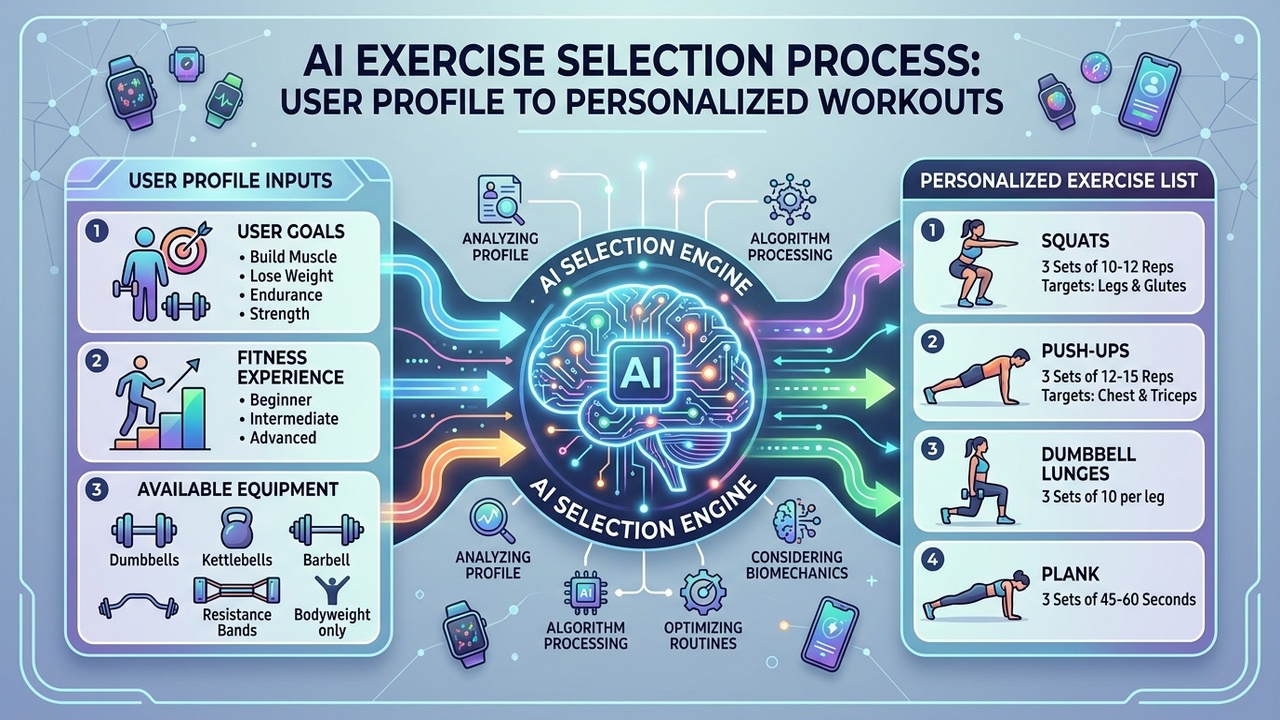
The quality of the exercise database matters enormously here. A planner with 200 exercises will run out of meaningful variations quickly. Load Muscle's database of 4,000+ exercises means the AI has a deep pool to draw from, which produces more varied and targeted programs — especially for lifters with limited equipment who need creative substitutions.
Volume and Intensity Programming
Selecting exercises is only half the battle. The AI must also determine how much work you should do — sets, reps, and intensity (percentage of your max or RPE). This is where exercise science meets algorithm design.
The evidence is clear on general volume guidelines. Research by Schoenfeld et al. suggests 10 to 20 sets per muscle group per week for hypertrophy, with most people responding best to the middle of that range. For strength, lower rep ranges (1-5) with higher intensity are preferred. For endurance, higher reps (15+) with lower weight work best.
A good AI planner does not just apply these ranges blindly. It considers your training age (beginners need less volume than advanced lifters), your recovery capacity (which correlates with sleep, stress, and nutrition), and your session time constraints. If you can only train for 45 minutes, the AI should not give you a 90-minute program — it should prioritize the highest-impact exercises and trim the rest.
Progressive Overload Automation
Progressive overload is the single most important principle in resistance training. If you are not doing more work over time — more weight, more reps, more sets, or more difficult variations — you are not giving your body a reason to adapt.
This is where AI planners have a structural advantage over static plans. A PDF plan cannot adjust itself. An AI planner can track your performance session by session and modify the program accordingly. Hit all your target reps? The AI increases the weight next session. Missed reps on a movement? The AI might hold the weight steady or slightly reduce it.
The sophistication of the overload model varies between planners. Basic ones add a fixed percentage every week. Advanced ones use performance curves, fatigue modeling, and periodization schemes to manage overload in a way that avoids plateaus. For a deeper look at why personalized progression matters, read our complete guide to personalized workout plans.
Recovery and Fatigue Management
Training is a stress-recovery-adaptation cycle. Push too hard without adequate recovery, and you regress instead of progress. The best AI workout planners model fatigue accumulation and recovery capacity to prevent overtraining.
This works through several mechanisms. The AI spaces muscle groups appropriately — it will not program heavy squats on Monday and heavy deadlifts on Tuesday. It manages weekly volume to stay within productive ranges. Some advanced systems even use deload protocols, automatically reducing intensity every 4-6 weeks to allow accumulated fatigue to dissipate.
Fatigue management is one of the areas where AI has the most room to grow. Current planners rely primarily on heuristics (rules derived from exercise science literature) rather than real-time biometric data. As wearable technology improves and AI planners integrate with devices that track sleep, heart rate variability, and readiness scores, fatigue management will become dramatically more precise.
AI Workout Planner vs Template-Based Plans
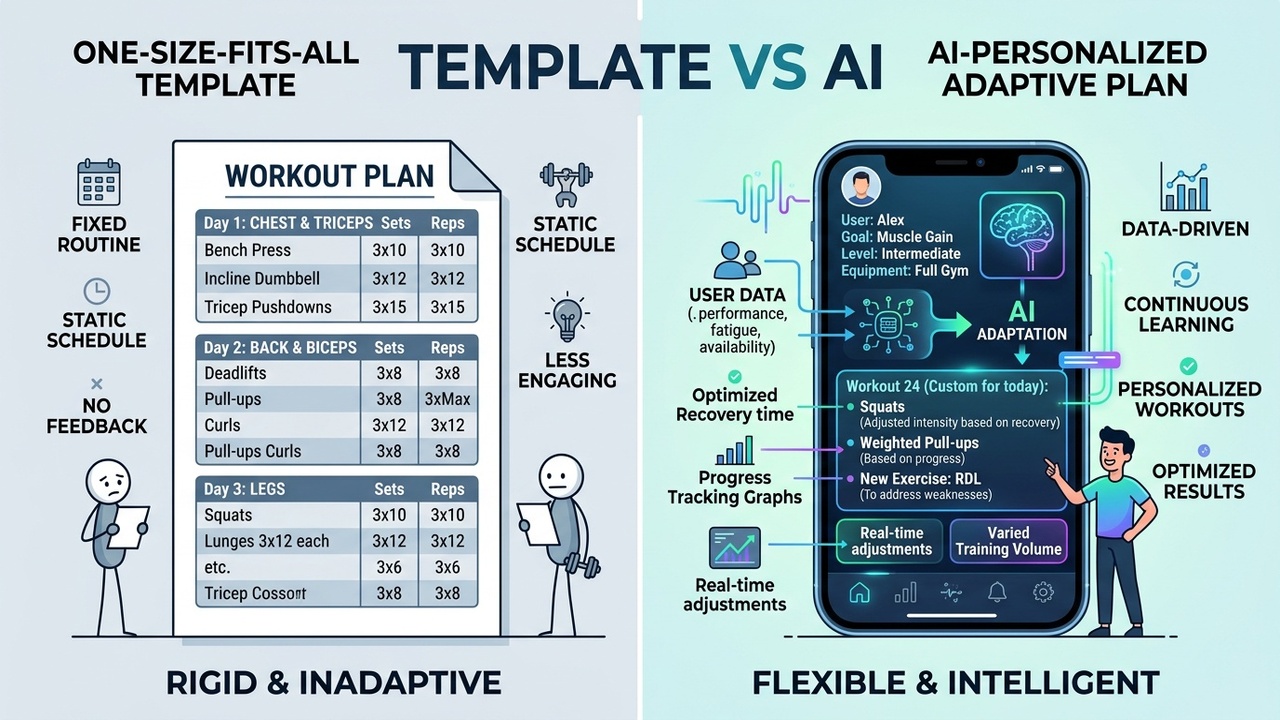
The internet is full of workout templates. "The Ultimate Push/Pull/Legs Split." "12-Week Muscle Building Program." These plans are not inherently bad — many are designed by qualified coaches and follow sound training principles. But they share a fundamental limitation: they are built for a generic person, not for you.
A template assumes your equipment, your schedule, your experience level, and your goals. If those assumptions match your situation, the plan might work well. If they do not — and they often do not — you are left modifying the plan yourself, which requires the knowledge that most people are looking for a plan precisely because they lack.
An AI workout planner eliminates this problem by generating the plan around your specific situation from the start. No assumptions, no modifications needed. Your home gym only has dumbbells and a pull-up bar? The AI knows that before it selects a single exercise. You can only train three days per week? The AI structures the program accordingly.
The adaptation difference is even more significant over time. A template is static. Week 8 looks the same whether you crushed week 7 or struggled through it. An AI planner adjusts. It is the difference between a map and a GPS — both can get you to the destination, but only one recalculates when you take a wrong turn.
If you are still evaluating your options, our guide on the best workout planner for beginners compares several approaches and can help you decide which style fits your needs.
AI Workout Planner vs Hiring a Coach
This is the comparison most people want to make, and we have covered it in detail in our AI workout planner vs personal trainer breakdown. Here is the summary.
A personal trainer excels at things AI currently cannot do: real-time form correction, hands-on spotting, in-person motivation, and the accountability that comes from a human relationship. If you are a complete beginner who has never touched a barbell, a few sessions with a trainer to learn movement patterns is genuinely valuable.
An AI workout planner excels at things most trainers struggle with: processing your entire training history to make data-driven decisions, being available at any hour, scaling personalization across thousands of variables, and costing a fraction of the price. The average trainer charges $50-$100 per session. An AI planner like Load Muscle offers a free tier and premium features for a fraction of a single training session.
The smartest approach is often a hybrid: use an AI planner for your daily programming and periodic sessions with a trainer for form checks and technique refinement. You get the best of both worlds without the $800/month price tag.
What Makes a Good AI Workout Planner
Not all AI workout planners are created equal. The label "AI-powered" has become a marketing term that gets slapped on everything from sophisticated machine learning systems to basic if-then logic wrapped in a shiny interface. Here is how to tell the difference.
Personalization Depth
The most important differentiator is how deeply the system personalizes your program. Ask yourself: does the planner just swap a few exercises based on your equipment, or does it build an entirely new program structure based on your full profile?
True personalization means the AI considers your goals, equipment, experience, schedule, preferences, and training history simultaneously. It should produce a meaningfully different program for a beginner with dumbbells training three days per week versus an intermediate lifter in a full gym training five days per week. If you change your inputs and the output barely changes, the "AI" is just window dressing on a template system.
Exercise Database Size
The size of the exercise database directly affects program quality and variety. A planner with 100 exercises will recycle the same movements constantly and struggle with equipment substitutions. A planner with 4,000+ exercises — like Load Muscle — can generate varied, targeted programs even for unusual equipment setups, and it can rotate exercises over training cycles to prevent staleness and address weak points from multiple angles.
Database size alone is not enough, though. Each exercise needs rich metadata: target muscles, synergist muscles, equipment required, difficulty level, movement pattern category, and contraindications. Without that metadata, the AI cannot make intelligent selection decisions.
Adaptation Over Time
A good AI workout planner gets better the longer you use it. It should learn from your training data — which exercises you respond to, what volume you can handle, where your sticking points are — and refine its recommendations accordingly.
This is where machine learning genuinely adds value. Rule-based systems apply the same logic regardless of your history. ML-enhanced systems identify patterns in your data that might not be obvious even to you. Maybe you progress faster on push movements after a rest day. Maybe your squat performance drops when weekly volume exceeds a certain threshold. A learning system can detect and act on these patterns.
Scientific Backing
The algorithms should be grounded in exercise science, not invented from scratch. Look for planners that reference established principles: progressive overload, the dose-response relationship for hypertrophy volume, periodization models, and appropriate frequency per muscle group. If the planner cannot explain why it prescribed what it did, that is a red flag.
Limitations of AI Workout Planners
Honesty about limitations builds trust, and AI workout planners have real ones.
Form and technique are invisible to the algorithm. The AI can prescribe a barbell back squat, but it cannot see whether you are squatting to depth, whether your knees are caving, or whether your lower back is rounding. Form correction still requires either a coach, a training partner, or the discipline to film yourself and self-assess.
Nutrition is usually out of scope. Most AI workout planners generate training programs but do not handle the nutrition side. This matters because nutrition and training are deeply interconnected — your recovery capacity, body composition changes, and energy levels all depend on what you eat. A workout plan without a nutrition strategy is incomplete, though it is still better than no plan at all.
Motivation is personal. An algorithm cannot call you out for skipping leg day or celebrate your deadlift PR with genuine enthusiasm. The motivational component of training — which is a significant predictor of long-term adherence — remains a human domain.
Edge cases and complexity. If you have a serious injury, a medical condition that affects training, or highly specialized goals (competitive powerlifting peaking, sport-specific conditioning), you likely need a human coach who can navigate the nuance. AI planners are excellent for the broad middle — the vast majority of lifters who want to get stronger, build muscle, or lose fat with a structured program.
The Future of AI in Fitness
The AI workout planner of 2026 is significantly better than what existed three years ago, and the trajectory points toward continued rapid improvement. Here is where the technology is heading.
Wearable integration will be the biggest near-term advancement. When AI planners can pull real-time data from your smartwatch — sleep quality, heart rate variability, daily activity levels — they can adjust your training on the fly. Had a terrible night of sleep? The AI reduces today's intensity. Your HRV shows you are fully recovered? The AI pushes you harder.
Computer vision for form analysis is already in early stages. Several companies are developing phone-based motion tracking that can identify movement flaws and provide real-time feedback. When this technology matures and integrates with AI planners, the form correction gap between AI and human coaches will narrow significantly.
Longitudinal learning will improve as AI planners accumulate more user data. With anonymized training data from millions of users, AI systems can identify which programming strategies work best for specific populations — not just in theory, but in practice.
Nutrition integration will close the gap between training programming and dietary planning, giving users a complete fitness management system rather than just a workout generator.
The direction is clear: AI workout planners will become more aware, more adaptive, and more comprehensive. They will not replace human coaches for everyone, but they will make high-quality, personalized programming accessible to anyone with a smartphone.
How Load Muscle's AI Planner Works
Load Muscle's AI workout planner was built to solve the specific problems we have outlined in this article. Here is how it works in practice.
When you open the free workout planner, the system collects your key training variables: your primary goal (muscle building, strength, fat loss, or general fitness), your available equipment, your experience level, and your preferred training frequency. This information feeds into the AI engine, which generates a complete, structured training program.
The engine draws from a library of 4,000+ exercises, each tagged with detailed metadata including target muscles, secondary muscles, required equipment, difficulty rating, and movement pattern classification. This depth allows the AI to build programs that are genuinely varied and precisely targeted — whether you are training in a fully equipped gym or a garage with a pair of dumbbells and a bench.
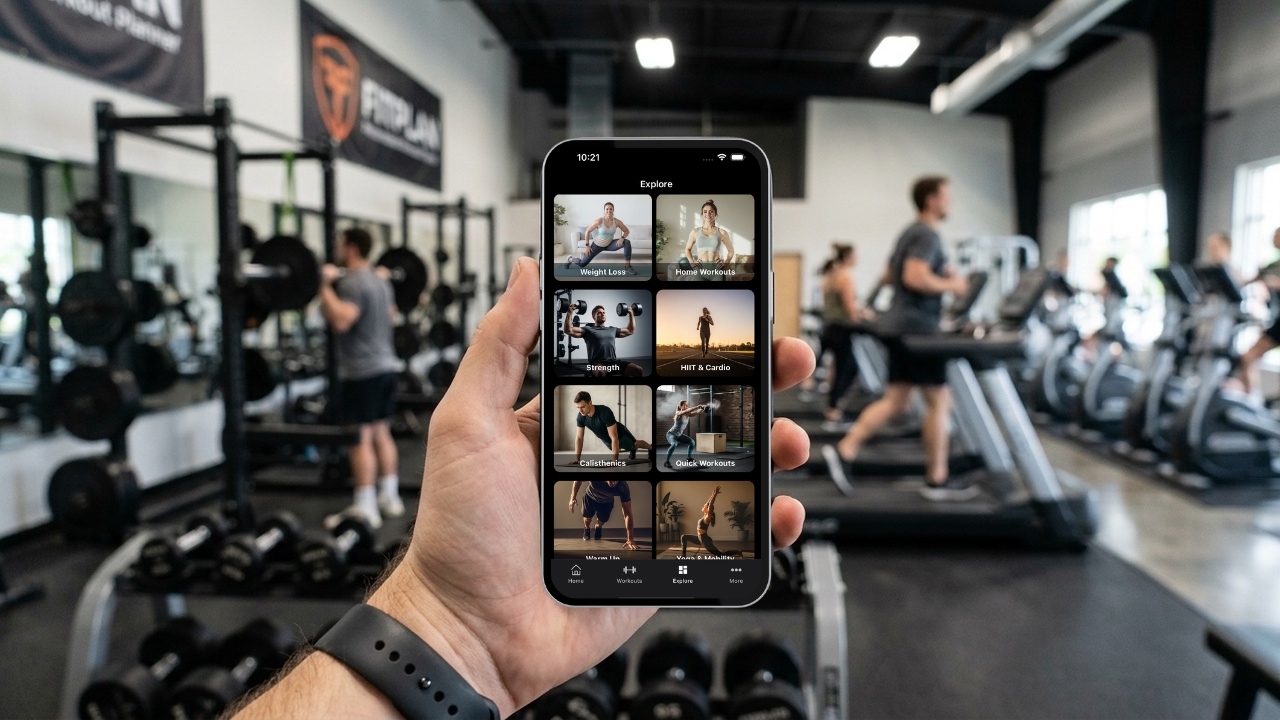
Every generated program follows evidence-based training principles. Volume is calibrated to your experience level. Exercise selection balances movement patterns to prevent imbalances. Compound movements form the foundation, with targeted isolation work layered on top. The result is a program that looks like it was written by a coach — because the same principles a good coach uses are embedded in the algorithm.
The free tier gives you full access to the AI workout generator with no account required. For lifters who want to track their progress, log workouts, and let the AI adapt their programming over time, downloading the full app unlocks those capabilities. The core philosophy is simple: everyone deserves access to structured, personalized training programming, regardless of budget.
FAQ
How accurate are AI workout planners compared to human coaches? For general fitness programming — building muscle, gaining strength, losing fat — modern AI planners produce programs comparable in quality to those from qualified coaches. Research shows that structured programming drives results regardless of whether a human or algorithm designed it. Where human coaches still have an edge is in real-time form correction, injury management, and the motivational aspect of in-person training.
Do I need to know anything about fitness to use an AI workout planner? No. A good AI workout planner is designed to handle the programming complexity for you. You provide your goals, equipment, and experience level, and the system generates an appropriate program. That said, learning basic movement patterns and form cues will help you execute the program safely. Our beginner's guide to workout planning is a good starting point.
Can an AI workout planner help with weight loss? Yes. An AI planner can generate training programs optimized for fat loss, which typically emphasize a mix of resistance training and higher-intensity work to maximize calorie expenditure while preserving muscle mass. However, weight loss is primarily driven by nutrition — specifically, maintaining a calorie deficit. The workout is one piece of the puzzle, not the whole picture.
How often should I change my AI-generated workout plan? Most AI planners will recommend program changes every 4-8 weeks, which aligns with standard periodization practices. The key is not changing for the sake of novelty — it is changing when the current program's stimulus has been maximized. If you are still progressing on your current plan, there is no reason to change it. A good AI planner monitors this and suggests changes when appropriate.
Is Load Muscle's AI workout planner really free? Yes. The free workout planner lets you generate AI-powered workout plans without creating an account or paying anything. You enter your training variables, and the AI generates a complete program. For users who want additional features like workout logging, progress tracking, and adaptive programming, the full app is available to download with both free and premium tiers.
What data does an AI workout planner need to work effectively? At minimum, an AI planner needs your training goal, available equipment, experience level, and preferred training frequency. The more data you provide — injury history, time constraints, muscle group priorities, past training experience — the more precisely the AI can tailor your program. Over time, logging your workouts gives the AI performance data that further refines its recommendations.
Want to see the difference yourself? Compare a hand-picked plan from our free workout routines with one the AI builds for you in the free workout planner.