The average personal trainer in the United States charges $50 to $100 per session. At two sessions per week, that is $400 to $800 per month. The average AI workout planner costs $0 to $15 per month. The price difference is obvious. The question is whether the results are comparable.
This is not a hit piece on personal trainers or a sales pitch for AI. The AI workout planner vs personal trainer debate has real nuance, and the right answer depends on your experience level, goals, budget, and training style. Here is what the data actually says.
TL;DR
- Personal trainers excel at form correction, complex injury rehabilitation, accountability through human connection, and highly specialized programming.
- AI workout planners excel at cost ($0-$15/mo vs $400-$800/mo), 24/7 availability, data-driven progressive overload, and scalable personalization.
- Research suggests that structured programming (whether from AI or a trainer) is significantly more effective than unstructured training. The source of the program matters less than its quality and your adherence.
- The hybrid approach — using an AI planner for daily programming and a trainer for periodic form checks — offers the best of both worlds.
- Try Load Muscle's free AI workout planner to see how AI-generated programming works.
The Rise of AI Workout Planners
Five years ago, "AI workout planner" was not a search term anyone used. Today, the global fitness app market is projected to reach $30 billion by 2030, and AI-powered workout planning is one of the fastest-growing segments.
The shift happened because AI got good enough. Early workout apps were glorified databases with random exercise selectors. Modern AI planners like Load Muscle analyze your goals, equipment, schedule, experience, and training history to generate structured programs that follow real exercise science principles — progressive overload, periodization, volume management, and muscle group balance.
According to a 2024 study published in the Journal of Sports Science & Medicine, participants using structured digital workout programs showed comparable strength gains to those following trainer-designed programs over a 12-week period. The key variable was not who designed the program — it was whether the program was structured and progressive.
That finding is important. It suggests that the quality of programming matters more than whether a human or algorithm creates it.
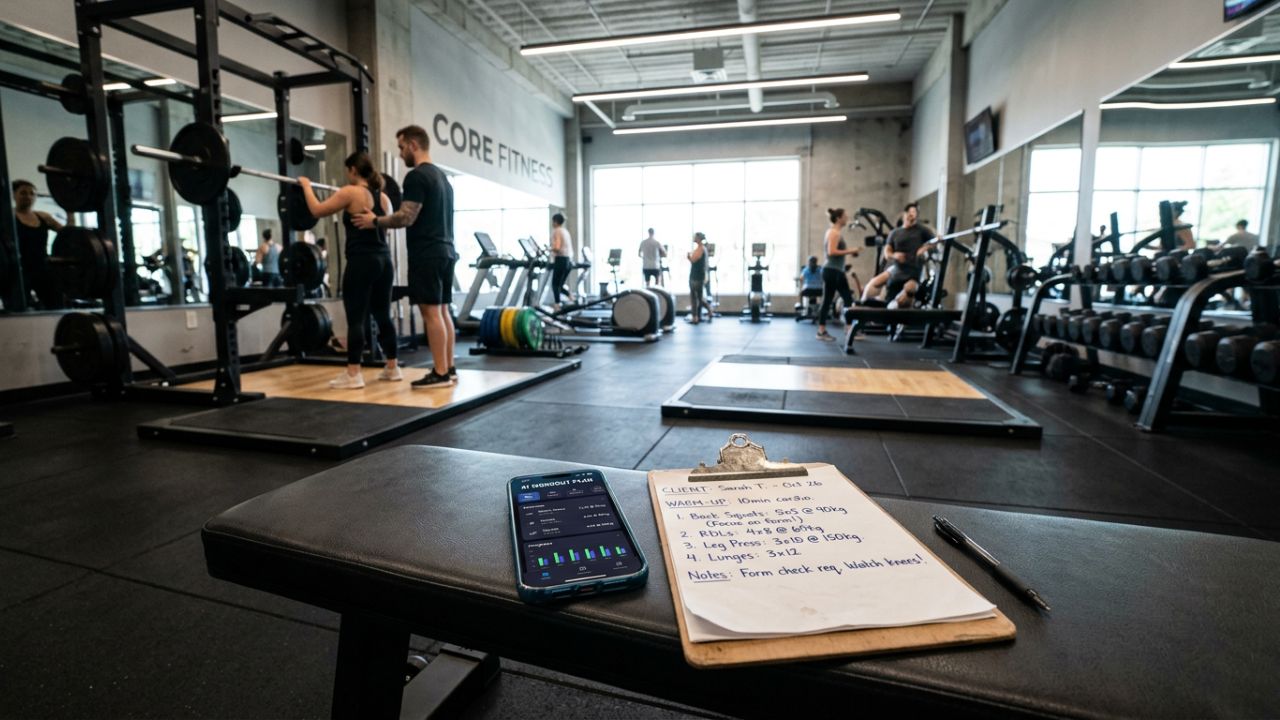
What a Personal Trainer Actually Does
Before comparing, let us be precise about what a good personal trainer provides:
Program design: A qualified trainer assesses your movement patterns, strength levels, injury history, and goals, then writes a program tailored to you. They adjust the program based on how you respond over weeks and months.
Form coaching: This is the trainer's biggest advantage. They watch you move in real time, identify compensations and weaknesses, and cue corrections. No app can replicate this — at least not yet.
Accountability: Having an appointment with a human being is a powerful motivator. You are less likely to skip a session when someone is waiting for you (and when you have already paid for it).
Motivation: A good trainer pushes you past what you would do on your own. They know when you have one more rep and when you need to stop.
Education: Over time, a good trainer teaches you how to train. The goal is to make yourself independent — to understand why you are doing what you are doing.
Not every trainer delivers all of this. The industry is inconsistent. Certification standards vary, and the difference between a great trainer and a mediocre one is enormous. According to the Bureau of Labor Statistics, the median pay for fitness trainers is around $46,000/year, and turnover is high.
What an AI Workout Planner Actually Does
Modern AI workout planners handle several functions that used to require a trainer:
Personalized program generation: The AI takes your input (goals, experience, equipment, schedule) and generates a complete training program. Load Muscle, for example, draws from 4,000+ exercises to build programs that match your specific setup.
Progressive overload tracking: The AI monitors your performance and adjusts programming to ensure you are progressing. It can increase weight, volume, or intensity based on your logged results.
Exercise selection and substitution: If you do not have a specific piece of equipment, the AI suggests alternatives. It can also rotate exercises to prevent staleness while maintaining training stimulus.
24/7 availability: You can generate a plan at 2 AM on a Sunday. You can modify it on the fly. You do not need to schedule anything.
Data-driven decisions: AI planners process your entire training history, not just what a trainer remembers from your last session. Over time, this data advantage compounds.
What AI cannot do (yet): watch you move, correct your form in real time, physically spot you, or provide the emotional support that comes from a human relationship.
For a deeper look at how AI workout planners work under the hood, read our AI workout planner guide.
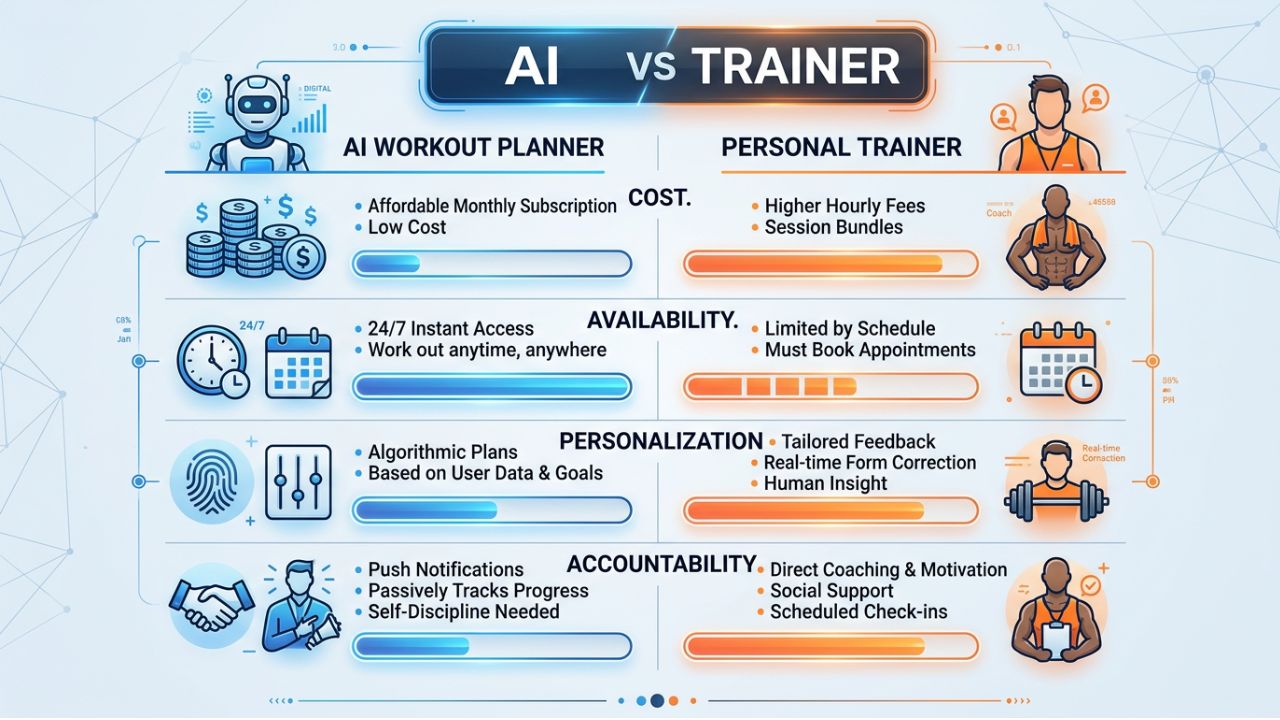
Head-to-Head Comparison
Personalization and Adaptability
Personal trainer: High-quality, real-time personalization. A good trainer reads your body language, adjusts the workout on the fly, and responds to things you cannot quantify — like "you look tired today" or "your right shoulder is compensating."
AI planner: Data-driven personalization based on your logged profile and performance history. Strong at pattern recognition over time but cannot observe you in person. Load Muscle's AI, for example, adapts programs based on your equipment changes, goal shifts, and training history.
Edge: Trainers for in-session adaptability. AI for long-term pattern recognition and consistency.
Cost Comparison (Monthly and Annual)
| Option | Monthly Cost | Annual Cost |
|---|---|---|
| Personal trainer (2x/week) | $400-$800 | $4,800-$9,600 |
| Personal trainer (1x/week) | $200-$400 | $2,400-$4,800 |
| Premium AI planner (average) | $5-$15 | $60-$180 |
| Load Muscle free tier | $0 | $0 |
The cost difference is not marginal — it is an order of magnitude. A single month of personal training at 2x/week costs more than a full year of most AI workout planners. Load Muscle's free workout planner eliminates cost as a factor entirely.
This matters because consistency beats perfection. A program you can afford to follow for a year will produce better results than a perfect program you can only afford for two months.
Availability and Convenience
Personal trainer: Limited by scheduling. You train when your trainer is available, at a gym where your trainer works. Cancellations and rescheduling are common friction points.
AI planner: Available 24/7, anywhere. Generate a new plan at midnight, modify it during lunch, train at any gym or at home. No scheduling conflicts, no cancellation fees.
Edge: AI, decisively. Accessibility is one of the biggest reasons people drop out of training, and AI removes most access barriers.
Accountability and Motivation
Personal trainer: Strong accountability through the human relationship and financial commitment. Knowing someone is waiting for you (and that you paid for the session) is a powerful motivator.
AI planner: Weaker on accountability. Nobody is waiting for you. However, apps increasingly use notifications, streaks, and progress tracking to create digital accountability. Some people respond to data-driven motivation (seeing their strength curve going up) better than social motivation.
Edge: Trainers for most people. Some self-motivated individuals prefer the independence of an AI planner.
Form Correction and Safety
Personal trainer: This is the trainer's clearest advantage. Real-time form correction prevents injuries and builds better movement patterns. A good trainer spots issues you would never catch on your own.
AI planner: Cannot watch you. Period. AI planners can provide video demonstrations and written cues (Load Muscle includes video demos for all 4,000+ exercises), but they cannot see your individual movement and correct it in real time.
Edge: Trainers, unambiguously. This is the one area where AI has no equivalent.
Programming Quality
Personal trainer: Varies enormously. A trainer with a CSCS certification and 10 years of experience will write excellent programs. A newly certified trainer with minimal education may write programs no better than what you would find for free online.
AI planner: Consistently applies evidence-based programming principles. No bad days, no knowledge gaps, no personal biases. The quality ceiling may be lower than the best trainers, but the quality floor is much higher than the worst trainers.
Edge: Top-tier trainers beat AI. AI beats average trainers. For most people, AI delivers more consistent quality.
What the Research Says
The evidence on this topic is growing but still limited. Here is what we know:
A 2023 meta-analysis in Sports Medicine found that supervised training produced modestly greater strength gains than unsupervised training (effect size of 0.3-0.5). However, the comparison was between supervised and completely unsupervised training — not between trainer-programmed and AI-programmed training.
Research from the American College of Sports Medicine suggests that program adherence is the strongest predictor of training outcomes, stronger than any individual programming variable. People who follow a program consistently for 12+ weeks see significantly better results than those who train sporadically, regardless of program quality.
A 2024 study comparing app-based structured programs to trainer-designed programs found no statistically significant difference in strength gains or body composition changes over 12 weeks among intermediate lifters. Both groups outperformed a control group that trained without structure.
The takeaway: having a structured program matters more than who or what designs it. The quality gap between AI and good trainers exists, but it is smaller than the gap between structured and unstructured training.
When You Need a Personal Trainer
Despite the data, there are clear scenarios where a personal trainer is the better choice:
- Injury rehabilitation: If you are coming back from an injury, a qualified trainer (ideally with corrective exercise certification) can assess your movement and program around limitations in ways AI cannot.
- Complete beginners: If you have never touched a barbell, a few sessions with a trainer to learn basic movement patterns is invaluable. No video demo replaces someone physically cueing your hip hinge.
- Sport-specific training: Athletes training for specific sports need programming that accounts for practice schedules, game days, and sport-specific movement patterns. This requires human expertise.
- Complex medical conditions: If you have conditions that affect your training (cardiovascular issues, neurological conditions, significant mobility limitations), a trainer working with your healthcare team is the safe choice.
- You need human accountability: If you know that you will not train without someone holding you accountable, a trainer is worth the cost. No app can replace that for some people.
We have explored this topic in detail in our fitness app vs personal trainer article, which covers additional scenarios.
When an AI Planner Is the Better Choice
For many lifters, an AI workout planner is not just a budget alternative — it is the genuinely better tool:
- Budget constraints: If $400-$800/mo is not in your budget, an AI planner gives you structured programming for free or near-free. Load Muscle's free tier includes full AI workout planning.
- Intermediate to advanced lifters: If you already know how to perform exercises with good form, the main value of a trainer is programming — and AI does that effectively.
- Irregular schedules: If your availability changes week to week, an AI planner adapts instantly. No rescheduling fees, no appointment conflicts.
- Data-driven types: If you respond to seeing your data trends and progression curves more than verbal encouragement, AI planners deliver. Every workout is logged, tracked, and analyzed.
- Home gym users: Trainers typically work at gyms. If you train at home, an AI planner that accounts for your specific equipment is more practical.
- Long-term consistency: The cost structure of AI means you can use it for years without financial pressure. Long-term consistent training beats short bursts of expensive coaching.
The Hybrid Approach: Best of Both Worlds
The smartest approach for many lifters is not either/or — it is both.
Use an AI planner like Load Muscle for your daily programming. Let the AI handle exercise selection, progressive overload, volume management, and program structure. Generate your free plan and follow it consistently.
Then, once every 4-8 weeks, book a single session with a qualified trainer for a form check. Have them watch your main lifts (squat, bench, deadlift, overhead press) and give you corrections. This single session costs $50-$100 and gives you the form correction that AI cannot provide.
This hybrid model gives you:
- Daily AI-driven programming ($0-$15/mo)
- Periodic expert form correction ($50-$100 every 1-2 months)
- Total cost: a fraction of regular personal training
- Best of both worlds: data-driven programming + human movement expertise
For beginners, check out the best workout planner for beginners to find tools designed for your experience level.
How Load Muscle Bridges the Gap
Load Muscle is designed to capture as much of the personal trainer experience as possible in an AI-powered app:
- 4,000+ exercises with video demonstrations: Every exercise includes detailed form instructions and video demos, reducing the form correction gap.
- Personalized AI programming: The AI builds complete programs based on your goals, equipment, experience, and schedule — the same programming service trainers charge hundreds for.
- Progressive overload built in: The app tracks your progress and builds progression into your program, so you do not plateau.
- Equipment-aware: Training at home with just dumbbells? At a commercial gym with full cable stations? The AI adapts.
- Free to start: The AI workout planner is available without a subscription, eliminating the cost barrier entirely.
No app replaces a trainer standing next to you. But for the programming, tracking, and personalization components of training, Load Muscle delivers at a fraction of the cost. Download the app to see for yourself.
FAQ
Can an AI workout planner replace a personal trainer?
For programming, tracking, and personalization — largely yes. AI planners generate structured, evidence-based programs comparable to what most trainers provide. However, AI cannot replace real-time form correction, hands-on spotting, or the human accountability that trainers offer. The best approach for many people is to use AI for daily programming and a trainer for periodic form checks.
How much does a personal trainer cost compared to an AI planner?
Personal trainers typically cost $50-$100 per session, or $400-$800 per month at 2 sessions per week. AI workout planners range from free (Load Muscle's free tier) to $15/month. Over a year, personal training costs $4,800-$9,600 while AI planners cost $0-$180. The cost difference is 25x to 50x.
Is AI-generated workout programming effective?
Research suggests that structured AI-generated programs produce comparable results to trainer-designed programs for most lifters, especially at intermediate and advanced levels. The key factor is program adherence — following any structured program consistently outperforms training without structure, regardless of who or what created the program.
Should beginners use an AI planner or hire a trainer?
Beginners benefit most from a few sessions with a trainer to learn basic movement patterns (squat, hinge, press, pull). After learning the fundamentals, most beginners can transition to an AI planner for ongoing programming. The hybrid approach — AI for daily plans, occasional trainer sessions for form checks — is the most cost-effective path for beginners.
Are AI workout planners safe?
AI planners that follow evidence-based programming principles (appropriate volume, progressive overload, rest periods) are safe for healthy individuals who know basic exercise form. They include exercise demonstrations and instructions to support proper execution. However, if you have injuries, medical conditions, or are completely new to exercise, starting with a trainer for a few sessions is recommended for safety.
How does Load Muscle's AI compare to a personal trainer's programming?
Load Muscle's AI applies the same programming principles that qualified trainers use: progressive overload, periodization, volume management, and exercise variation. It draws from a library of 4,000+ exercises and adapts to your specific goals, equipment, and schedule. The main difference is that a trainer can observe your form and make real-time adjustments, while Load Muscle provides video demonstrations and detailed instructions.
Whichever route you choose, you can start training today with our free workout routines — 80+ plans organized by goal, no signup required.