Calves are the most stubbornly undertrained muscle group in most lifters' programs. You squat, you lunge, you leg press, and your calves barely grow. Sound familiar?
The problem is not that calves cannot grow. The problem is that most people treat calf training as an afterthought - a few lazy sets of bouncy calf raises at the end of leg day. That is not enough.
This guide breaks down the 8 best calf exercises for size and strength, gives you a complete calf workout routine, and explains exactly why calves are so hard to grow and what to do about it.
TL;DR
TL;DR
- Calves have two key muscles: the gastrocnemius (straight-leg work) and the soleus (bent-knee work). You need to train both.
- The 8 best exercises: standing calf raise, seated calf raise, leg press calf raise, donkey calf raise, Smith machine calf raise, single-leg calf raise, jump rope, and tibialis raise.
- Train calves 3-4x per week with 10-16 total sets for stubborn calves.
- Use a full range of motion with a 2-second stretch at the bottom and a hard squeeze at the top.
- Use the free workout planner to add calf work into your existing program.
Calf Muscle Anatomy
Your calf is made up of two main muscles that work together to plantar flex the ankle (push your toes down).
The gastrocnemius is the larger, diamond-shaped muscle on the back of your lower leg. It has two heads (medial and lateral) and crosses both the knee and ankle joints. Because it crosses the knee, it is most active when your legs are straight. Standing calf raises target this muscle.
The soleus sits underneath the gastrocnemius. It is a flat, wide muscle that only crosses the ankle joint. Because the gastrocnemius is slackened when your knees are bent, the soleus takes over as the primary mover during bent-knee calf work. Seated calf raises target this muscle.
To build complete calves, you need exercises that hit both. Straight-leg work for the gastrocnemius, bent-knee work for the soleus.
8 Best Calf Exercises
1. Standing Calf Raise

Primary Focus: Gastrocnemius (both heads)
Why it matters: The standing calf raise is the foundation of any calf program. With straight legs, the gastrocnemius is fully lengthened and can produce maximum force. This is the exercise where you can load the heaviest and drive the most growth in the outer shape of your calves.
Coaching Cues:
- Stand on the edge of a step or calf raise platform with the balls of your feet on the surface and your heels hanging off.
- Lower your heels as far as possible into a deep stretch. Hold the bottom for 2 seconds.
- Drive up onto your toes and squeeze hard at the top for 1 second.
- Control the eccentric. No bouncing. Each rep should take about 4 seconds total.
If your gym has a standing calf raise machine, use it. If not, hold a dumbbell in one hand and use the other hand for balance on any elevated surface.
2. Seated Calf Raise
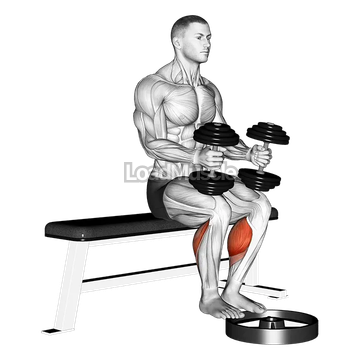
Primary Focus: Soleus
Why it matters: The seated calf raise is the only way to directly isolate the soleus. Because your knees are bent at 90 degrees, the gastrocnemius is shortened and cannot contribute much force. The soleus takes over completely. Skipping this exercise means you are only training half your calf.
Coaching Cues:
- Sit on a seated calf raise machine (or place a dumbbell on each knee) with the balls of your feet on the foot plate.
- Lower your heels into a full stretch at the bottom. Feel the pull deep in the lower calf.
- Press up through the balls of your feet and hold the top contraction for 1 second.
- Use a lighter weight than standing raises. The soleus is a slow-twitch dominant muscle that responds best to higher reps (12-20).
The soleus makes up roughly 60% of your total calf mass. If you want bigger calves, this exercise is not optional.
3. Leg Press Calf Raise
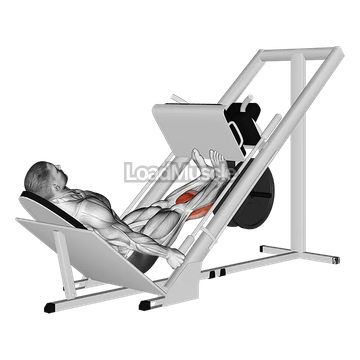
Primary Focus: Gastrocnemius and soleus
Why it matters: The leg press calf raise lets you load heavy in a stable, controlled environment. Your back is supported, your balance is taken out of the equation, and you can focus entirely on pushing through the balls of your feet. It is also easy to adjust the weight quickly for drop sets, which are brutal on calves.
Coaching Cues:
- Sit in the leg press with your feet at the bottom of the platform, only the balls of your feet making contact.
- Unlock the safety and extend through your ankles, pushing the sled away with your toes.
- Lower slowly until you feel a deep stretch in the calves, then drive back up.
- Keep your legs straight (or very slightly bent) throughout to maximize gastrocnemius involvement.
Safety note: always keep the safeties engaged or use a spotter. If your feet slip off the bottom of the platform, the sled drops. Be deliberate with foot placement.
4. Donkey Calf Raise

Primary Focus: Gastrocnemius (extreme stretch)
Why it matters: The donkey calf raise was Arnold's favorite calf exercise for a reason. The bent-over hip position places the gastrocnemius under a deeper stretch than any other calf movement. Greater stretch under load means greater muscle damage and growth stimulus. If your gym has a donkey calf raise machine, you are lucky - use it.
Coaching Cues:
- Position yourself on the machine with your hips bent at roughly 90 degrees, forearms on the pad, and the balls of your feet on the edge of the platform.
- Lower your heels as deep as possible. You should feel a strong stretch through the entire calf.
- Drive up onto your toes and squeeze at the top.
- Keep your knees straight throughout to keep the gastrocnemius fully engaged.
If your gym does not have a donkey calf raise machine, you can replicate the position using a Smith machine or by bending over at a hip-height surface with a partner sitting on your lower back (old school, but it works).
5. Smith Machine Calf Raise
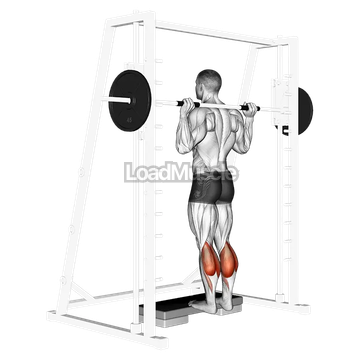
Primary Focus: Gastrocnemius
Why it matters: The Smith machine calf raise gives you the heavy loading of a standing calf raise with the added stability of a fixed bar path. You do not need to worry about balance, which lets you focus entirely on the contraction and stretch. It is one of the easiest calf exercises to progressively overload because adding small plates is straightforward.
Coaching Cues:
- Place a step or block under the Smith machine bar. Stand on it with the balls of your feet on the edge and the bar across your upper back (like a squat position).
- Unrack the bar and lower your heels into a deep stretch below the step.
- Push up through the balls of your feet until you are on your toes, squeezing at the top.
- Use slow, controlled reps. The Smith machine makes it easy to bounce, so resist that temptation.
This is a great option if your gym does not have a dedicated standing calf raise machine. Apply the same principles from progressive overload - add a small amount of weight each week.
6. Single-Leg Calf Raise
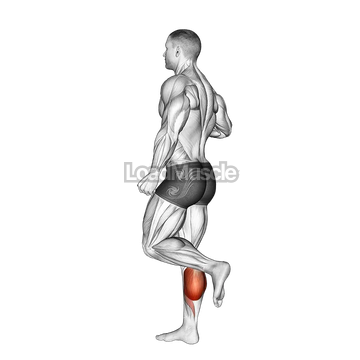
Primary Focus: Gastrocnemius and soleus (unilateral)
Why it matters: Training one leg at a time doubles the load on each calf without needing any extra equipment. Single-leg calf raises also expose and fix imbalances between your left and right calf. Most people have one calf stronger or larger than the other, and bilateral exercises let the dominant side compensate. This exercise does not allow that.
Coaching Cues:
- Stand on one foot on the edge of a step or plate, holding a wall or rack for balance.
- Lower your heel into a full stretch, pause for 1-2 seconds.
- Drive up onto your toes and squeeze for 1 second at the top.
- Complete all reps on one side before switching. Start with your weaker leg.
You can do these with bodyweight alone or hold a dumbbell for added resistance. Either way, the single-leg version forces each calf to do 100% of the work. This exercise pairs well with other unilateral leg work from our leg day guide.
7. Jump Rope
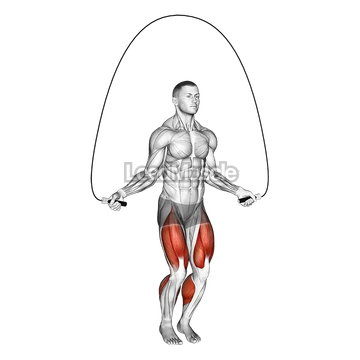
Primary Focus: Gastrocnemius, soleus, cardiovascular conditioning
Why it matters: Jump rope is not a traditional hypertrophy exercise, but it trains the calves through hundreds of rapid, low-amplitude contractions that build muscular endurance and create a serious pump. It also improves calf elasticity and tendon stiffness, which translates to better performance on heavy calf raises. Boxers and combat athletes have some of the most defined calves around, and jump rope is a staple in their training.
Coaching Cues:
- Stay on the balls of your feet the entire time. Your heels should never touch the ground.
- Keep your jumps small - just enough to clear the rope (1-2 inches).
- Spin the rope with your wrists, not your arms.
- Start with 2-3 rounds of 1-2 minutes. Build up to 5-10 minutes of continuous jumping.
Use jump rope as a warm-up before calf training or as a finisher after your heavy sets. It also works as a cardio tool that doubles as calf work, making it efficient for a full body workout plan.
8. Tibialis Raise
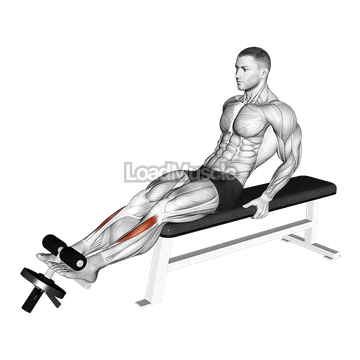
Primary Focus: Tibialis anterior (front of the shin)
Why it matters: The tibialis anterior is the muscle on the front of your shin that dorsiflexes the ankle (pulls your toes up). It is the antagonist to your calves. Training it creates balanced lower leg development, reduces shin splint risk, and actually improves your calf training by allowing a deeper stretch at the bottom of calf raises. Think of it like training both biceps and triceps for complete arm development.
Coaching Cues:
- Sit on a bench with your feet flat on the floor and a weight plate resting on top of your toes.
- Lift your toes up toward your shins by dorsiflexing your ankles, keeping your heels on the ground.
- Lower slowly and repeat. Aim for 15-25 reps per set.
- You can also do these standing with your back against a wall, heels about a foot away from the wall, lifting your toes up repeatedly.
Tibialis raises are low-intensity and easy to recover from. Add them to the beginning of your calf workout as a warm-up or superset them with calf raises.
Calf Workout Routine
Here is a complete calf workout you can add to any leg day or run as a standalone session. It takes about 15-20 minutes.
| Exercise | Sets x Reps | Rest |
|---|---|---|
| Tibialis Raise | 2 x 20 | 45s |
| Standing Calf Raise | 4 x 10-12 | 90s |
| Seated Calf Raise | 3 x 15-20 | 60s |
| Leg Press Calf Raise | 3 x 12-15 | 60s |
| Single-Leg Calf Raise (bodyweight) | 2 x 15 each | 45s |
Programming notes:
- On standing calf raises, use a weight that makes the last 2-3 reps genuinely hard.
- On seated calf raises, slow the tempo down. Take 3 seconds to lower and 1 second to squeeze at the top.
- On leg press calf raises, finish the last set with a drop set: reduce the weight by 50% and do another 15-20 reps immediately.
- Every rep on every exercise should include a full stretch at the bottom. No half reps.
How Often to Train Calves
If your calves are a weak point (and for most lifters they are), training them once a week on leg day is not enough.
Train calves 3-4 times per week. Calves recover fast. They are designed for endurance - you walk on them all day, every day. They can handle frequent training and they need it to grow.
Aim for 10-16 direct sets per week. Split those across 3-4 sessions. That might look like:
- Monday: Standing calf raise 4 x 10-12 + Seated calf raise 3 x 15-20 (7 sets)
- Wednesday: Leg press calf raise 3 x 12-15 + Single-leg calf raise 2 x 15 (5 sets)
- Friday: Smith machine calf raise 3 x 10-12 + Seated calf raise 3 x 15 (6 sets)
That is 18 sets across 3 days - plenty of volume to force stubborn calves to grow. If you are newer to calf training, start with 10 sets per week and add 2 sets per week every few weeks.
Always include at least one seated variation per week to hit the soleus. A program with only standing calf raises misses roughly 60% of your calf muscle mass.
You do not need to dedicate an entire session to calves. Tack 2-4 sets onto the end of whatever workout you are already doing. Calves work well after legs, but they also work fine after upper body days. For a complete training split, check our full body workout plan or browse our exercise library for more lower body options.
Why Calves Are Hard to Grow
If you feel like your calves refuse to grow despite training them, you are not imagining it. There are real physiological reasons why calves are the most stubborn muscle group for many lifters.
Genetics and fiber type. The soleus is one of the most slow-twitch dominant muscles in your body (up to 80% slow-twitch fibers in some people). Slow-twitch fibers have less growth potential than fast-twitch fibers. The ratio of slow-to-fast twitch fibers in your calves is largely genetic. Some people are born with calves that respond quickly, and some are not.
Daily walking adaptation. Your calves carry your entire body weight thousands of times per day when you walk. They are already adapted to high-volume, low-intensity work. To make them grow, you need to provide a stimulus that is significantly different from walking - heavier loads, deeper stretches, and controlled tempos.
Short range of motion. Many lifters perform calf raises with a tiny, bouncy range of motion. They never get a full stretch at the bottom or a full contraction at the top. This turns every set into the equivalent of walking, which your calves already do all day. Using a full range of motion with a pause at the bottom is the single most important calf training tip. Stand on a step, let your heels drop as low as they can go, hold for 2 seconds, then drive up all the way. The difference is night and day.
Not enough frequency. Training calves once a week gives them one growth stimulus every 7 days. For a muscle that recovers in 24-48 hours, that is a lot of wasted potential. Bumping frequency to 3-4 sessions per week dramatically increases total weekly growth signals.
The solution is not complicated: train calves more often, use a full range of motion, include both straight-leg and bent-knee exercises, and apply progressive overload over time.
FAQ
How many sets per week do I need for calf growth?
Aim for 10-16 direct sets per week, split across 3-4 sessions. If your calves are a stubborn weak point, lean toward the higher end. If they grow easily (lucky you), 8-10 sets is fine. Start lower and add volume gradually to avoid excessive soreness that interferes with your other training.
Can I train calves every day?
You can, but you probably should not. While calves recover fast, training them daily can lead to overuse injuries in the Achilles tendon and plantar fascia. 3-4 sessions per week with at least one rest day between sessions is the sweet spot for most people. Quality of reps matters more than sheer frequency.
Do calf raises need to be heavy?
Not always. The gastrocnemius responds well to moderate-to-heavy loads (8-12 reps), but the soleus is slow-twitch dominant and grows best with lighter weights and higher reps (15-25). Use both rep ranges in your calf program. Heavy standing raises plus lighter seated raises is a proven combination.
Are squats and leg presses enough for calf growth?
No. Squats and leg presses train the quads, glutes, and hamstrings. The calves assist as stabilizers, but they do not go through a meaningful range of motion during these movements. You need dedicated calf exercises that take the ankle through full plantar flexion and dorsiflexion. Check our leg day guide for a complete lower body approach that includes direct calf work.
Should I train calves on leg day or separately?
Both approaches work. If you train calves on leg day, do them at the end so they do not fatigue your ankle stability for squats and lunges. The better approach for stubborn calves is to spread calf work across multiple days - a few sets after leg day, a few sets after upper body day, and a few sets on another day. More frequent stimulation drives better results.
Why is one calf bigger than the other?
Asymmetry is common and usually caused by dominance patterns from walking, driving, or sports. Single-leg calf raises are the best fix. Always start with your weaker side, match the reps on your stronger side, and over time the imbalance will correct itself.
Add Calves to Your Plan
Calf training is simple, but it is not easy. You need to commit to training them frequently, using a full range of motion, hitting both the gastrocnemius and soleus, and applying progressive overload week after week.
The exercises and routine in this guide give you everything you need to start. Pick 2-3 exercises per session, train calves 3-4 times per week, and be patient. Even stubborn calves grow when you train them properly and consistently.
Use the free workout planner to build a complete training program that includes dedicated calf work alongside your main lifts. Or download the LoadMuscle app to log your calf exercises, track your progress, and follow a structured plan that keeps you moving forward.
Browse our full exercise library for more calf variations, lower body exercises, and coaching cues for every movement. For structured lower body programs that include calf work, check out our glutes and legs routines.