If there is one supplement with decades of research behind it, it is creatine. Whether you are a beginner stepping into the gym for the first time or an experienced lifter chasing new personal records, understanding creatine for workouts can help you get more out of every training session. It is the most studied sports supplement in history, and the science is overwhelmingly clear: creatine works.
Yet despite this mountain of evidence, creatine remains surrounded by myths and confusion. Is it safe? Will it make you bloated? Do you need to load it? Should you take it before or after your workout? This guide answers every question, breaks down the science in plain language, and gives you a practical protocol you can start today.
This article is for informational purposes only and is not medical advice. Consult a healthcare professional before starting any supplement regimen.
TL;DR
- Creatine monohydrate is the most researched and effective sports supplement available. It increases strength, power, and muscle mass.
- Your body naturally produces creatine, but supplementing with 3-5g daily saturates your muscle stores for better performance.
- A loading phase (20g/day for 5-7 days) is optional. Taking 3-5g daily reaches the same saturation in about 3-4 weeks.
- Timing does not matter much, but post-workout with carbs and protein may have a slight edge.
- Creatine is safe for healthy adults. It does not damage kidneys, it is not a steroid, and you do not need to cycle it.
- Plan your training around proven science with the free workout planner.
What Is Creatine?
Creatine is a naturally occurring compound found in your muscles and brain. Your body produces about 1-2 grams of creatine per day from the amino acids arginine, glycine, and methionine, primarily in the liver and kidneys. You also get creatine from food — red meat and fish are the richest dietary sources, with roughly 1-2 grams per pound of raw meat.
About 95% of your body's creatine is stored in skeletal muscle, mostly as phosphocreatine (creatine phosphate). The remaining 5% is found in the brain, liver, and kidneys. When you supplement with creatine, you are increasing the total amount of phosphocreatine stored in your muscles, which directly fuels short-duration, high-intensity efforts like lifting weights, sprinting, and jumping.
The average person's muscles are only about 60-80% saturated with creatine through diet and natural production alone. Supplementation fills the remaining capacity, giving your muscles a larger energy reserve to draw from during intense exercise. This is why creatine for workouts is so effective — you are simply topping off a fuel tank that was never full to begin with.
How Creatine Works (ATP-CP System)
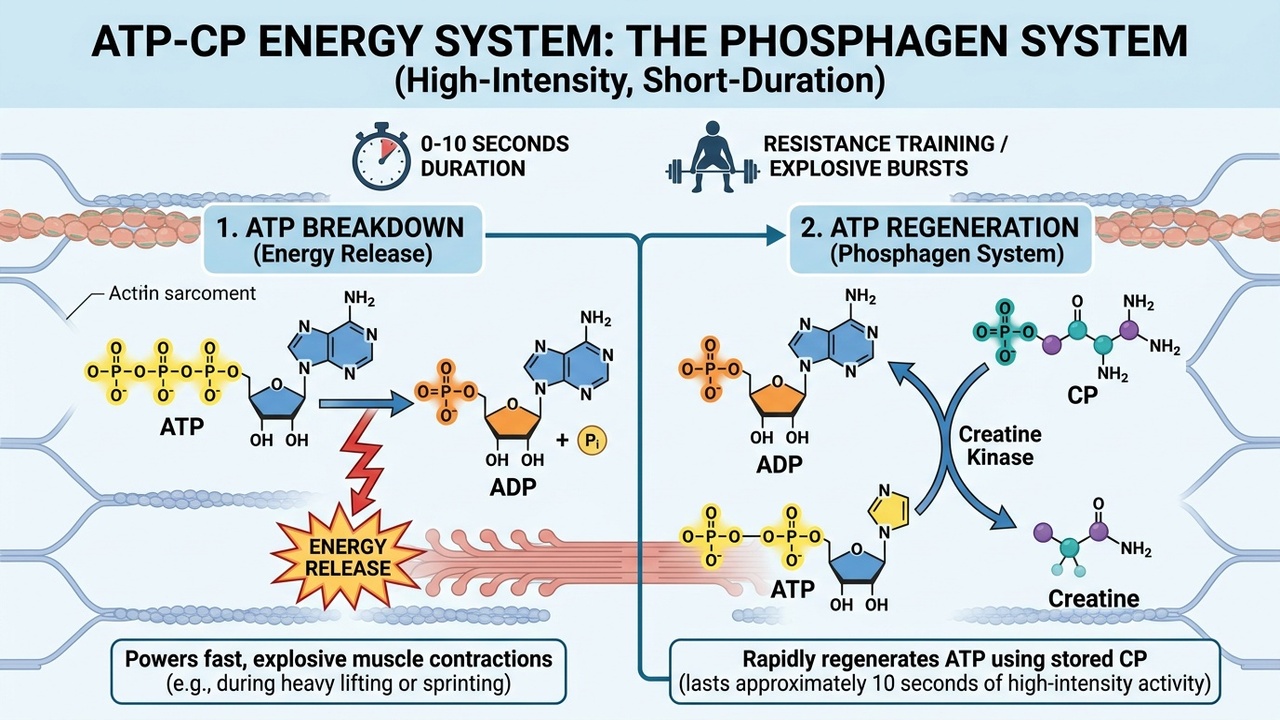
To understand creatine, you need a quick primer on how your muscles produce energy. Your muscles run on adenosine triphosphate (ATP). When you contract a muscle — whether lifting a barbell or picking up a grocery bag — ATP loses one of its phosphate groups, becoming adenosine diphosphate (ADP). This reaction releases the energy that powers the contraction.
The problem is that your muscles only store enough ATP for about 2-3 seconds of maximum effort. After that, your body needs to regenerate ATP quickly or performance drops. This is where phosphocreatine steps in.
Phosphocreatine donates its phosphate group to ADP, rapidly converting it back into ATP. This process is called the ATP-CP (adenosine triphosphate-creatine phosphate) system, and it is the fastest way your body can regenerate ATP. It does not require oxygen and happens almost instantaneously.
By supplementing with creatine and increasing your phosphocreatine stores, you extend how long this rapid energy system can operate. In practical terms, this means you can perform a few extra reps at a given weight, maintain power output for longer during a set, and recover faster between sets. Over weeks and months of training, those extra reps and that maintained intensity compound into significantly greater strength and muscle gains. For a deeper understanding of the muscle-building process, read our guide on the science of building muscle.
Proven Benefits of Creatine
Creatine is not a marginal supplement. The performance and body composition benefits are substantial, well-documented, and consistent across hundreds of studies. Here is what the research shows.
Increased Strength and Power
This is the headline benefit. Meta-analyses consistently show that creatine supplementation increases maximal strength by 5-15% compared to training without creatine. Research demonstrates that the improvements are most pronounced in compound movements like the squat, bench press, and deadlift — the lifts where your ATP-CP system is most taxed.
The mechanism is straightforward. More phosphocreatine means more rapid ATP regeneration, which means you can lift heavier loads and perform more reps at a given intensity. If creatine helps you get 2 extra reps on your bench press over the course of a training cycle, that additional volume drives greater strength and muscle adaptation. If you want to maximize your strength gains with a structured program, the free workout planner can help you build a plan tailored to your goals.
More Muscle Mass
Creatine supports muscle growth through multiple mechanisms. First, the increased training capacity (more weight, more reps) provides a greater stimulus for hypertrophy. Second, creatine draws water into muscle cells — a process called cell volumization — which may directly stimulate muscle protein synthesis. Third, research suggests creatine may enhance the expression of genes and growth factors involved in muscle repair and growth.
Studies consistently show that individuals supplementing with creatine gain more lean body mass than those taking a placebo during the same training program. The difference is typically 1-2 kg more lean mass over 8-12 weeks of training. For a comprehensive approach to gaining muscle, pair creatine with the principles outlined in our hypertrophy training guide.
Better High-Intensity Performance
Any activity lasting under about 30 seconds that requires near-maximal effort benefits from creatine supplementation. This includes sprinting, jumping, throwing, and most importantly for gym-goers, heavy sets of resistance training. Research shows performance improvements of 5-20% in short-duration, high-intensity tasks.
Team sport athletes also benefit. Repeated sprint ability — think of a soccer player making multiple sprints during a match — improves with creatine because it accelerates the recovery of phosphocreatine between bursts of effort.
Faster Recovery Between Sets
This benefit is underappreciated. Because creatine accelerates the resynthesis of phosphocreatine after a set, your muscles recover their energy stores faster during rest periods. Research indicates that creatine supplementation can improve the rate of phosphocreatine resynthesis by 15-20%.
In practice, this means you maintain performance across multiple sets. Instead of your strength dropping significantly from set 1 to set 4, creatine helps you stay closer to your peak output throughout your entire workout. Over a training session, that sustained performance means significantly more total work — and more total work means better results.
Cognitive Benefits
Emerging research shows that creatine is not just a muscle supplement. Your brain also uses the ATP-CP system for energy, and creatine supplementation appears to improve cognitive performance, particularly under conditions of stress, sleep deprivation, or mental fatigue. Studies suggest improvements in short-term memory, reasoning, and mental processing speed.
While the cognitive research is newer and less extensive than the exercise performance data, the early results are promising. This makes creatine one of the few supplements that benefits both your body and your brain.
Types of Creatine
Walk into any supplement store and you will find shelves full of different creatine formulations, each claiming to be superior. Here is what you actually need to know.
Creatine Monohydrate (Gold Standard)
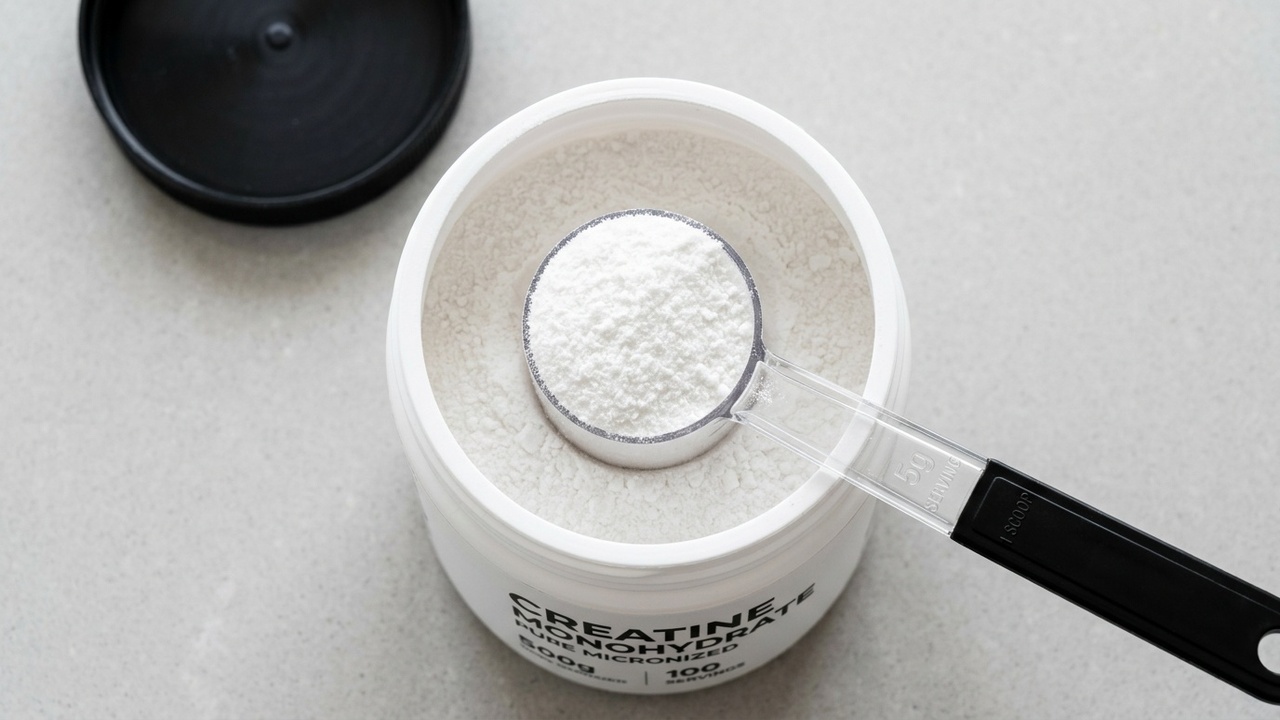
Creatine monohydrate is the original form and remains the gold standard. It is the form used in the vast majority of research studies, it is the most cost-effective, and no other form has been shown to be superior. When someone says "creatine works," they are almost always referring to creatine monohydrate.
It is simply creatine bound to a water molecule. Purity levels of 99%+ are standard. It dissolves reasonably well in water (better in warm water) and is tasteless. If you take nothing else from this section: buy creatine monohydrate. Everything else is marketing.
Creatine HCL
Creatine hydrochloride (HCL) is creatine bound to a hydrochloric acid molecule. Manufacturers claim it is more soluble and absorbs better, allowing lower doses. While creatine HCL does dissolve more easily in water, there is no reliable evidence that it is more effective than monohydrate at equivalent doses.
It is more expensive per serving and has far less research behind it. The improved solubility is a convenience factor, not a performance factor. If you find monohydrate causes mild stomach discomfort (which is uncommon at standard doses), HCL may be worth trying.
Buffered Creatine
Buffered creatine (such as Kre-Alkalyn) has a higher pH, which manufacturers claim prevents creatine from breaking down in stomach acid. The theory is that more creatine reaches your muscles intact.
Research does not support this claim. A well-designed study compared buffered creatine to monohydrate and found no difference in muscle creatine content, body composition, or strength outcomes. Buffered creatine is more expensive with no proven advantage.
How to Take Creatine
The practical side of creatine for workouts is simple. There are no complicated protocols or precise timing windows. Here is what the evidence says about how to take it effectively.
Loading Phase vs No Loading
The traditional loading protocol involves taking 20 grams per day (split into 4 doses of 5 grams) for 5-7 days, followed by a maintenance dose of 3-5 grams per day. Loading saturates your muscle creatine stores in about one week.
Alternatively, you can skip the loading phase entirely and take 3-5 grams daily from the start. This approach reaches the same muscle saturation level, but it takes approximately 3-4 weeks instead of one. The end result is identical — you simply get there more slowly.
Loading is useful if you want faster results (for example, if you have a competition coming up). Skipping the loading phase is equally effective long-term and avoids the minor gastrointestinal discomfort some people experience with higher doses. Most people are better off just taking 3-5 grams daily and not overthinking it.
Daily Dosage (3-5g)
The standard maintenance dose is 3-5 grams per day. Research consistently shows this is sufficient to maintain fully saturated muscle creatine stores once saturation is achieved.
For most individuals, 5 grams per day is the practical recommendation. Larger individuals (over 90 kg / 200 lbs) with more muscle mass may benefit from the higher end of this range or even slightly above. Smaller individuals can get by with 3 grams. The cost difference between 3g and 5g is negligible, so most people simply take 5 grams daily. Proper nutrition amplifies the effects of supplementation — see our guide on protein for muscle growth for the dietary foundation.
Before or After Workout?
This is one of the most frequently asked questions about creatine for workouts, and the honest answer is: it does not matter much. Research comparing pre-workout and post-workout creatine timing shows minimal differences. Some studies suggest a slight advantage to taking creatine post-workout with a meal containing carbohydrates and protein, likely because insulin helps drive creatine into muscle cells.
That said, the difference is marginal at best. What matters far more than timing is consistency — taking creatine every single day. If taking it post-workout with your protein shake helps you remember, do that. If you prefer it in your morning coffee, that works too. To learn more about optimizing your workout nutrition, check out our guide on pre-workout and post-workout meals.
Creatine on Rest Days
Yes, take creatine on rest days. The purpose of daily supplementation is to maintain saturated muscle stores. Creatine works by keeping your phosphocreatine levels topped off at all times, not by providing an acute boost on training days. Skipping rest days would gradually deplete your stores and reduce the benefit.
Take your 3-5 grams on rest days just as you would on training days. The timing on rest days is completely irrelevant — take it whenever it is convenient. With a meal, with a snack, first thing in the morning — it does not matter as long as you take it.
Creatine Myths Debunked
Despite being the most researched supplement in sports nutrition, creatine is plagued by persistent myths. Here are the big ones, addressed with evidence.
"Creatine Causes Kidney Damage"
This is the most common and most damaging myth. It originates from the fact that creatine supplementation increases creatinine levels in blood tests. Creatinine is a breakdown product of creatine, and doctors use it as a marker for kidney function. Higher creatinine levels can indicate kidney problems — but only when the increase is due to impaired kidney filtration, not increased creatine intake.
In healthy individuals, research consistently shows no adverse effects on kidney function from creatine supplementation, even at doses higher than recommended and over extended periods. Studies lasting up to five years have found no kidney damage in healthy adults. However, if you have a pre-existing kidney condition, consult your doctor before supplementing.
"Creatine Is a Steroid"
Creatine is not a steroid. It is not even remotely similar to a steroid. Anabolic steroids are synthetic hormones that alter your hormonal profile. Creatine is a natural compound found in food and produced by your own body. It does not affect testosterone, estrogen, or any other hormone.
Creatine is legal in all professional and amateur sports organizations, including the International Olympic Committee, the NCAA, and every major professional sports league. Calling creatine a steroid is like calling caffeine an amphetamine — they are fundamentally different substances with different mechanisms.
"You Need to Cycle Creatine"
There is no scientific reason to cycle creatine (taking it for a set period, then stopping, then starting again). Your body does not build tolerance to creatine, and long-term continuous use is safe and effective. Research on continuous supplementation lasting over five years shows no adverse effects and no reduction in effectiveness.
The cycling myth likely comes from confusion with other supplements or performance-enhancing drugs where cycling is necessary or recommended. Creatine does not fall into this category. Take it daily, indefinitely, and do not overthink it.
"Creatine Causes Bloating"
Creatine does cause increased water retention — but it is intracellular water retention, meaning the water is drawn into your muscle cells, not under your skin. This is actually beneficial. Cell volumization (swollen muscle cells) may contribute to muscle growth and makes muscles appear fuller, not bloated.
Some individuals experience minor gastrointestinal discomfort during a loading phase due to the higher doses. This is easily avoided by skipping the loading phase or splitting doses throughout the day. At standard maintenance doses of 3-5 grams, GI issues are rare. The "bloating" people associate with creatine is usually just water weight gain of 1-2 kg, which is mostly held within the muscles and is not visible as puffiness.
Who Should Take Creatine?
The short answer is: almost anyone who exercises regularly can benefit from creatine supplementation. The research supports benefits across a remarkably broad population.
Strength athletes and bodybuilders are the most obvious beneficiaries. If your training revolves around lifting heavy weights and building muscle, creatine directly supports both goals. The 5-15% strength increase and additional lean mass gain are significant advantages over training without it.
Endurance athletes may see smaller benefits, but creatine can still help with high-intensity efforts within endurance events — like a sprint finish in a cycling race or surges during a run. It may also support the resistance training component that many endurance athletes incorporate into their programs.
Older adults are an underrecognized population that stands to benefit enormously from creatine. As muscle mass and strength decline with age, creatine supplementation combined with resistance training has been shown to produce greater improvements in strength and functional performance compared to resistance training alone. Research on adults over 60 shows meaningful improvements in muscle mass and daily functional capacity.
Vegetarians and vegans typically have lower baseline muscle creatine stores because they do not consume meat or fish. They often see larger performance improvements from supplementation compared to omnivores, simply because they have more room for their stores to increase.
The people who should exercise caution include those with pre-existing kidney disease and individuals under 18 (not because creatine is dangerous for adolescents, but because long-term research in this population is limited). When in doubt, consult your healthcare provider.
FAQ
Is creatine safe for long-term use? Yes. Creatine is one of the most extensively studied supplements in existence, with research spanning over 30 years. Studies lasting up to five years of continuous daily use show no adverse health effects in healthy adults. Major health and sports science organizations recognize creatine as safe and effective.
How quickly does creatine start working? If you use a loading phase (20g/day for 5-7 days), you can notice performance improvements within the first week or two. Without loading, it takes about 3-4 weeks of daily 3-5g doses to fully saturate your muscles. Once saturated, the performance benefits are consistent as long as you continue supplementing daily.
Can I mix creatine with protein shakes or coffee? Absolutely. Creatine is stable in liquid and can be mixed with virtually anything — water, protein shakes, juice, or coffee. Taking it with carbohydrates and protein may slightly enhance absorption due to insulin response, but the difference is small. Choose whatever helps you take it consistently.
Does creatine cause hair loss? This concern comes from a single study that found creatine increased levels of dihydrotestosterone (DHT), a hormone linked to male pattern baldness. However, no follow-up studies have replicated this finding, and no research has directly linked creatine to hair loss. The current scientific consensus is that creatine does not cause hair loss, though more research would be welcome.
Should women take creatine? Yes. Creatine works the same way in women as it does in men. Research on women shows similar improvements in strength, power, and lean body mass. Women will not get "bulky" from creatine — it simply helps you train harder and recover faster. The 3-5g daily dosage applies equally to women.
Can I take creatine while trying to lose fat? Yes, and you should. Creatine helps preserve strength and muscle mass during a calorie deficit, which is exactly what you want during a fat loss phase. The water weight gain from creatine (1-2 kg) may temporarily mask fat loss on the scale, but it does not affect actual fat loss. Focus on the mirror and measurements rather than the scale number.
Do I need to drink more water when taking creatine? While creatine draws water into muscle cells, there is no evidence that standard creatine doses cause dehydration when you follow normal hydration practices. You do not need to dramatically increase water intake. Simply drink water when you are thirsty and ensure your urine stays light in color — the same advice that applies whether or not you take creatine.
Creatine works best alongside consistent, structured training. Pick a plan from our strength workout routines and let the supplement support the work.