You can squat 400 pounds but struggle to carry two suitcases up a flight of stairs. You can bench press your bodyweight but throw out your back picking up a toddler. Something doesn't add up.
That gap between gym strength and real-life capability is exactly what functional fitness is designed to close. It's a training approach that prioritizes movements your body actually needs to perform — pushing, pulling, carrying, rotating, bracing, and moving through space in every direction.
Functional fitness has exploded in popularity over the past few years, and for good reason. It builds a body that works as well as it looks. Whether you're an athlete chasing performance, a parent keeping up with kids, or someone who just wants to move well into their 70s and beyond, functional training delivers results that matter outside the gym.
This guide breaks down everything you need to know: what functional fitness actually is, the principles behind it, the 15 best exercises, a complete 4-week program, and how to tailor it to your goals.
TL;DR
Functional fitness trains your body for real-world movement using multi-joint, multi-planar exercises that build strength, stability, and coordination simultaneously. The best functional exercises include kettlebell swings, Turkish get-ups, farmers walks, and goblet squats.
This guide includes a complete 4-week functional fitness program (4 days per week) plus exercise breakdowns and programming principles.
Use the free workout planner to build a functional training plan customized to your equipment and schedule.
What Is Functional Fitness?
Functional fitness is a training approach that emphasizes movements mimicking real-world physical demands. Instead of isolating individual muscles on machines, functional training uses compound, multi-joint exercises that challenge your body to move as an integrated unit.
The concept isn't new. Before gyms existed, all human movement was functional. Lifting heavy objects off the ground, carrying loads over distance, climbing, pushing, pulling — these are the movement patterns humans evolved to perform. Functional fitness simply applies those patterns in a structured training environment.
At its core, functional fitness prioritizes movement quality over muscle isolation. A goblet squat doesn't just train your quads. It trains your core to brace, your thoracic spine to stay upright, your ankles to stay mobile, and your hips to move through a full range of motion. That's what makes it functional — it develops multiple physical qualities at once.
You might be wondering how functional fitness relates to CrossFit. While CrossFit incorporates many functional movements, they're not the same thing. CrossFit is a specific competitive fitness methodology with standardized workouts, a scoring system, and an emphasis on intensity and speed. Functional fitness is broader — it's a training philosophy that can be applied within CrossFit, traditional gym training, home workouts, or sport-specific programs. You don't need to do kipping pull-ups or compete in timed workouts to train functionally.
If you've been following a traditional strength program built around compound exercises, you're already partway there. Functional fitness takes those same movement patterns and adds elements like loaded carries, rotational work, unilateral training, and conditioning to create a more complete picture of physical readiness.
Functional Fitness vs Traditional Strength Training
Traditional strength training and functional fitness aren't enemies. They're different tools with overlapping goals. But understanding where they diverge helps you program more effectively.
| Feature | Traditional Strength Training | Functional Fitness |
|---|---|---|
| Primary goal | Maximal strength, hypertrophy | Movement quality, real-world capability |
| Plane of motion | Mostly sagittal (up/down, forward/back) | All three planes (sagittal, frontal, transverse) |
| Equipment | Barbells, dumbbells, machines | Kettlebells, medicine balls, sleds, bodyweight, ropes |
| Stability | Stable surfaces, bilateral movements | Unstable positions, unilateral emphasis |
| Muscle focus | Individual muscle groups | Movement patterns and kinetic chains |
| Rep ranges | Structured (3-5 for strength, 8-12 for hypertrophy) | Varied (time-based, distance-based, rep-based) |
| Conditioning | Usually separate | Integrated into training |
Traditional strength training excels at building maximum force production. If your goal is to squat or deadlift as much weight as possible, traditional programming is the most direct path.
Functional fitness excels at building adaptable, resilient physical capacity. It develops strength that transfers to unpredictable, uncontrolled environments — which is how most of life actually works.
The smartest approach for most people is to combine elements of both. Heavy barbell work builds a strength foundation. Functional exercises develop the stability, coordination, and conditioning that make that strength usable. If you're interested in blending strength and endurance work, our hybrid training guide covers that approach in detail.
Benefits of Functional Training
Real-World Strength
The most obvious benefit is the one that gives functional fitness its name. Training with carries, crawls, rotational work, and multi-planar movements builds strength that directly transfers to everyday tasks. Carrying groceries, moving furniture, playing with your kids, shoveling snow — these activities require your muscles to work together through complex, unpredictable patterns. Functional training rehearses exactly that.
A farmers walk doesn't just build grip strength. It trains your core to stabilize under load, your shoulders to pack and stabilize, your hips to stay level, and your entire body to coordinate while moving. That's real-world strength.
Injury Prevention
Functional training strengthens the stabilizer muscles, connective tissue, and movement patterns that traditional training often misses. When you train on machines that guide the weight along a fixed path, your stabilizers don't need to work. That creates a strength imbalance between your prime movers and the smaller muscles that support them.
Injuries rarely happen during controlled, bilateral movements. They happen when you step off a curb wrong, twist to grab something, or catch yourself from a fall. Functional training exposes your body to these types of demands in a controlled setting, building resilience against the chaotic forces of daily life.
Improved Balance and Coordination
Exercises like the single-leg Romanian deadlift, Turkish get-up, and bear crawl challenge your balance and proprioception in ways that bilateral barbell work simply cannot. Balance is a skill. Like any skill, it improves with practice.
Better balance and coordination translate directly to athletic performance, fall prevention (especially important as you age), and overall movement confidence. You move through the world with more control and less hesitation.
Better Athletic Performance
Nearly every sport demands multi-directional movement, explosive power, and the ability to produce force from unstable positions. Functional training develops all of these qualities. That's why you'll see elements of functional training in the programs of football players, soccer athletes, martial artists, and competitive Hyrox racers alike.
If you play any sport — even recreationally — functional fitness will make you better at it. The rotational strength from medicine ball work, the explosiveness from box jumps and kettlebell swings, and the core stability from carries and crawls all feed directly into athletic performance.
Longevity and Aging
This is arguably the most important benefit. The physical qualities that functional fitness develops — balance, coordination, grip strength, core stability, multi-directional mobility — are the same qualities that decline with age and predict fall risk, loss of independence, and mortality in older adults.
Research consistently shows that grip strength is one of the strongest predictors of all-cause mortality. The ability to get up from the floor (essentially a Turkish get-up) correlates with longevity. Functional fitness directly trains these capabilities. If you want to be active, independent, and healthy at 70, 80, and beyond, functional training is one of the most effective investments you can make.
Principles of Functional Training
Before diving into exercises, it helps to understand the programming principles that make functional training effective. These principles guide exercise selection and program design.
Multi-Joint Movements
Functional exercises use two or more joints working together. A goblet squat bends at the hip, knee, and ankle. A pull-up moves at the shoulder and elbow. Multi-joint movements train muscles as part of a kinetic chain rather than in isolation, which is how your body actually works during real-world tasks.
This doesn't mean isolation exercises are useless. But in a functional program, they play a supporting role rather than taking center stage. The majority of your training volume should come from movements that require multiple joints to work in concert.
Multi-Planar Movement
Your body moves in three planes: sagittal (forward and backward), frontal (side to side), and transverse (rotational). Traditional gym training heavily favors the sagittal plane — squats, deadlifts, bench press, rows. These are all forward-and-back or up-and-down movements.
Functional training intentionally includes work in all three planes. Lateral lunges train the frontal plane. Medicine ball slams with a rotational component train the transverse plane. Bear crawls challenge coordination across multiple planes simultaneously. Training in all three planes builds a body that can handle whatever direction life throws at you.
Core Integration
In functional training, your core isn't an afterthought or a five-minute abs circuit tacked onto the end of a session. It's integrated into every exercise. Your core's primary job isn't to crunch — it's to stabilize your spine while your limbs produce and absorb force.
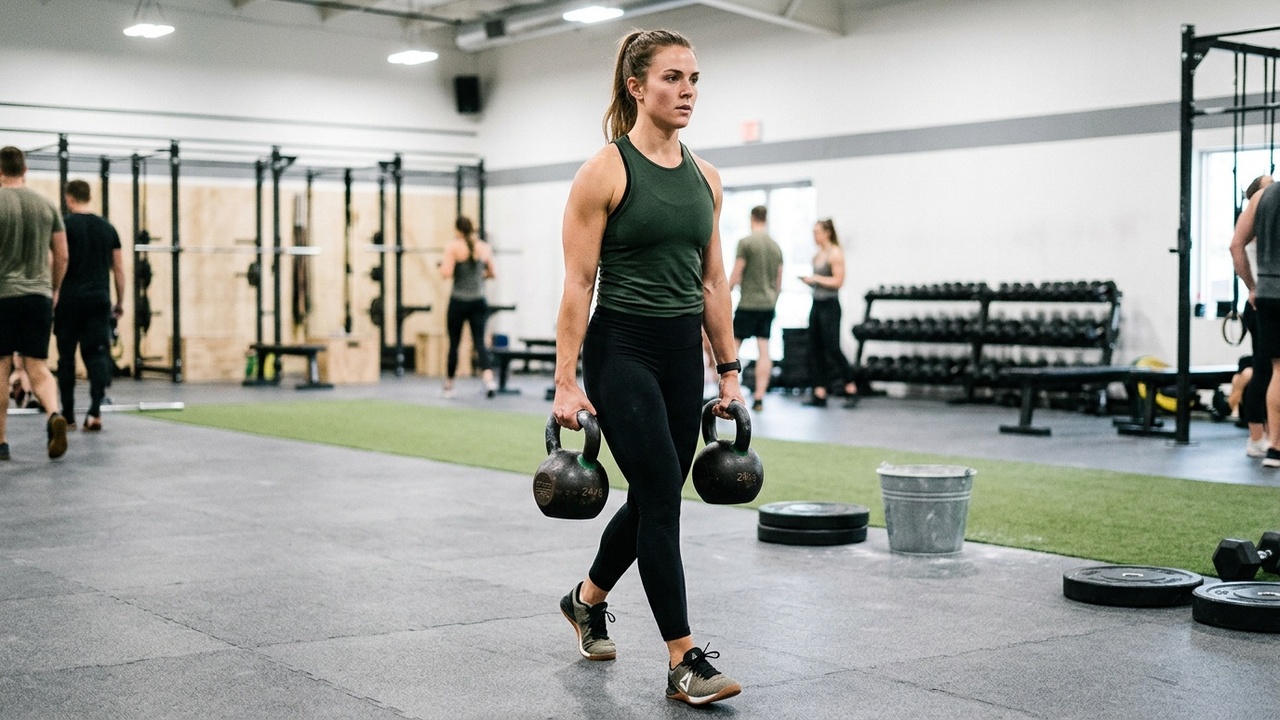
Exercises like the Cable Pallof Press, farmers walk, and overhead carry train anti-rotation, anti-lateral flexion, and anti-extension — the core functions that actually protect your spine during real-world activities. If you want strong, functional abs, skip the crunches and load up on carries and planks.
Unilateral Work
Real life rarely lets you use both limbs symmetrically. You carry a bag in one hand, step up stairs one leg at a time, and reach for objects with one arm. Unilateral (single-limb) exercises like the single-leg Romanian deadlift and step-ups expose and correct strength imbalances between your left and right sides.
They also demand more stabilization. Holding a weight on one side forces your core to work overtime to prevent you from tipping over. This makes unilateral exercises doubly functional — they build strength and stability simultaneously.
15 Best Functional Fitness Exercises
These 15 movements form the foundation of an effective functional fitness program. Each one trains multiple muscle groups, challenges coordination or stability, and has direct carryover to real-world tasks.
Turkish Get-Up
The Kettlebell Turkish Get-Up is arguably the single most functional exercise in existence. You start lying on the floor with a weight overhead and work through a complex sequence of movements to stand up — all while keeping the weight locked out above you.
It trains shoulder stability, hip mobility, core strength, single-leg balance, and total-body coordination in one fluid sequence. It's also an excellent diagnostic tool: if any link in the movement chain is weak, the get-up will expose it. Start light and master the technique before adding load. Even bodyweight get-ups are valuable.
Kettlebell Swing
The Kettlebell Swing is the cornerstone of functional conditioning. It's a hip-hinge movement that develops explosive posterior chain power — glutes, hamstrings, and lower back working together to drive the kettlebell forward.
It's also an outstanding conditioning tool. High-rep swings elevate your heart rate rapidly while building strength endurance. Twenty swings will leave you breathing hard. Two hundred swings in a session will transform your work capacity. The swing teaches you to produce force from your hips, which is fundamental to sprinting, jumping, and lifting heavy objects.
Farmers Walk
The Farmers Walk is deceptively simple: pick up something heavy in each hand and walk. That simplicity masks one of the most effective total-body exercises available. It builds grip strength, core stability, shoulder endurance, hip stability, and cardiovascular conditioning all at once.
Farmers walks have enormous real-world carryover. Carrying groceries, luggage, and heavy objects is something you do regularly. Training it makes you better at it and builds resilient connective tissue throughout your hands, forearms, and shoulders.
Medicine Ball Slam
The Medicine Ball Overhead Slam is a full-body power exercise that also serves as an excellent stress reliever. You drive the ball overhead, then slam it into the ground with everything you've got. It trains the entire posterior chain, shoulders, and core through a powerful extension-to-flexion pattern.
Slams also develop rotational power when performed with a lateral variation. They're a staple in AMRAP and EMOM workouts because they're easy to program, require minimal technique, and produce serious metabolic demand.
Battle Ropes
Battling Ropes deliver one of the most intense conditioning stimuli available. Thirty seconds of all-out waves will spike your heart rate to near-maximum levels. They train shoulder endurance, grip strength, core stability, and cardiovascular fitness simultaneously.
What makes battle ropes uniquely functional is that they're self-limiting — you can only go as fast and as hard as your body allows, with very low injury risk. They're also highly versatile. Alternating waves, double waves, slams, circles, and lateral throws each challenge different movement patterns and muscle groups.
Sled Push/Pull
The Sled Push and Sled Pull are functional training essentials. Pushing a heavy sled develops quad strength, hip drive, and cardiovascular capacity. Pulling it backward or with a rope builds the posterior chain and upper back. Both are incredibly demanding metabolically while being very joint-friendly because there's no eccentric (lowering) phase.
Sled work is a staple in Hyrox competition training and is increasingly popular in general functional fitness programming. It's scalable from rehabilitation-level light loads to absolutely brutal heavy pushes.
Box Jump
Box jumps develop explosive lower-body power — the ability to generate maximum force in minimum time. That explosiveness translates to sprinting, changing direction, and athletic performance in general. They also train landing mechanics, which is critical for injury prevention.
Start with a moderate box height and focus on soft, quiet landings. Step down between reps rather than jumping down to reduce impact on your joints. The goal is powerful output, not maximum height.
Pull-Up
The Pull-Up is the gold standard upper-body pulling exercise. It's functional because you're moving your entire bodyweight through space, requiring lat strength, grip endurance, scapular control, and core stability. If you ever need to climb over something, pull yourself up, or hang from a bar, pull-ups are the exercise that prepares you.
If you can't do pull-ups yet, our calisthenics workout plan for beginners includes progressions to get you there. Start with dead hangs, negatives, and band-assisted variations.
Goblet Squat
The Dumbbell Goblet Squat is the most accessible and arguably the most functional squat variation. Holding the weight at your chest forces an upright torso, teaches proper depth, and builds core strength alongside leg power. It mimics the pattern of picking up and holding a heavy object in front of your body.
The goblet squat is excellent for all fitness levels. Beginners use it to learn squat mechanics. Advanced athletes use it for high-rep conditioning or as a warm-up before heavier barbell work.
Single-Leg Romanian Deadlift
The Dumbbell Single-Leg Deadlift trains the posterior chain unilaterally while demanding balance, hip stability, and proprioception. It's one of the best exercises for building the single-leg strength and stability that running, walking on uneven terrain, and most sports require.
It also reveals asymmetries between your left and right sides. If one side is noticeably weaker or wobblier, you've identified a gap that needs attention. Start with bodyweight or a light dumbbell until you can perform the movement with control.
Overhead Carry
The Dumbbell Overhead Carry takes the farmers walk concept and adds a massive shoulder stability and core demand. Walking with a weight locked out overhead challenges your shoulder stabilizers, thoracic spine position, and core anti-extension strength.
It's humbling — most people are shocked at how challenging a moderate weight becomes when held overhead during a walk. Single-arm overhead carries are even more demanding because they add an anti-lateral flexion component.
Burpee
The Burpee is the exercise everyone loves to hate, and for good reason. It combines a squat, a push-up, a plank, and a jump into one movement that challenges your entire body and cardiovascular system. No equipment needed, minimal space required, maximum conditioning effect.
Burpees are a staple in functional fitness and AMRAP-style workouts because they're self-regulating — the harder you push, the more demanding they become. Even 10 burpees at full intensity will leave most people gasping.
Step-Up
The Step-Up is a fundamental human movement pattern — you do it every time you climb stairs. Adding load makes it a powerful single-leg strength exercise that trains quads, glutes, and hip stability with direct real-world carryover.
Focus on driving through the lead leg without pushing off the back foot. Use a box height that allows your thigh to be parallel to the ground or slightly below. This ensures you're actually building single-leg strength rather than using momentum.
Pallof Press
The Cable Pallof Press is an anti-rotation core exercise that trains your core to resist twisting forces. You hold a cable or band at chest height and press it straight out in front of you while your core works to prevent your torso from rotating toward the anchor point.
It's one of the most functional core exercises because real-world core demands are almost always about resisting movement rather than creating it. Resisting rotation is essential for injury prevention during activities like carrying, throwing, and any sport that involves change of direction.
Bear Crawl
The Bear Crawl looks simple but delivers a surprisingly brutal total-body challenge. Moving on all fours with your knees hovering just above the ground trains core stability, shoulder endurance, hip mobility, and coordination in a way that no other exercise replicates.
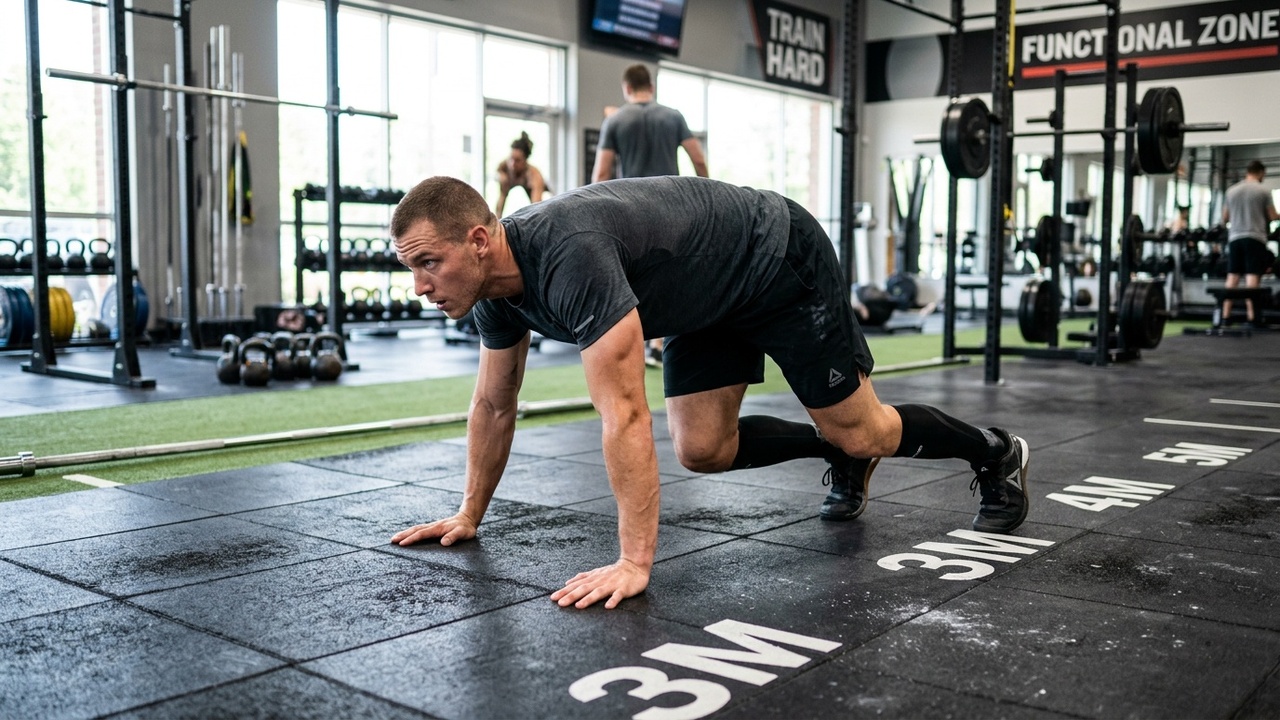
Bear crawls also challenge your cardiovascular system aggressively. Thirty seconds of controlled bear crawling will elevate your heart rate and light up muscles you didn't know you had. They're an excellent warm-up, finisher, or conditioning tool.
4-Week Functional Fitness Program
This program runs 4 days per week with 3 rest days. Each session takes approximately 45-55 minutes. The structure progresses over four weeks by adding volume and intensity while keeping the movement patterns consistent.
Rest 60-90 seconds between exercises unless otherwise noted. For circuit-style blocks, rest only at the end of the circuit.
Browse our workout routines for more pre-built programs, or use the free workout planner to customize this plan to your equipment.
Day 1 -- Push + Carry
| Exercise | Week 1-2 | Week 3-4 | Rest |
|---|---|---|---|
| Dumbbell Goblet Squat | 3 x 10 | 4 x 10 | 90s |
| Push-Up | 3 x 12-15 | 4 x 12-15 | 60s |
| Sled Push | 3 x 30m | 4 x 30m | 90s |
| Dumbbell Overhead Carry | 3 x 40m | 4 x 40m | 60s |
| Front Plank | 3 x 30s | 3 x 45s | 60s |
Finisher: 3 rounds of 10 burpees + 30m farmers walk. Rest 90 seconds between rounds.
Day 2 -- Pull + Core
| Exercise | Week 1-2 | Week 3-4 | Rest |
|---|---|---|---|
| Kettlebell Swing | 4 x 12 | 5 x 12 | 60s |
| Pull-Up (or band-assisted) | 3 x 6-8 | 4 x 6-8 | 90s |
| Sled Pull | 3 x 30m | 4 x 30m | 90s |
| Cable Pallof Press | 3 x 10/side | 3 x 12/side | 60s |
| Bear Crawl | 3 x 20m | 4 x 20m | 60s |
Finisher: 4 rounds of 8 medicine ball slams + 20s battling ropes. Rest 60 seconds between rounds.
Day 3 -- Lower Body + Plyometrics
| Exercise | Week 1-2 | Week 3-4 | Rest |
|---|---|---|---|
| Barbell Squat | 4 x 6-8 | 4 x 5-7 (heavier) | 2-3 min |
| Dumbbell Single-Leg Deadlift | 3 x 8/side | 4 x 8/side | 90s |
| Step-Up (loaded) | 3 x 10/side | 4 x 10/side | 60s |
| Box Jump | 3 x 5 | 4 x 5 | 90s |
| Mountain Climber | 3 x 20 (total) | 3 x 30 (total) | 60s |
Finisher: 2 rounds of 40m farmers walk (heavy) + 10 kettlebell swings. Rest 90 seconds between rounds.
Day 4 -- Full Body Conditioning
This session is designed as a circuit. Complete all exercises in order, rest 2 minutes at the end, and repeat.
Circuit (4-5 rounds in weeks 1-2, 5-6 rounds in weeks 3-4):
| Exercise | Reps/Duration |
|---|---|
| Kettlebell Turkish Get-Up | 2 per side |
| Battling Ropes | 30 seconds |
| Dumbbell Goblet Squat | 10 |
| Burpee | 8 |
| Farmers Walk | 40m |
| Bear Crawl | 20m |
Rest 2 minutes between rounds. The goal is to maintain quality movement throughout — if your form breaks down significantly, take extra rest or reduce the rounds.
Weekly schedule suggestion: Monday (Day 1), Wednesday (Day 2), Friday (Day 3), Saturday (Day 4). Tuesdays, Thursdays, and Sundays are rest or light active recovery (walking, stretching, mobility work).
Functional Fitness for Different Populations
Functional training is one of the most adaptable training methodologies. The principles stay the same; the execution shifts based on who's doing it.
For Athletes
Athletes benefit from functional training as a complement to sport-specific work. The multi-directional movement, rotational power, and single-leg stability that functional exercises develop translate directly to field and court sports. Sled pushes, medicine ball throws, and lateral movement drills build the acceleration, deceleration, and change-of-direction ability that games demand.
Athletes should integrate functional work into their existing program rather than replacing their sport-specific training with it. Two to three functional sessions per week alongside sport practice and competition is typically the right balance. For athletes training for endurance-based competitions, pairing functional work with AMRAP and EMOM protocols creates effective conditioning.
For Older Adults
Functional fitness may be most valuable for adults over 50. The qualities it develops — balance, grip strength, the ability to get up from the floor, walking stability under load — are the exact qualities that predict independence and fall risk in older populations.
Programming for older adults should emphasize lower loads, slower progressions, and extra attention to balance work. Goblet squats, step-ups, farmers walks, and modified Turkish get-ups are all excellent starting points. The single-leg deadlift (even bodyweight only) is one of the best exercises an older adult can practice for fall prevention. Start simple, progress slowly, and prioritize consistency over intensity.
For Desk Workers
If you spend 8+ hours a day sitting, functional training addresses the muscular imbalances and movement deficiencies that sedentary life creates. Tight hip flexors, weak glutes, rounded shoulders, and a stiff thoracic spine are the hallmarks of desk-bound work.
Functional exercises like goblet squats, overhead carries, bear crawls, and kettlebell swings directly counteract these issues. They open up tight hips, strengthen the posterior chain, mobilize the upper back, and train your core to stabilize your spine — exactly the opposite of what sitting all day does to your body. Even two functional sessions per week can dramatically improve how you feel and move.
How Load Muscle Programs Functional Workouts
Load Muscle's workout planner generates functional training programs tailored to your equipment, experience level, and goals. The algorithm selects exercises from our library of over 4,000 movements, prioritizing compound, multi-joint patterns that build real-world strength and conditioning.
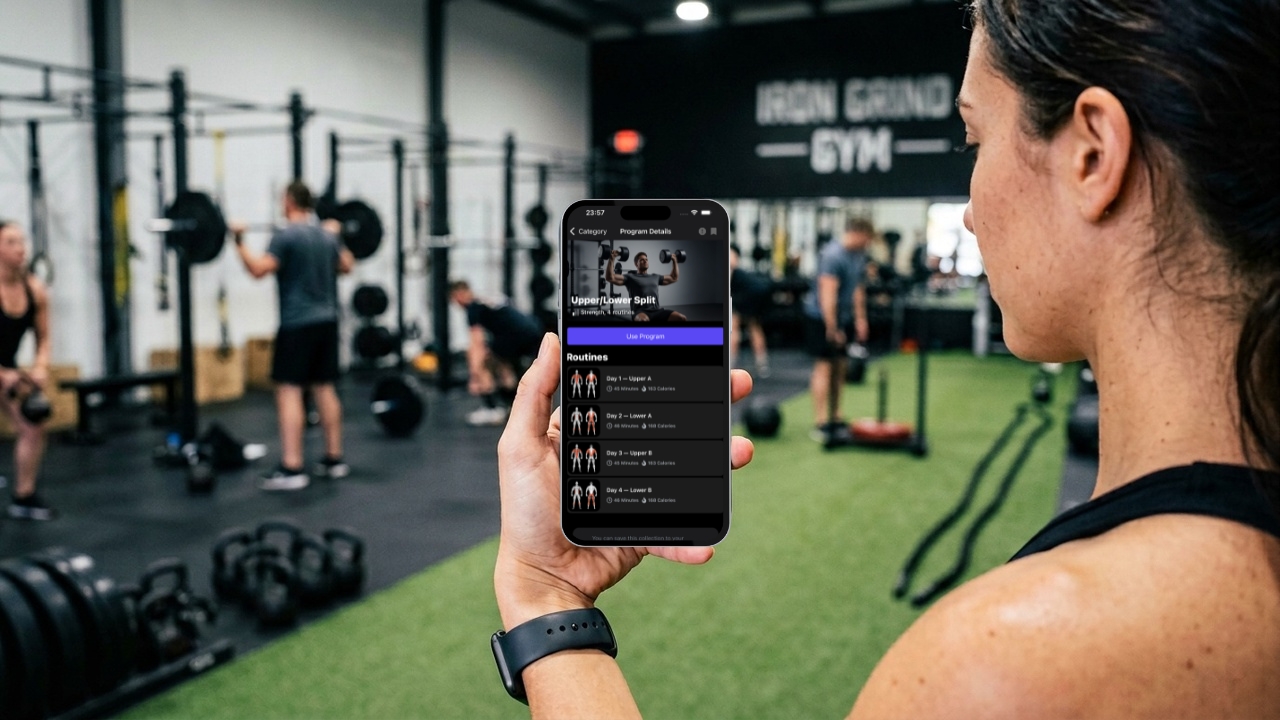
Whether you train at a fully equipped gym, a garage gym with kettlebells, or at home with just your bodyweight, the planner adapts to what you have available. It balances push, pull, carry, and lower body patterns across your training week and applies progressive overload to keep you advancing.
You can also browse our curated workout routines for ready-to-follow functional programs. Each routine includes exercise demonstrations, set and rep schemes, and rest periods so you can get started immediately.
FAQ
What is functional fitness in simple terms?
Functional fitness is training that prepares your body for real-life physical tasks. Instead of isolating individual muscles, it uses exercises that work multiple muscle groups and joints together through natural movement patterns like squatting, pushing, pulling, carrying, and rotating. The goal is to build strength, balance, and coordination that you can actually use outside the gym.
Can you build muscle with functional training?
Yes, absolutely. Functional exercises like goblet squats, pull-ups, kettlebell swings, and loaded carries create significant mechanical tension and metabolic stress, which are the primary drivers of muscle growth. You may not maximize hypertrophy the way a dedicated bodybuilding program would, but you'll build a strong, muscular physique while also developing conditioning and athleticism.
How often should I do functional fitness workouts?
Three to four sessions per week is ideal for most people. This provides enough training stimulus for meaningful progress while allowing adequate recovery. The 4-week program in this guide uses a 4-day schedule. If you're combining functional training with other activities like running or sport practice, two to three sessions per week is a good starting point.
Is functional fitness good for beginners?
Functional training is excellent for beginners because it builds fundamental movement patterns from the ground up. Exercises like goblet squats, step-ups, and farmers walks are intuitive and relatively easy to learn compared to complex barbell lifts. Start with bodyweight or light loads, focus on movement quality, and progress gradually. Our beginner strength training guide covers the fundamentals in more detail.
What equipment do I need for functional fitness?
You can start with nothing — bodyweight exercises like push-ups, burpees, mountain climbers, and bear crawls are all functional. To expand your options, a kettlebell, a set of dumbbells, and a pull-up bar cover the vast majority of functional exercises. Sleds, battle ropes, and medicine balls are great additions but not essential. Use the free workout planner to generate a program based on whatever equipment you have access to.
How is functional fitness different from CrossFit?
CrossFit is a branded fitness methodology that incorporates functional movements but adds competitive elements, standardized benchmark workouts, and an emphasis on high intensity. Functional fitness is a broader training philosophy that can be applied at any intensity level and in any setting. You can train functionally without timing your workouts, competing against others, or performing Olympic lifts at high rep counts. Think of CrossFit as one specific expression of functional fitness principles, not the only one.