Time-based training is one of the most effective ways to get more work done in less time. If you have ever watched the clock during a rest period and wondered whether there is a better way to structure your session, there is. AMRAP and EMOM workouts flip the script on traditional set-and-rep training by putting the clock in charge.
These two formats have been used by competitive athletes, military programs, and everyday gym-goers for years. They work because they remove the guesswork from rest periods, create a built-in tracking system, and push your conditioning while still building real strength and muscle.
This guide breaks down exactly what AMRAP and EMOM mean, how they differ, how to program them, and gives you 8 ready-to-use workout templates for every level. Whether you train at home with nothing but your bodyweight or have a full gym at your disposal, there is a template here for you.
TL;DR
- AMRAP (As Many Rounds/Reps As Possible) challenges you to do maximum work in a fixed time
- EMOM (Every Minute On the Minute) assigns a set amount of work at the start of each minute
- Both formats build conditioning, support progressive overload, and scale to any fitness level
- This guide includes 4 AMRAP and 4 EMOM workout templates from beginner to advanced
- Use the free workout planner to build a custom time-based program tailored to your goals
- Pair these workouts with a structured workout routine for best results
What Is an AMRAP Workout?
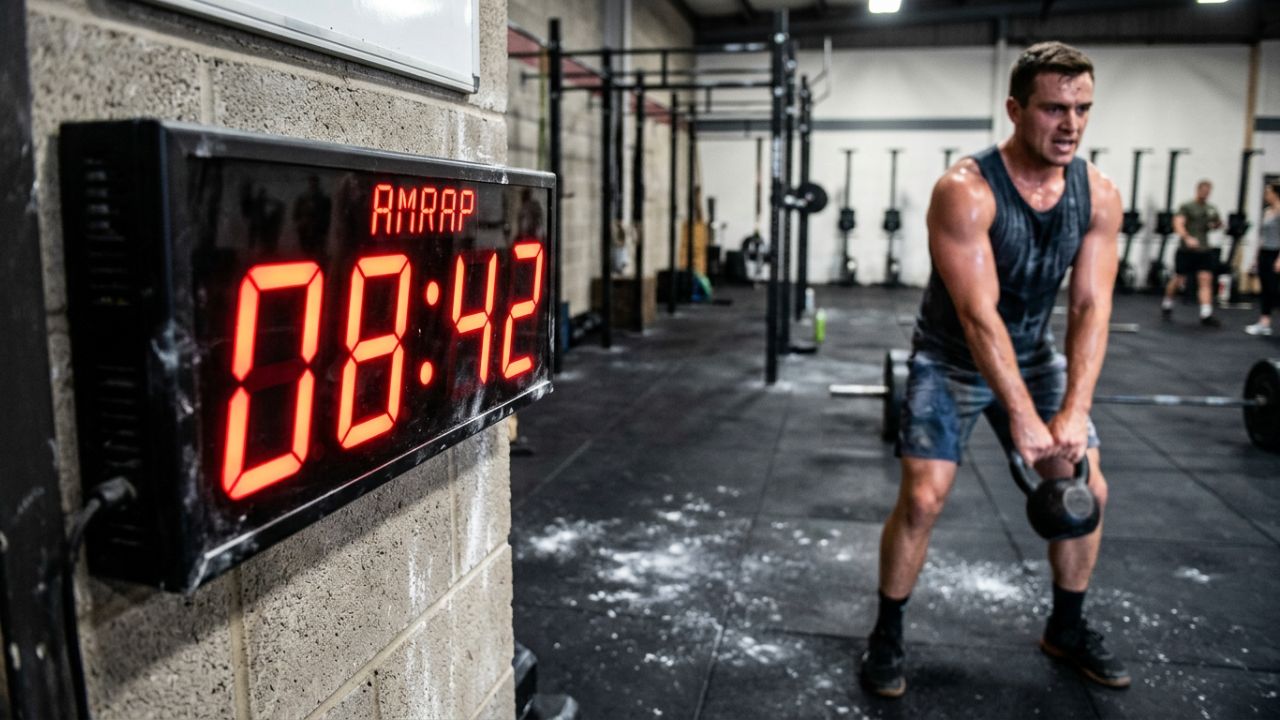
AMRAP stands for As Many Rounds As Possible (or As Many Reps As Possible, depending on the context). You pick a set of exercises with fixed reps, start a timer, and complete as many full rounds as you can before the clock runs out.
For example, a simple 10-minute AMRAP might look like this: 10 push-ups, 10 dumbbell goblet squats, and 10 mountain climbers. You cycle through those three exercises continuously for 10 minutes, resting only when you need to. Your score is the total number of rounds and extra reps completed.
The beauty of an AMRAP workout is that it self-regulates intensity. A beginner might finish 4 rounds. An advanced athlete might finish 8. Both are working at their own capacity, and both have a clear number to beat next time. That built-in benchmark is what makes AMRAP so effective for long-term progress. It is also why this format shows up in competitive fitness events and in Hyrox-style training where conditioning and pacing are everything.
What Is an EMOM Workout?
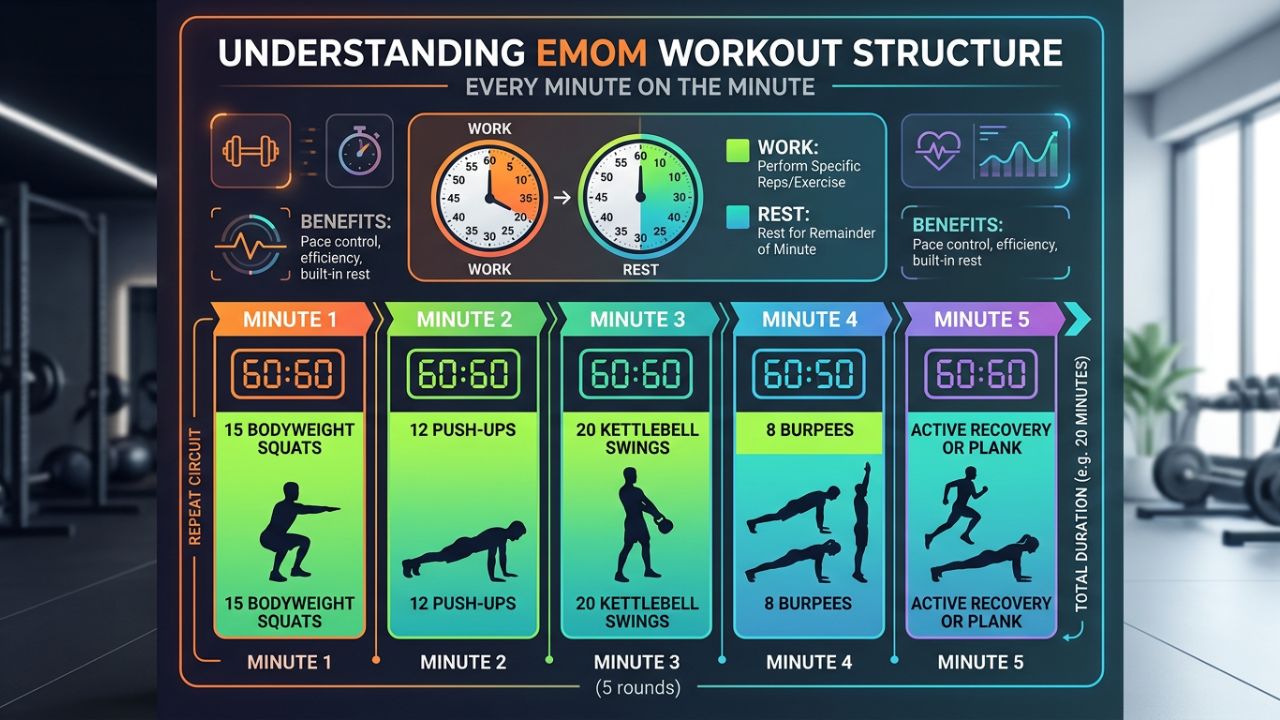
EMOM stands for Every Minute On the Minute. At the start of each minute, you perform a prescribed number of reps of an exercise. Whatever time remains in that minute is your rest. When the next minute begins, you go again.
Here is a quick example. A 10-minute EMOM might assign 5 barbell deadlifts every minute. If it takes you 20 seconds to complete your 5 reps, you get 40 seconds of rest. If it takes you 35 seconds, you only get 25 seconds of rest. The faster you work, the more you rest, but as fatigue builds, those rest windows shrink.
EMOM workouts are excellent for practicing movement quality under mild fatigue. Because the rep count is low and you get built-in rest, the focus stays on crisp, controlled reps rather than grinding through sloppy ones. This makes EMOM a particularly good format for strength work and skill-based movements like pull-ups or kettlebell swings.
You can also alternate exercises each minute. Odd minutes might be 8 barbell bench presses, and even minutes might be 10 barbell bent-over rows. This creates a natural push-pull structure that keeps intensity high without frying any single muscle group.
AMRAP vs EMOM: Key Differences
Both AMRAP and EMOM are time-based training methods, but they create very different training experiences. Understanding the differences helps you choose the right format for your goal on any given day.
| Feature | AMRAP | EMOM |
|---|---|---|
| Structure | Continuous work for a set time | Fixed work at the start of each minute |
| Rest | Self-selected (you rest when needed) | Built-in (remaining time in the minute) |
| Intensity | High and sustained | Moderate with brief recovery windows |
| Best for | Conditioning, mental toughness, calorie burn | Strength practice, skill work, pacing |
| Tracking metric | Total rounds/reps completed | Weight used, consistency across minutes |
| Fatigue pattern | Accumulates steadily, reps slow toward the end | Manageable early, rest windows shrink later |
| Rep quality | Can degrade as fatigue builds | Easier to maintain because of built-in rest |
When to use AMRAP: You want a conditioning-heavy finisher, a standalone metabolic session, or a benchmark workout you can retest. AMRAP is ideal when the goal is to push your work capacity as hard as possible within a time limit.
When to use EMOM: You want to practice a lift with good form under light fatigue, accumulate quality volume at a moderate intensity, or build pacing discipline. EMOM is the better choice when movement quality matters more than total output.
Many well-designed programs use both. You might run a strength EMOM as your main work and finish with a short AMRAP to cap the session. If you want to explore how these formats fit into a broader training plan, check out the workout routines library for structured programs that incorporate time-based elements.
Benefits of Time-Based Training
Whether you choose AMRAP, EMOM, or a mix of both, time-based training offers several advantages over traditional set-and-rep formats.
Built-In Progressive Overload
Every AMRAP gives you a score. Every EMOM gives you a consistency benchmark. If you did 6 rounds last week and 7 rounds this week, you got stronger, fitter, or both. You do not need to guess whether you are progressing. The numbers tell you directly.
This automatic tracking pairs well with the principles of progressive overload. Over time, you can also increase the load, extend the time cap, or add more challenging exercises to keep pushing forward. The combination of a compound exercise foundation with time-based formats is one of the most effective ways to build both strength and conditioning simultaneously.
Time-Efficient
An AMRAP workout can deliver a brutal full-body session in 10-20 minutes. An EMOM can pack serious strength volume into 12-16 minutes. When you remove the unstructured rest that creeps into traditional training (checking your phone, chatting, waiting for equipment), the density of work per minute goes way up.
If you are someone who struggles to find 60-90 minutes for the gym, a focused 20-minute AMRAP or EMOM can be more productive than a distracted hour of traditional training.
Scalable for All Levels
A beginner and an advanced lifter can do the exact same AMRAP workout. The beginner uses lighter weights and completes fewer rounds. The advanced lifter loads heavier and finishes more rounds. The structure does not change, only the output does.
This scalability makes time-based workouts perfect for group settings, home training, and anyone who needs a flexible format. You can even do effective sessions with zero equipment. If you train at home, pair these formats with exercises from the bodyweight workout guide for a complete program.
Improves Work Capacity
Work capacity is your ability to perform and recover from training volume. AMRAP and EMOM workouts improve this directly by forcing you to do meaningful work under time pressure. Over weeks and months, you will notice that you recover faster between sets in traditional training too, that you can handle more volume per session, and that your cardiovascular system supports your strength work instead of limiting it.
This crossover benefit is why many powerlifters and strength athletes include conditioning blocks built around time-based formats. It makes you harder to kill in the gym and more resilient in daily life.
How to Program AMRAP Workouts
An AMRAP workout is only as good as its design. Throwing random exercises into a circuit and setting a timer will give you a sweat, but smart programming gives you real results.
Choosing Exercises
Select 3-5 exercises that flow well together. Ideally, alternate between upper body, lower body, and a conditioning or core movement. This prevents any single muscle group from being the bottleneck.
Good exercise selection rules:
- Avoid movements that require complex setup between rounds (switching barbells, adjusting cables). Keep transitions fast.
- Mix movement patterns. A push, a pull, a squat or hinge, and a conditioning move is a solid four-exercise template.
- Choose exercises you can perform safely when fatigued. An AMRAP is not the place for heavy singles on barbell squats. Use moderate loads and higher rep ranges.
- Include at least one compound movement to maximize muscle engagement per round.
Setting Time Caps
Time caps determine the intensity and character of the workout.
- 5-8 minutes: Short and brutal. Best for 2-3 exercises with low reps. Sprint pace.
- 10-15 minutes: The sweet spot for most AMRAP workouts. Enough time to accumulate serious volume without the workout dragging.
- 20+ minutes: Longer AMRAPs shift toward endurance and pacing. Use lighter loads and simpler exercises. Think of these as metabolic conditioning sessions.
Start with 10-15 minute AMRAPs if you are new to the format. You can adjust the time cap as you learn your pacing.
Tracking Progress
Record three things after every AMRAP: the exercises and loads used, the time cap, and your total rounds plus extra reps. Write it as "6+8" to mean six full rounds plus 8 reps into the seventh.
Retest the same AMRAP every 3-4 weeks. If your score goes up with the same load, you improved. If it stays the same but you used heavier weight, you also improved. This tracking system makes progress undeniable and keeps you motivated.
You can log and track these workouts easily with the free workout planner, which lets you save custom workouts and monitor your progress over time.
How to Program EMOM Workouts
EMOM programming requires a bit more precision than AMRAP. The work-to-rest ratio within each minute determines whether the session is strength-focused, conditioning-focused, or somewhere in between.
Choosing Reps per Minute
The golden rule for EMOM reps is: your working set should take no more than 30-40 seconds to complete. This guarantees at least 20-30 seconds of rest per minute, which is enough to maintain quality across the full duration.
For strength work, 3-6 reps per minute is typical. For conditioning, 8-15 reps works well. If you find yourself unable to complete the prescribed reps before the minute is up by the halfway point of the workout, you chose too many reps or too much weight.
Rest Management
The built-in rest in an EMOM is your recovery tool. Use it wisely.
In the early minutes, you will have plenty of rest. The temptation is to rush through reps and enjoy long breaks. Resist this. Use a controlled tempo on every rep, set up properly each minute, and treat the early minutes as practice for the hard ones.
As fatigue builds in later minutes, your rest windows shrink. This is by design. If you are still finishing with 20+ seconds to spare in the final minutes, the workout was too easy. If you cannot finish the reps at all, it was too hard. The sweet spot is finishing your last few sets with 10-15 seconds to spare.
Duration Guidelines
EMOM duration depends on what you are training.
- 8-12 minutes: Good for single-exercise strength EMOMs. Example: 5 barbell deadlifts EMOM for 10 minutes.
- 12-16 minutes: Ideal for 2-exercise alternating EMOMs. Odd minutes are one exercise, even minutes are another.
- 20-30 minutes: Full conditioning sessions with 3-4 exercises rotating through. These are demanding and should be programmed carefully.
A well-designed EMOM can serve as either the main workout or a finisher at the end of a full body session. For main work, aim for 16-24 minutes. For a finisher, keep it to 8-12 minutes.
4 AMRAP Workout Templates
These four AMRAP workouts cover a range of equipment needs and difficulty levels. Each one lists exercises, reps, time cap, and recommended intensity.
Bodyweight AMRAP (10 min)
No equipment needed. Perfect for home training or a hotel room.
Time cap: 10 minutes
| Exercise | Reps |
|---|---|
| Push-Up | 10 |
| Mountain Climber | 20 (10 per side) |
| Burpee | 8 |
| Front Plank | 20 sec hold |
Target: 4-7 rounds depending on fitness level. Focus on completing full reps with good form rather than rushing. This workout pairs well with the bodyweight exercises guide for warm-up and cool-down ideas.
Dumbbell AMRAP (15 min)
All you need is a pair of dumbbells. Great for a home gym or when the gym is crowded.
Time cap: 15 minutes
| Exercise | Reps |
|---|---|
| Dumbbell Goblet Squat | 12 |
| Push-Up | 10 |
| Dumbbell Lunge | 10 (5 per side) |
| Barbell Bent-Over Row (sub dumbbell rows) | 10 |
Target: 5-8 rounds. Use a dumbbell weight that is challenging but allows you to maintain form through at least 5 rounds before needing extra rest.
Barbell AMRAP (12 min)
A barbell-only AMRAP focused on the big compound lifts. Use 50-60% of your one-rep max on each exercise to keep the pace moving.
Time cap: 12 minutes
| Exercise | Reps |
|---|---|
| Barbell Deadlift | 8 |
| Barbell Bench Press | 8 |
| Barbell Bent-Over Row | 8 |
| Burpee | 6 |
Target: 4-6 rounds. The barbell movements will slow you down, and that is fine. Maintain solid bracing and technique on every rep. This AMRAP is a serious test of full-body conditioning and strength endurance.
Full Gym AMRAP (20 min)
Uses a mix of equipment for a comprehensive conditioning session. Best suited for intermediate to advanced trainees.
Time cap: 20 minutes
| Exercise | Reps |
|---|---|
| Rowing Machine | 250 m |
| Kettlebell Swing | 15 |
| Pull-Up | 8 |
| Dumbbell Goblet Squat | 12 |
| Push-Up | 15 |
Target: 4-7 rounds. The rower provides a natural pacing element. Do not sprint the row early on or you will pay for it in later rounds. This is a 20-minute war of attrition, treat it with respect.
4 EMOM Workout Templates
These EMOM workouts range from beginner-friendly to advanced conditioning tests. Each one specifies the exercises, reps per minute, and total duration.
Beginner EMOM (10 min)
A simple alternating EMOM to learn the format. Two exercises, manageable reps, plenty of built-in rest.
Duration: 10 minutes (alternating minutes)
| Minute | Exercise | Reps |
|---|---|---|
| Odd (1, 3, 5, 7, 9) | Dumbbell Goblet Squat | 8 |
| Even (2, 4, 6, 8, 10) | Push-Up | 8 |
Notes: You should have 30-40 seconds of rest each minute. If not, reduce reps to 6. This is a great entry point if you have never tried EMOM before.
Strength EMOM (16 min)
A heavier EMOM focused on building strength in two major lifts. Use 70-75% of your one-rep max.
Duration: 16 minutes (alternating minutes)
| Minute | Exercise | Reps |
|---|---|---|
| Odd (1, 3, 5, ..., 15) | Barbell Squat | 4 |
| Even (2, 4, 6, ..., 16) | Barbell Bench Press | 5 |
Notes: This is real strength work. The low rep count keeps quality high, and the EMOM structure ensures consistent rest. By minute 12, the weight will feel heavier than it did in minute 2. That is the training stimulus. If you want a structured program built around these lifts, explore the workout routines library for squat and bench press focused plans.
Conditioning EMOM (20 min)
A four-exercise rotation that cycles through a different movement every minute. High-paced and demanding.
Duration: 20 minutes (rotating through 4 exercises)
| Minute | Exercise | Reps |
|---|---|---|
| 1, 5, 9, 13, 17 | Kettlebell Swing | 12 |
| 2, 6, 10, 14, 18 | Burpee | 8 |
| 3, 7, 11, 15, 19 | Step-Up | 10 (5 per side) |
| 4, 8, 12, 16, 20 | Mountain Climber | 20 (10 per side) |
Notes: Each exercise appears 5 times. The variety keeps things mentally fresh, but the cumulative fatigue is significant. Aim to maintain the same pace in round 5 as you did in round 1. This EMOM builds the kind of conditioning that translates directly to Hyrox events and functional fitness competitions.
Full Body EMOM (24 min)
A comprehensive session that hits every major movement pattern. This is a full workout, not a finisher.
Duration: 24 minutes (rotating through 4 exercises)
| Minute | Exercise | Reps |
|---|---|---|
| 1, 5, 9, 13, 17, 21 | Barbell Deadlift | 5 (at 65-70% 1RM) |
| 2, 6, 10, 14, 18, 22 | Pull-Up | 6 |
| 3, 7, 11, 15, 19, 23 | Barbell Bench Press | 6 (at 65-70% 1RM) |
| 4, 8, 12, 16, 20, 24 | Dumbbell Lunge | 10 (5 per side) |
Notes: Six rounds through four exercises gives you 24 total working sets in 24 minutes. That is exceptional volume density. Use moderate loads and focus on movement quality. This session replaces a traditional full body workout and pairs perfectly with the principles outlined in the full body workout plan guide.
Common Mistakes
Time-based workouts are simple to understand but easy to mess up. These are the most common errors that reduce effectiveness or increase injury risk.
Sacrificing form for speed. The clock creates urgency, and urgency leads to sloppy reps. A half-depth squat or a push-up with a sagging back does not count. Every rep should meet the same standard whether it is minute 1 or minute 20. If your form breaks down, reduce the reps or the load, not the standard.
Going too heavy. AMRAP and EMOM workouts are not max-effort strength sessions. Use 50-70% of your max for AMRAP exercises and 65-75% for EMOM strength work. Going heavier than this turns a conditioning session into a grindfest where you spend most of the time resting.
Starting too fast. This is the number one mistake in AMRAPs. You blaze through the first 3 rounds at a pace you cannot maintain, then crawl through the last 5 minutes. Start at a pace you could hold for double the time cap. You will naturally speed up as you learn the workout.
Not tracking results. If you do not write down your score, you cannot track progress. The entire point of time-based training is the built-in benchmark. Record every workout, retest regularly, and watch the numbers climb.
Using AMRAP/EMOM for every session. These formats are tools, not a complete program. Two to three time-based sessions per week is plenty. The rest of your training should include traditional strength work with proper rest periods. Balance is key.
Skipping the warm-up. Because time-based workouts feel casual at the start, many people skip warming up. Do 5 minutes of light cardio and 1-2 warm-up sets of your heaviest exercise before starting the clock. Your joints and muscles will thank you.
FAQ
What does AMRAP stand for? AMRAP stands for As Many Rounds As Possible or As Many Reps As Possible. You perform a set list of exercises continuously for a fixed time and record the total work completed. It is one of the most popular time-based training formats used in functional fitness, CrossFit, and general conditioning programs.
What does EMOM stand for? EMOM stands for Every Minute On the Minute. You begin a prescribed number of reps at the top of each minute and rest for whatever time remains. This structure provides consistent work-to-rest ratios and is excellent for building strength, practicing movements, and improving pacing.
Can beginners do AMRAP and EMOM workouts? Absolutely. Both formats scale naturally to any fitness level. A beginner simply uses lighter weights, fewer reps per round, or shorter time caps. The Beginner EMOM and Bodyweight AMRAP templates in this guide are designed specifically for people new to time-based training. Start there and progress gradually.
How often should I do AMRAP or EMOM workouts? Two to three times per week is ideal for most people. You can use them as standalone sessions or as finishers after traditional strength training. Avoid doing them every day, as the cumulative fatigue can interfere with recovery. Balance them with structured workout routines that include dedicated strength and rest days.
Are AMRAP workouts good for building muscle? Yes, when programmed correctly. AMRAP workouts with moderate loads (50-70% of your max) and compound exercises create significant metabolic stress and time under tension, both drivers of muscle growth. They will not replace heavy strength training, but they are an excellent complement. For a deeper look at how muscle growth works, explore the best compound exercises guide to see which movements give you the most bang for your buck.
Can I combine AMRAP and EMOM in the same workout? Yes, and it is a great strategy. A common approach is to use an EMOM for your main strength work (12-16 minutes of a heavy compound lift) and then finish with a 8-10 minute AMRAP as a conditioning finisher. This gives you the benefits of both formats in a single session that takes under 30 minutes.