HYROX training has exploded onto the fitness scene as one of the fastest-growing competitive events in the world. If you have been scrolling through social media and wondered what all the fuss is about — people pushing sleds, doing wall balls, and running laps in massive arenas — you are looking at HYROX. It is a standardized fitness race that combines running with functional workout stations, and it is designed so that anyone from first-time competitors to elite athletes can participate. The 2025/2026 HYROX season has seen record-breaking participation, with events selling out across North America, Europe, Asia, and Australia, proving that this format has struck a chord with the global fitness community.
Whether you are a runner looking to add strength, a gym-goer wanting a competitive goal, or someone who simply wants a structured challenge to train toward, HYROX delivers. This guide will walk you through everything you need to know: what HYROX is, how the race works, the equipment and stations you will face, and a complete 8-week HYROX training plan to get you race-ready. If you are interested in blending strength and cardio in your training more broadly, our hybrid training guide covers the foundational principles behind this approach.
TL;DR
- HYROX is a standardized fitness race: 8 x 1km runs alternating with 8 functional workout stations, totaling approximately 13km of effort.
- The 8 stations are SkiErg, Sled Push, Sled Pull, Burpee Broad Jumps, Rowing, Farmers Carry, Sandbag Lunges, and Wall Balls.
- Training requires a blend of running endurance, strength endurance, and station-specific practice.
- Follow the 8-week beginner training plan below to prepare for your first race.
- Use the free workout planner to build complementary strength sessions around your HYROX preparation.
What Is HYROX?
HYROX is a global fitness race founded in 2017 in Hamburg, Germany. It was created to be the sport of fitness racing — a standardized competition format where every race around the world follows the exact same course, the exact same distances, and the exact same weights. Whether you race in London, Los Angeles, Dubai, or Sydney, the challenge is identical. This standardization is what sets HYROX apart from obstacle course races and CrossFit competitions, and it is a major reason for its rapid growth.
The concept is simple: run 1 kilometer, complete a workout station, run another kilometer, complete the next station, and repeat until you have finished all 8 running segments and all 8 workout stations. The total distance covered is approximately 8km of running plus the distance covered during stations, bringing the overall effort to roughly 13km equivalent. Your finish time is your score, making it easy to track progress and compare performances across events and seasons.
HYROX is not about being the strongest or the fastest in isolation. It is about being well-rounded. You need enough running fitness to handle repeated 1km efforts, enough strength endurance to push sleds and carry heavy loads, and enough mental toughness to keep moving when your legs are burning and your lungs are on fire. This blend of capacities is exactly what makes HYROX training so effective as a general fitness program, even if you never plan to compete.
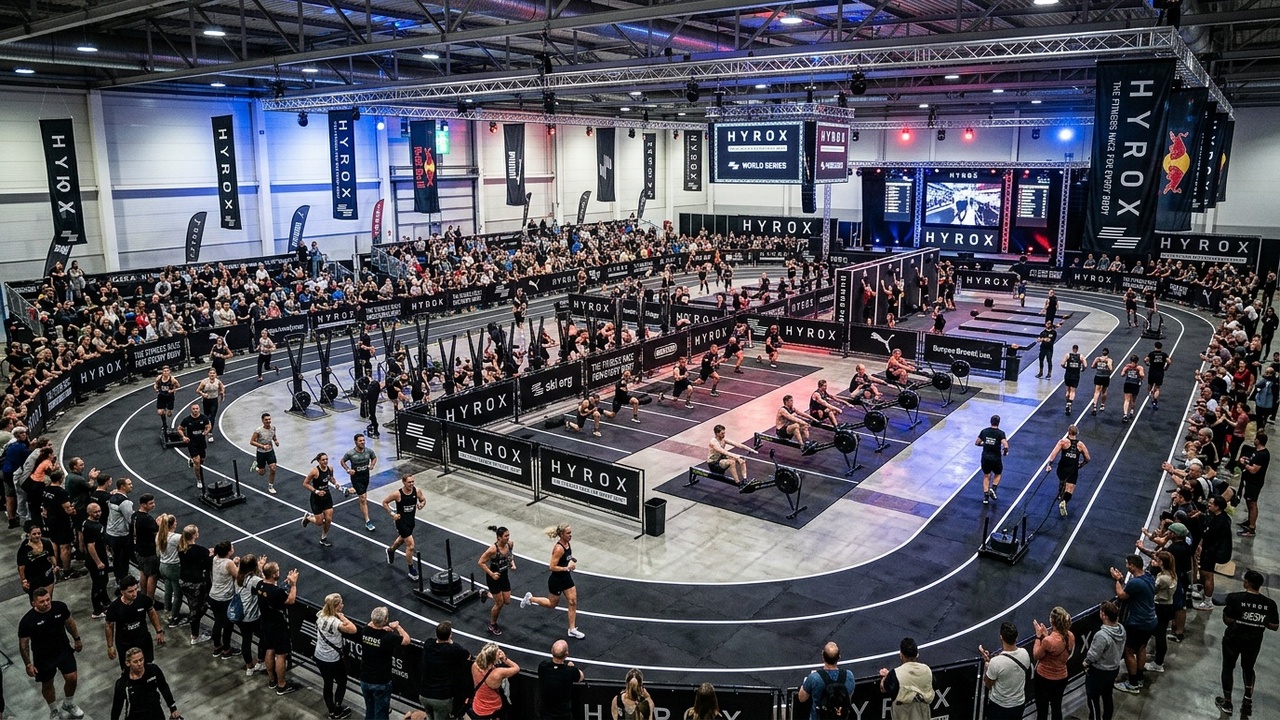
The HYROX Race Format
Every HYROX race follows an identical structure. Understanding the format in detail is the first step to building an effective training plan. The race alternates between running and workout stations in a fixed order, and you must complete each station before moving on to the next run.
8 Running Segments (8 x 1km)
The running portions take place on an indoor track, typically set up inside a large convention center or arena. Each 1km segment is run before each workout station. The surface is usually flat and hard, similar to running on a treadmill or indoor track. The pace you choose for these segments is crucial — go out too fast on the early kilometers and you will pay for it at the later stations.
For most beginners, a comfortable 1km pace falls between 5:30 and 7:00 minutes per kilometer. The key is consistency. Your eighth kilometer should not be dramatically slower than your first. This is where HYROX training differs from traditional race training. You are not just running — you are running fatigued, with heavy legs from the preceding workout stations. Learning to run under fatigue is one of the most important skills you will develop.
8 Workout Stations Explained
Each station has specific requirements, including prescribed weights that differ between divisions. Here is a detailed breakdown of all 8 stations in race order, with weights listed for the Open (standard) division.
Station 1: SkiErg (1,000m)
The race kicks off with 1,000 meters on the SkiErg. This machine simulates cross-country skiing and hammers your lats, triceps, core, and shoulders. The key to an efficient SkiErg is using a powerful hip hinge rather than relying solely on your arms. Drive your hips back, pull with your entire posterior chain, and maintain a rhythm you can sustain for the full distance. Most beginners finish in 4-6 minutes.
Station 2: Sled Push (50m)
You push a weighted sled across a 25m track and back. The sled weighs 152kg for men and 102kg for women in the Open division. This is one of the most physically demanding stations, targeting your quads, glutes, and cardiovascular system. Keep a low body angle, drive through your legs, and take short, powerful steps. Walking pace is perfectly fine for beginners.
Station 3: Sled Pull (50m)
Immediately after the next 1km run, you face the sled pull. Using a rope attached to the sled (same weights as the push), you pull it toward you across 50 meters. This station crushes your grip, biceps, back, and core. Use a hand-over-hand technique, sit back into a low squat position, and pull in long, steady strokes. Grip endurance is often the limiting factor here.
Station 4: Burpee Broad Jumps (80m)
This is 80 meters of burpees combined with broad jumps. You perform a burpee, then jump forward as far as you can, and repeat. This station is both technically demanding and extremely fatiguing. It targets your entire body and spikes your heart rate dramatically. Pacing is everything — start conservatively and find a sustainable rhythm.
Station 5: Rowing (1,000m)
You row 1,000 meters on a Concept2 rowing machine. This station arrives at the midpoint of the race when fatigue is setting in. Strong rowing technique — legs first, then back, then arms — will save you significant energy. Aim for a consistent split time rather than going all-out at the start. Most beginners target a 2:00-2:30 per 500m split.
Station 6: Farmers Carry (200m)
You carry a pair of heavy kettlebells or implements for 200 meters. The weight is 2 x 24kg for men and 2 x 16kg for women. The farmers walk is a test of grip strength, core stability, and mental toughness. Keep your shoulders packed down, your core braced, and take steady steps. If you need to set the weight down, do so briefly and get moving again quickly. Building grip endurance through exercises like the farmers walk in training will pay dividends here.
Station 7: Sandbag Lunges (100m)
You perform 100 meters of walking lunges while carrying a sandbag on your shoulders. The sandbag weighs 20kg for men and 10kg for women. This station arrives late in the race when your legs are already destroyed from running and previous stations. Focus on maintaining good lunge form — front knee tracking over toes, back knee lightly touching the ground — and find a pace you can sustain without stopping.
Station 8: Wall Balls (100 reps)
The final station is 100 wall balls. You squat with a medicine ball (6kg for men, 4kg for women), then explosively stand and throw it to a target on the wall (men target at 3m, women at 2.7m). This station is a brutal combination of leg and shoulder endurance. Break it into manageable sets — 20s, 15s, or 10s — with brief rest periods. The finish line is just one more 1km run away after this station.
HYROX Divisions (Singles, Doubles, Relay)
HYROX offers several divisions to accommodate different fitness levels and preferences. Understanding these options helps you choose the right entry point for your first race.
HYROX Open (Singles) is the standard individual division. You complete the entire race on your own — all 8 runs and all 8 stations. This is the most popular division and the one most beginners target. The weights are standardized as described above.
HYROX Pro uses heavier weights at certain stations (heavier sled, heavier farmers carry) and is designed for experienced competitors chasing faster times and qualification for the World Championships. This is not recommended for first-time racers.
HYROX Doubles allows you to race with a partner. Both athletes run every 1km segment together, but you alternate workout stations — one person does stations 1, 3, 5, 7 while the other does 2, 4, 6, 8 (or vice versa). This is a fantastic option for beginners because it halves the station workload while keeping all the running.
HYROX Relay splits the race across a team of four. Each team member completes 2 running segments and 2 workout stations. This is the most accessible entry point and great for groups who want to experience the race atmosphere without committing to the full individual effort.
For your first HYROX, either the Open Singles or Doubles division is a solid choice. The Doubles option is particularly appealing if you have a training partner and want to share the challenge.
How to Train for HYROX
Effective HYROX training requires developing multiple fitness qualities simultaneously. You cannot simply run more or lift heavier — you need a balanced approach that builds running endurance, strength endurance, station-specific skills, and the ability to transition between different movement patterns under fatigue. This is where understanding progressive overload becomes essential, as you will need to systematically increase your training demands across all these areas.
Running Fitness
Running is the backbone of HYROX. You will cover 8km of running during the race, and that running happens between physically demanding stations. Your HYROX training should include three types of running sessions each week.
Easy runs (2-3 per week) build your aerobic base. These should be at a conversational pace — 60-70% of your maximum heart rate. Start with 20-30 minute runs and gradually build to 40-50 minutes. The purpose is to develop your body's ability to use oxygen efficiently and recover between efforts.
Tempo or threshold runs (1 per week) improve your ability to sustain a faster pace. Run at a comfortably hard effort — you can speak in short phrases but not hold a conversation — for 15-25 minutes. These sessions teach your body to clear lactate more effectively, which directly translates to maintaining your 1km pace later in the race.
Interval sessions (1 per week) develop your speed and ability to run under fatigue. These could be 6-8 x 1km repeats at your target race pace with 90 seconds rest, or shorter 400m repeats at a faster pace. If you want to understand why combining running with resistance training is so powerful, check out our guide on why every runner needs to lift.
Strength Endurance
HYROX stations demand strength, but not maximum strength. You do not need to deadlift 200kg or bench press your bodyweight. What you need is the ability to produce moderate force repeatedly over extended periods. This is strength endurance, and it is trained differently from traditional strength work.
Focus on higher-rep sets (12-20 reps) with moderate weights. Compound exercises are your best friend here — squats, deadlifts, lunges, rows, overhead presses, and carries. These movements train multiple muscle groups simultaneously, just like the HYROX stations demand.
Circuit-style training is particularly effective for HYROX preparation. Perform 4-6 exercises back-to-back with minimal rest, then take a longer recovery period before repeating. AMRAP and EMOM workouts are excellent training formats for HYROX preparation, as they build the work capacity and pacing skills that directly transfer to race day. This trains your cardiovascular system and your muscles to work together under fatigue, which is exactly what race day demands.
Station-Specific Training
While general fitness covers most of your HYROX preparation, spending time on station-specific practice improves your efficiency and confidence. If you have access to the equipment, dedicate one session per week to practicing 2-3 stations.
For the SkiErg and rowing, focus on technique and pacing. Learn to hold a sustainable pace rather than going all-out. For sled work, practice driving with your legs and maintaining a low body angle. Burpees and broad jumps can be practiced anywhere — focus on finding an efficient movement pattern that minimizes wasted energy. For wall balls, drill the squat-to-throw timing so the movement becomes automatic.
If you do not have access to specific HYROX equipment, you can substitute effectively. Replace sled pushes with heavy prowler work or even car pushes in a parking lot. Replace the SkiErg with medicine ball overhead slams or battle ropes. Replace farmers carries with heavy dumbbell walks. The movement patterns matter more than the exact equipment.
Transitions
One of the most overlooked aspects of HYROX training is practicing transitions — the shift from running to a station, and from a station back to running. These transitions can cost you significant time if you are not prepared for them.
Practice "brick" workouts where you run 1km immediately followed by a station exercise, then run another 1km. The first few steps after a heavy sled push or 100 wall balls will feel terrible. Your legs will be heavy, your breathing will be ragged, and your brain will want to walk. Training through this discomfort teaches your body and mind to settle back into a running rhythm quickly.
A simple transition drill is to run 1km, immediately do 20 wall balls, then run another 1km. Repeat with different exercises. The goal is to practice that mental and physical shift between modalities.

8-Week HYROX Training Plan for Beginners
This 8-week plan assumes you can currently run 5km without stopping and have some basic gym experience. If you are starting from scratch, spend 4-6 weeks building a running and strength base first. The plan uses 4-5 training days per week with 2-3 rest days. You can explore additional workout routines to supplement any weak areas in your preparation.
Weeks 1-2 (Base Building)
The goal for these first two weeks is to establish your training rhythm, build an aerobic foundation, and learn the basic movement patterns of each station.
| Day | Session | Details |
|---|---|---|
| Monday | Easy Run + Core | 25-30 min easy pace. 3 rounds: 30s plank, 15 dead bugs each side, 10 bird dogs each side |
| Tuesday | Strength Circuit | 4 rounds: 12 goblet squats, 10 dumbbell rows each arm, 12 walking lunges, 10 push-ups. 60s rest between rounds |
| Wednesday | Rest | Active recovery: light walk or stretching |
| Thursday | Tempo Run | 10 min easy warm-up, 15 min at tempo pace, 5 min cool-down |
| Friday | Station Practice | Practice 3 stations: 500m SkiErg, 500m row, 30 wall balls. Rest 3 min between each. Repeat once |
| Saturday | Long Run | 35-40 min at easy pace, building your aerobic base |
| Sunday | Rest | Full rest day |
Week 2 increases run durations by 5 minutes and adds 1 round to the strength circuit. Keep weights moderate — you should finish each circuit feeling challenged but not destroyed.
Weeks 3-4 (Capacity Building)
Now you start increasing volume and introducing more HYROX-specific work. The intensity stays moderate but the total workload increases.
| Day | Session | Details |
|---|---|---|
| Monday | Intervals | Warm-up 10 min. 6 x 800m at target race pace, 90s walk/jog recovery. Cool-down 5 min |
| Tuesday | Strength Endurance | 5 rounds: 15 squats (barbell or goblet), 12 bent-over rows, 15 walking lunges, 8 burpees, 200m farmers carry. 90s rest between rounds |
| Wednesday | Easy Run | 30-35 min easy pace |
| Thursday | Brick Session | 1km run + 500m SkiErg + 1km run + 500m row + 1km run + 40 wall balls + 1km run. No rest between transitions |
| Friday | Rest | Active recovery |
| Saturday | Long Run | 45-50 min at easy pace. Include 4 x 30s pick-ups (faster efforts) during the second half |
| Sunday | Station Practice or Rest | Practice 2-3 weaker stations with full race weights if possible |
Week 4 increases intervals to 8 x 800m, adds a round to the strength circuit, and extends the long run by 5 minutes.
Weeks 5-6 (Race-Specific)
These weeks shift toward simulating race conditions. Brick sessions become longer, you practice more stations in sequence, and running volume is maintained. This is where you build confidence that you can handle the race demands.
| Day | Session | Details |
|---|---|---|
| Monday | Race Pace Intervals | Warm-up 10 min. 8 x 1km at target race pace, 60s recovery. Cool-down 5 min |
| Tuesday | Full Station Circuit | 3 rounds: 500m SkiErg, 30 burpees, 500m row, 200m farmers walk (race weight), 50 wall balls. 2 min rest between rounds |
| Wednesday | Easy Run + Mobility | 30 min easy pace. 15 min stretching and foam rolling |
| Thursday | Brick Simulation | 4km total running (4 x 1km) alternating with 3 station efforts (choose from sled work, lunges, or SkiErg). Minimize transition time |
| Friday | Rest | Full rest or light walk |
| Saturday | Long Run | 50-55 min at easy pace, final 10 min at tempo effort |
| Sunday | Strength Maintenance | 3 rounds: 12 squats, 10 Romanian deadlifts, 10 overhead presses, 20 walking lunges. Moderate weight, focus on form |
Week 6 is your highest volume week. Increase the brick session to 5 x 1km with 4 station efforts, and push the full station circuit to include more reps or heavier weights. After this week, volume begins to taper.
Weeks 7-8 (Peak and Taper)
These final two weeks reduce volume while maintaining intensity. Your body needs time to absorb all the training you have done and arrive at race day fresh, fit, and ready.
| Day | Session | Details |
|---|---|---|
| Monday | Intervals (Reduced) | 6 x 1km at race pace, 90s recovery (shorter session, same intensity) |
| Tuesday | Station Skills | Practice each station at race weight but reduced volume: 500m SkiErg, 500m row, 50 wall balls, 100m farmers carry, 50m lunges. Focus on technique |
| Wednesday | Easy Run | 25 min easy pace |
| Thursday | Short Brick | 3 x 1km run with 2 short station efforts between (choose your two weakest stations). Focus on smooth transitions |
| Friday | Rest | Full rest |
| Saturday | Shakeout Run | 15-20 min very easy pace. A few short pick-ups to keep legs feeling sharp |
| Sunday | Rest or Light Mobility | Prepare mentally. Lay out race day gear. Rest |
Week 8 (Race Week): Reduce everything by another 30-40%. Monday and Tuesday should be light sessions only. Wednesday or Thursday can include a very short shakeout run with a few station movements at reduced effort. Rest completely for the 1-2 days before race day.
Essential HYROX Training Exercises
Beyond the station-specific movements, several exercises are particularly valuable for building the fitness qualities HYROX demands. Incorporate these into your strength sessions throughout the 8-week plan.
Squats are the foundation. Every station from wall balls to lunges to sled work requires strong legs and hips. Front squats are especially useful because they mirror the upright torso position needed for wall balls and sandbag lunges.
Deadlifts and Romanian Deadlifts build posterior chain strength — your glutes, hamstrings, and lower back. This strength directly transfers to sled pulls, the SkiErg, and maintaining running form when fatigued.
Bear Crawls develop full-body coordination, core stability, and shoulder endurance. They also train you to work in uncomfortable positions under fatigue, which is a core HYROX skill.
Farmers Walk variations should be a weekly staple. Besides directly preparing you for Station 6, heavy carries build grip strength, core stability, and mental toughness that transfer to every other station.
Rowing and SkiErg intervals develop the specific cardiovascular and muscular endurance you need for those stations. If you only have access to a rower, prioritize that — rowing fitness transfers well to the SkiErg.
Medicine Ball Overhead Slams are an excellent SkiErg substitute and also build the explosive hip extension pattern used in wall balls and burpee broad jumps.
Sled work of any kind — push, pull, drag — builds the specific leg drive and cardiovascular capacity the sled stations demand. If you do not have a sled, heavy prowler work, car pushes, or even hill sprints can substitute.
HYROX Race Day Tips
Your training is only half the equation. How you execute on race day determines your result. These tips will help you avoid the most common race day mistakes and have the best possible experience.
Arrive early and walk the course. HYROX venues are large and can be disorienting. Familiarize yourself with the layout, find the transition areas, and note where each station is located. Knowing the route removes anxiety and helps you plan your pacing.
Warm up properly. Do 10-15 minutes of easy jogging, dynamic stretches, and a few bodyweight movements (squats, lunges, arm circles). Get your heart rate up slightly so that the first 1km run does not shock your system.
Pace your first three kilometers conservatively. The biggest mistake beginners make is going out too fast. Adrenaline will make you feel invincible for the first two stations, but you will pay for it during stations 5-8. Run your first three 1km segments 10-15 seconds per kilometer slower than your target pace.
Break stations into sets before you start. Decide in advance how you will break up the wall balls (for example, 5 sets of 20 with 10-second rests) and burpee broad jumps. Having a plan prevents you from going to failure and needing extended recovery.
Fuel and hydrate. Drink water at every available opportunity. If your expected finish time is over 90 minutes (most beginners finish between 80 and 120 minutes), consider carrying a small energy gel for the midpoint of the race. Practice any fueling strategy during training — never try something new on race day.
Embrace the atmosphere. HYROX events have incredible energy. Loud music, cheering crowds, and hundreds of athletes competing alongside you create a motivating environment. Let the atmosphere carry you through the tough moments, but do not let it push you into an unsustainable pace.
Common HYROX Training Mistakes
Understanding what not to do is just as important as knowing what to do. These are the mistakes that derail most beginners' HYROX preparation.
Neglecting running volume. Many gym-goers underestimate how much running HYROX requires. If you cannot comfortably run 8km, you are not ready. Running should make up at least 40-50% of your total HYROX training time. Do not sacrifice running sessions for more gym work.
Training too heavy. HYROX is not a powerlifting competition. Training with heavy weights and low reps builds maximum strength, which is not the primary demand. Focus on moderate weights and higher reps (12-20) to build the strength endurance the race requires.
Skipping station practice. You would not run a marathon without practicing running, so do not race HYROX without practicing the stations. Even one session per week on station-specific work will dramatically improve your efficiency and confidence.
Ignoring transitions. Many athletes lose 5-10 minutes on race day simply because they are unprepared for how it feels to run after a heavy station effort. Brick sessions that combine running and station work are essential for teaching your body to handle these transitions.
Going too hard too soon in training. Progressive overload applies to HYROX training just as much as any other program. Start with manageable volumes and intensities, then build gradually over weeks. Doing too much too soon leads to injury, burnout, or overtraining — none of which serve your race day performance.
Not resting enough. Recovery is when your body adapts to training. If you are training 6-7 days per week at high intensity, you are likely doing too much. Most beginners do best with 4-5 training days and 2-3 rest or active recovery days per week.

Build Your HYROX Plan with Load Muscle
Preparing for HYROX requires balancing running, strength work, station practice, and recovery. That is a lot of variables to juggle on your own. The free workout planner can help you build structured strength and conditioning sessions that complement your HYROX training, taking the guesswork out of your gym days.
Whether you need a strength endurance circuit, a leg-focused session to build sled push power, or an upper body workout to improve your SkiErg and rowing performance, the planner generates customized routines based on your available equipment and fitness level. Browse our full library of workout routines for additional inspiration and programming ideas that fit alongside your HYROX preparation.
HYROX is a prime example of functional fitness in competition — it tests real-world strength, endurance, and movement skills in a single event. HYROX training is ultimately about becoming a more complete, well-rounded athlete. The strength, endurance, and mental toughness you build while preparing for this race will carry over into every other area of your fitness. Whether you finish your first race in 70 minutes or 120 minutes, crossing that finish line is an achievement worth training for. Start your 8-week plan today and see what you are capable of.
FAQ
What fitness level do I need to start HYROX training?
You should be able to run 5km comfortably and have basic experience with gym exercises like squats, lunges, and rowing. You do not need to be an elite athlete. The 8-week beginner plan in this guide is designed for people with a moderate fitness base, and the Doubles or Relay divisions offer more accessible entry points if you are not ready for the full individual race.
How long does a HYROX race take?
Most beginners finish in 80-120 minutes, depending on their running fitness and station efficiency. Competitive athletes in the Open division typically finish in 60-80 minutes, while elite Pro division athletes can finish in under 60 minutes. Your first race is about completing the event and establishing a benchmark time you can improve upon.
Can I train for HYROX without specific equipment like a SkiErg or sled?
Absolutely. While practicing on the actual equipment is ideal, effective substitutions exist for every station. Replace the SkiErg with medicine ball overhead slams or battle ropes. Replace sled pushes with heavy prowler work or hill sprints. Replace the rowing machine with bear crawls or bike intervals. The key is to train the same energy systems and movement patterns, even if the equipment differs.
How many days per week should I train for HYROX?
Four to five days per week is ideal for most beginners. This typically includes 2-3 running sessions, 1-2 strength or station-specific sessions, and 1 brick session that combines running with station work. Rest days are essential — your body needs time to recover and adapt to the training demands. Overtraining is one of the most common mistakes HYROX beginners make.
What should I eat before a HYROX race?
Eat a familiar, carbohydrate-rich meal 2-3 hours before your race start time. Good options include oatmeal with banana, toast with peanut butter, or rice with a light protein source. Avoid high-fiber, high-fat, or spicy foods that could cause digestive issues. If your race time is expected to be over 90 minutes, bring a small energy gel or sports drink to consume around the midpoint. Always practice your race day nutrition during training so there are no surprises.
Is HYROX harder than a half marathon or a CrossFit competition?
HYROX is a different kind of challenge. It is generally shorter in duration than a half marathon but more physically varied because of the strength stations. Compared to CrossFit competitions, HYROX is more standardized and running-focused, with less emphasis on maximum strength or complex gymnastics movements. Many athletes find HYROX uniquely demanding because it requires competency across both running and functional fitness — you cannot hide a weakness. The combination of sustained running under fatigue and heavy station work creates a challenge that is distinct from either pure running or pure gym-based competitions.