Starting strength training is one of the best decisions you can make for your body, your health, and your confidence. But if you have never touched a barbell before, walking into a gym full of equipment and experienced lifters can feel overwhelming. Where do you start? What exercises should you do? How much weight is enough?
Here is the truth: every strong person in that gym was once a complete beginner. They started exactly where you are now — unsure, maybe a little nervous, and full of questions. The difference between people who build lasting strength and those who quit after two weeks is not talent or genetics. It is having a clear plan and sticking with it long enough to see results.
This guide gives you that plan. We will cover the fundamentals of strength training, break down the best exercises for beginners, and give you a complete 8-week program you can start this week. No prior experience required. If you are looking for even more guidance on getting started, our how to start working out guide covers the broader picture of building a fitness habit.
TL;DR
- Strength training uses resistance to build muscle, strengthen bones, and improve overall health — beginners see the fastest gains.
- Focus on compound exercises like squats, bench press, deadlifts, and rows that train multiple muscle groups at once.
- Start with light weight and perfect form before adding load. Progressive overload (gradually increasing difficulty) drives all progress.
- Train 3 days per week with a full-body routine for the first 8 weeks.
- Use the free workout planner to build a personalized beginner program in seconds.
What Is Strength Training?
Strength training — also called resistance training or weight training — is any exercise where you work your muscles against an external resistance. That resistance can be a barbell, dumbbells, machines, resistance bands, or even your own body weight. The goal is to progressively challenge your muscles so they adapt by growing stronger and larger over time.
Unlike cardio, which primarily trains your cardiovascular system, strength training targets your musculoskeletal system. You are teaching your muscles to produce more force, your tendons and ligaments to handle greater loads, and your nervous system to recruit muscle fibers more efficiently.
The beautiful thing about being a beginner is that you are in the best position to make rapid progress. Your body has never been exposed to this type of stimulus before, so it responds dramatically. Beginners routinely add weight to the bar every single workout for months. This is called "newbie gains," and it is a real phenomenon backed by research. Enjoy it — experienced lifters would trade years of training to get those rapid gains back.
Strength training is not just for bodybuilders or athletes. It is for everyone — young, old, male, female, regardless of your current fitness level. Whether you want to look better, feel stronger, move more easily, or live longer, strength training is the single most effective tool available to you.
Benefits of Strength Training
Muscle and Bone Health
Strength training is the most effective way to build and maintain muscle mass. After age 30, adults lose approximately 3-5% of their muscle mass per decade through a process called sarcopenia. Resistance training is the only intervention proven to reverse this decline. The more muscle you build now, the more you have in reserve as you age.
Your bones also respond to the mechanical stress of lifting weights. Resistance training increases bone mineral density, which significantly reduces your risk of osteoporosis and fractures later in life. This is especially important for women, who are at higher risk of bone density loss after menopause. The best compound exercises are particularly effective for bone health because they load multiple joints simultaneously.
Beyond muscle and bone, strength training strengthens tendons, ligaments, and connective tissue. This makes your joints more stable and resilient, reducing your risk of injury both in and out of the gym.
Metabolism and Fat Loss
Muscle is metabolically active tissue — it burns calories even at rest. The more muscle you carry, the higher your basal metabolic rate (BMR). While the calorie difference per pound of muscle is modest (roughly 6-7 calories per pound per day), over time this adds up, especially when combined with the significant calorie burn of the training sessions themselves.
Strength training also creates a phenomenon called excess post-exercise oxygen consumption (EPOC), often called the "afterburn effect." After a hard strength session, your body continues to burn calories at an elevated rate for up to 24-48 hours as it repairs muscle tissue and replenishes energy stores.
For fat loss specifically, strength training is essential because it preserves muscle mass while you are in a calorie deficit. Without resistance training, a significant portion of weight lost during dieting comes from muscle — which is the opposite of what you want. If you are interested in the fat loss side of training, our guide on weights vs cardio for fat loss breaks down the science in detail.
Mental Health and Confidence
The mental health benefits of strength training are just as compelling as the physical ones. Research consistently shows that regular resistance training reduces symptoms of anxiety and depression, improves sleep quality, and enhances cognitive function.
There is also something uniquely empowering about getting stronger. When you deadlift a weight that felt impossibly heavy two months ago, or you notice that carrying groceries suddenly feels effortless, it builds a deep, earned confidence that spills over into every area of your life. You start to believe that you are capable of hard things — because you have proof.
Essential Strength Training Concepts
Before you start lifting, there are a few foundational concepts you need to understand. These principles will guide every training decision you make, from your first workout to your hundredth.
Progressive Overload
Progressive overload is the single most important principle in strength training. It means gradually increasing the demands you place on your muscles over time. Without progressive overload, your body has no reason to adapt — and adaptation (getting stronger, building muscle) is the entire point.
For beginners, progressive overload is simple: add a small amount of weight each session. If you squatted 65 pounds on Monday, try 70 pounds on Wednesday. This linear progression works incredibly well for the first several months because your body is adapting so rapidly.
When you can no longer add weight every session (and that day will come), you can progress by increasing reps, adding sets, improving form and range of motion, or reducing rest periods. Our progressive overload guide covers all of these strategies in depth.
The key takeaway: every workout should be slightly harder than the last. Not dramatically harder — just a little. Small, consistent increases compound into massive strength gains over months and years.
Compound vs Isolation Exercises
Exercises fall into two broad categories:
Compound exercises work multiple joints and muscle groups simultaneously. Think squats (hips, knees, ankles), bench press (shoulders, elbows), and deadlifts (hips, knees, ankles, spine). These are the foundation of any good strength program because they train the most muscle in the least time, allow you to use the heaviest weights, and closely mimic real-world movement patterns.
Isolation exercises target a single joint and muscle group. Think bicep curls (elbow only), leg extensions (knee only), and lateral raises (shoulder only). These are useful for bringing up weak points or adding volume to specific muscles, but they are not the priority for beginners.
As a beginner, 80-90% of your training should be compound exercises. You will build more muscle, get stronger faster, and spend less time in the gym. Isolation work can be sprinkled in later once you have built a solid foundation. For a deep dive, check out our compound exercises guide.
Sets, Reps, and Rest Periods
These three variables define the structure of your training:
Reps (repetitions) are the number of times you perform a movement in a row. For strength, 3-5 reps per set with heavy weight is ideal. For muscle growth (hypertrophy), 8-12 reps with moderate weight works well. For beginners, 8-12 reps is the sweet spot because it allows you to practice form with manageable weight while still building significant strength and muscle.
Sets are groups of reps performed consecutively. Beginners should aim for 3 sets per exercise. This provides enough volume to stimulate growth without accumulating so much fatigue that your form breaks down.
Rest periods are the time you take between sets. For compound exercises with moderate-to-heavy weight, rest 2-3 minutes between sets. This allows your muscles and nervous system to recover enough to perform the next set with good form and similar effort. For lighter isolation exercises, 60-90 seconds is sufficient.
Training Frequency
How often should a beginner train? Three days per week with at least one rest day between sessions is the ideal starting point. A Monday-Wednesday-Friday schedule works perfectly.
Why three days? Full-body training three times per week gives each muscle group three growth stimuli per week — which research shows is optimal for beginners — while providing adequate recovery between sessions. Your muscles do not grow in the gym. They grow during rest, as your body repairs the damage from training and builds back stronger.
More is not always better, especially when you are starting out. Training too frequently without adequate recovery leads to accumulated fatigue, poor performance, and increased injury risk. Start with three days and only add a fourth session after several months of consistent training if your recovery supports it. For more on structuring your weekly training, browse our workout routines library.
The 8 Best Beginner Exercises
These eight exercises form the backbone of your beginner program. Master these movements and you will build a strong, balanced, injury-resistant body. Every one of these has been chosen because it trains a fundamental movement pattern, works multiple muscle groups, and scales well as you get stronger.
Squat
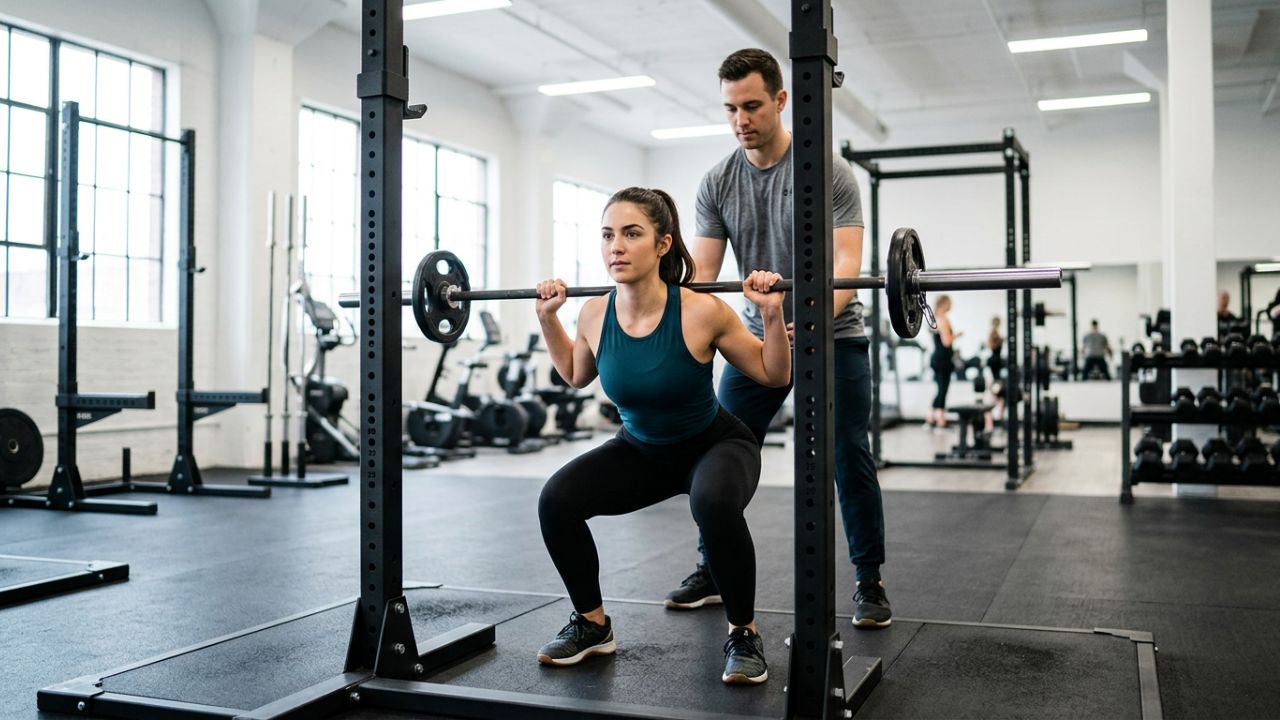
The barbell squat is the king of lower body exercises. It trains your quadriceps, glutes, hamstrings, core, and spinal erectors in a single movement. No other exercise builds total lower body strength as effectively.
How to perform it: Set up under the bar with it resting on your upper traps. Unrack, step back, and stand with feet shoulder-width apart, toes pointed slightly outward. Take a deep breath, brace your core, then push your hips back and bend your knees to lower yourself until your hip crease drops below your knee. Drive through your whole foot to stand back up.
Beginner tip: Start with just the barbell (45 lbs / 20 kg) or even goblet squats with a dumbbell. Depth and control matter far more than weight. For a complete breakdown, read our how to squat guide.
Bench Press
The barbell bench press is the primary upper body pushing exercise. It targets the chest, front delts, and triceps. Building a strong bench press creates a solid foundation for all pressing movements.
How to perform it: Lie on the bench with your eyes directly under the bar. Grip the bar slightly wider than shoulder width. Unrack, lower the bar to your mid-chest with control, lightly touch your chest, then press it back up to full lockout. Keep your feet flat on the floor and your shoulder blades pinched together throughout.
Beginner tip: Always use a spotter or set the safety pins in the rack so the bar cannot pin you. Start with just the bar and add weight gradually. Our detailed how to bench press guide covers every nuance of the movement.
Deadlift
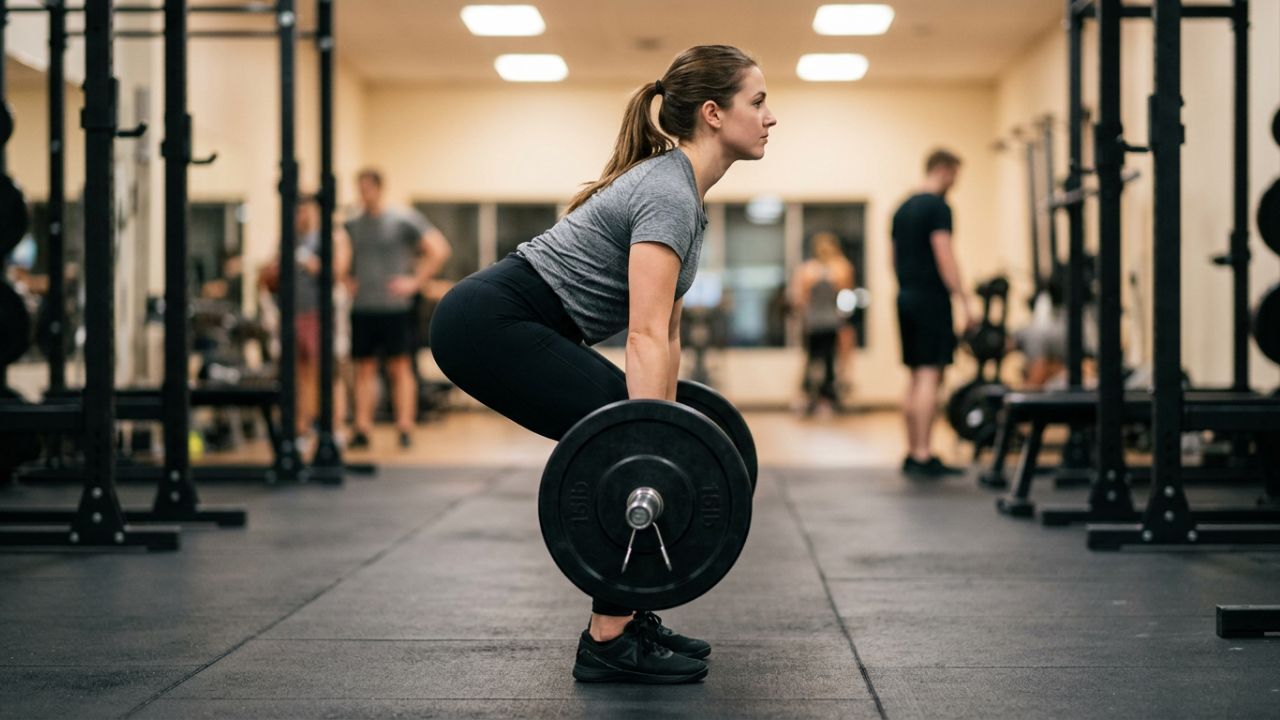
The barbell deadlift trains the entire posterior chain — hamstrings, glutes, spinal erectors, traps, and grip. It is the exercise where you will eventually move the most weight, and it builds a kind of total-body strength that nothing else replicates.
How to perform it: Stand with feet hip-width apart, the bar over your mid-foot. Hinge at the hips, bend your knees, and grip the bar just outside your shins. Flatten your back, brace your core, then drive through the floor to stand up, pulling the bar along your legs. Reverse the motion to lower it back down with control.
Beginner tip: The deadlift is not a squat. Your hips should be higher than your knees at the start position, and the movement is primarily a hip hinge. Focus on keeping your back flat — if it rounds, the weight is too heavy.
Overhead Press
The barbell overhead press (also called the military press) is the best exercise for building strong, well-developed shoulders. It also works the triceps, upper chest, and core.
How to perform it: Unrack the bar at shoulder height with a grip slightly wider than shoulder width. Take a breath, brace your core, and press the bar straight overhead until your arms are fully locked out. Move your head forward slightly as the bar passes your face so the bar travels in a straight line.
Beginner tip: The overhead press is the slowest lift to progress. Do not get frustrated when the weight on the bar increases in smaller increments than your squat or deadlift. This is completely normal — your shoulders are simply smaller muscles.
Barbell Row
The barbell bent-over row is the primary horizontal pulling exercise. It builds the lats, rhomboids, rear delts, biceps, and lower back. Strong rows create a thick, powerful back and balance out all the pressing you do.
How to perform it: Stand with feet shoulder-width apart, hinge at the hips until your torso is roughly 45 degrees to the floor. Grip the bar slightly wider than shoulder width. Pull the bar to your lower chest or upper abdomen, squeezing your shoulder blades together at the top. Lower with control.
Beginner tip: Avoid using momentum to "jerk" the bar up. If you have to heave the weight, it is too heavy. A controlled, smooth row with a full range of motion will build more muscle than a sloppy heavy one.
Pull-Up / Lat Pulldown
Pull-ups are the gold standard for vertical pulling — they train the lats, biceps, rear delts, and core. If you cannot do a pull-up yet (most beginners cannot), the lat pulldown is an excellent substitute that trains the same muscles.
How to perform it (lat pulldown): Sit with your thighs secured under the pads. Grip the bar wider than shoulder width. Pull the bar down to your upper chest, driving your elbows down and back. Return the bar with control — do not let it yank your arms up.
Beginner tip: Work toward your first bodyweight pull-up as a goal. Start with lat pulldowns, then progress to band-assisted pull-ups, negative (lowering-only) pull-ups, and eventually full pull-ups. It is one of the most satisfying milestones in strength training.
Dumbbell Lunge
The dumbbell lunge is a unilateral (single-leg) exercise that trains the quads, glutes, and hamstrings while improving balance and coordination. Lunges are important because they expose and correct strength imbalances between your left and right legs.
How to perform it: Hold a dumbbell in each hand at your sides. Step forward with one foot, lower your back knee toward the floor until both knees form roughly 90-degree angles, then push through your front foot to return to standing. Alternate legs each rep.
Beginner tip: If balance is an issue, start with stationary lunges (also called split squats) where your feet stay in a fixed split stance throughout the set. This removes the balance challenge and lets you focus on building strength.
Plank
The plank is a core stability exercise that trains the entire midsection — rectus abdominis, obliques, transverse abdominis, and lower back. A strong core is essential for safely performing every other exercise on this list.
How to perform it: Get into a push-up position but rest on your forearms instead of your hands. Your body should form a straight line from your head to your heels. Squeeze your glutes, brace your core, and hold this position. Do not let your hips sag or pike up.
Beginner tip: Start with 20-30 second holds and build up to 60 seconds. Once you can hold a plank for 60 seconds with good form, add difficulty by placing your feet on a slight elevation or adding a light weight plate on your back.
Your First 8-Week Beginner Program
This program uses a 3-day full-body split performed on non-consecutive days (e.g., Monday, Wednesday, Friday). You will alternate between two workouts — Workout A and Workout B — throughout the program.
The first four weeks focus on learning the movements with moderate weight and higher reps. The second four weeks increase intensity with heavier weights and introduce small progressions. If you want a program tailored to your specific equipment and schedule, try the free workout planner to generate one automatically.
Weeks 1-4 (Foundation Phase)
The goal of the foundation phase is learning proper form and building the work capacity to handle more volume later. Do not rush to add weight. If your form is solid at the end of a set, add 5 lbs to the bar next session for lower body exercises and 2.5 lbs for upper body exercises. If form breaks down, repeat the same weight.
Workout A
| Exercise | Sets | Reps | Rest |
|---|---|---|---|
| Barbell Squat | 3 | 10 | 2-3 min |
| Barbell Bench Press | 3 | 10 | 2-3 min |
| Barbell Bent-Over Row | 3 | 10 | 2-3 min |
| Dumbbell Lunge | 2 | 10 each leg | 90 sec |
| Front Plank | 3 | 30 sec hold | 60 sec |
Workout B
| Exercise | Sets | Reps | Rest |
|---|---|---|---|
| Barbell Deadlift | 3 | 8 | 2-3 min |
| Overhead Press | 3 | 10 | 2-3 min |
| Lat Pulldown | 3 | 10 | 2-3 min |
| Barbell Squat | 2 | 10 | 2-3 min |
| Front Plank | 3 | 30 sec hold | 60 sec |
Weekly schedule example:
- Week 1: Mon (A), Wed (B), Fri (A)
- Week 2: Mon (B), Wed (A), Fri (B)
- Continue alternating...
Weeks 5-8 (Progression Phase)
By now you should feel comfortable with the movement patterns. In the progression phase, we increase intensity by dropping reps slightly and adding weight, and we introduce an additional set on the main compound lifts.
Workout A
| Exercise | Sets | Reps | Rest |
|---|---|---|---|
| Barbell Squat | 4 | 8 | 2-3 min |
| Barbell Bench Press | 4 | 8 | 2-3 min |
| Barbell Bent-Over Row | 4 | 8 | 2-3 min |
| Dumbbell Lunge | 3 | 10 each leg | 90 sec |
| Front Plank | 3 | 45 sec hold | 60 sec |
Workout B
| Exercise | Sets | Reps | Rest |
|---|---|---|---|
| Barbell Deadlift | 4 | 6 | 3 min |
| Overhead Press | 4 | 8 | 2-3 min |
| Lat Pulldown | 4 | 8 | 2-3 min |
| Barbell Squat | 3 | 8 | 2-3 min |
| Front Plank | 3 | 45 sec hold | 60 sec |
Progression rules for weeks 5-8:
- Add 5 lbs to squat and deadlift each session when all reps are completed with good form.
- Add 2.5 lbs to bench press, overhead press, and rows each session.
- If you fail to complete all prescribed reps, repeat the same weight next session. If you fail twice at the same weight, deload by 10% and work back up.
For a broader look at beginner-friendly programming, see our beginner gym workout plan article.
Equipment You Need
One of the great things about beginner strength training is that you do not need much equipment. Here is what you actually need versus what is nice to have:
Essential:
- Barbell and weight plates — A standard Olympic barbell weighs 45 lbs (20 kg). Most gyms have these. If you are training at home, a barbell and a set of bumper plates is the single best investment you can make.
- Squat rack or power cage — You need a way to safely squat and bench press. A power cage with adjustable safety bars is ideal because it allows you to fail safely without a spotter.
- Flat bench — For bench pressing. Most squat racks can accommodate a bench.
- Flat-soled shoes — Avoid running shoes with cushioned, spongy soles. They compress under heavy loads and make you unstable. Flat shoes like Chuck Taylors, wrestling shoes, or dedicated lifting shoes provide a stable base.
Nice to have (but not required at first):
- Fractional plates (1.25 lb / 0.5 kg) — These allow 2.5 lb jumps instead of 5 lb jumps, which is essential for progressing upper body lifts.
- Lifting belt — Useful once your squat and deadlift get heavy. Not necessary for the first few months.
- Resistance bands — Great for warm-ups and for assisted pull-ups.
- Gym membership — If you do not want to invest in a home gym, a basic gym membership gives you access to everything you need for under $30-50 per month.
Common Beginner Mistakes
After coaching thousands of beginners, the same mistakes come up again and again. Avoiding these will save you months of wasted effort and reduce your injury risk significantly.
Ego lifting. This is the number one mistake. Using more weight than you can handle with proper form teaches your body bad movement patterns, limits muscle growth, and dramatically increases injury risk. Leave your ego at the door. Nobody in the gym cares how much weight is on your bar. They care about their own workout. Start light, nail your form, and let the strength come.
Program hopping. Switching programs every two weeks because you saw a new one on social media is a guaranteed way to make zero progress. Pick one program (like the one above) and follow it for the full 8 weeks before evaluating. Consistency with a mediocre program beats constantly switching between great programs.
Skipping legs. The temptation to focus on "mirror muscles" — chest, shoulders, arms — is real. But your legs contain the largest muscles in your body and are responsible for the majority of your total strength. Squat. Deadlift. Lunge. Every week, without exception.
Neglecting recovery. Training is the stimulus, but growth happens during recovery. Sleep 7-9 hours per night. Eat enough protein (0.7-1g per pound of body weight). Drink plenty of water. Manage stress. These basics are not glamorous, but they determine how fast you progress.
Not tracking workouts. If you do not record what you did last session, you cannot ensure progressive overload. You need to know that you squatted 135 lbs for 3x8 last Wednesday so you can try 140 lbs this Wednesday. Use a notebook or an app — download Load Muscle to track every set, rep, and weight automatically.
Overcomplicating things. You do not need 15 different exercises, fancy periodization schemes, or advanced techniques like drop sets and supersets. As a beginner, you need basic compound movements, progressive overload, consistency, and time. That is it. Simplicity is your superpower right now.
When to Move Beyond Beginner Programming
Beginner programming works as long as you can add weight to the bar every session (or at least every week). This is called linear progression, and it typically lasts 3-6 months depending on your age, genetics, nutrition, sleep, and training consistency.
You know it is time to move to an intermediate program when:
- You have stalled on the same weight for 2-3 sessions in a row on multiple lifts, even after deloading and working back up.
- You have been training consistently for at least 3-4 months.
- Your squat is approaching 1-1.25x body weight, your bench press is approaching 0.75-1x body weight, and your deadlift is approaching 1.25-1.5x body weight (these are rough benchmarks, not hard rules).
- You feel like sessions are becoming very difficult to recover from.
When you are ready to move on, intermediate programs introduce weekly progression instead of session-to-session progression, add more training volume, and use more sophisticated periodization. Options include upper/lower splits, push/pull/legs routines, or 4-day programs. Our workout routines page has dozens of intermediate templates to choose from.
The important thing is to not rush this transition. Milk your beginner gains for as long as possible. Linear progression is the most efficient path to strength, and leaving it too early means leaving free progress on the table.
How Load Muscle Builds Your Beginner Program
Building a proper beginner program requires balancing exercise selection, volume, frequency, and progression — and it needs to fit your schedule, equipment, and goals. That is exactly what Load Muscle does.
The free workout planner uses AI to generate a personalized beginner strength program based on your experience level, available equipment, training days, and goals. It selects the right compound movements, sets appropriate volume and intensity, and structures your week for optimal recovery.
As you progress, the app adapts with you. It tracks your weights and reps across sessions, identifies when you are ready to increase load, and adjusts programming as you advance from beginner to intermediate. No more guessing whether you should add weight or keep the same load — the app tells you.
Whether you are training at a fully equipped gym or in your garage with a barbell and rack, Load Muscle builds a program that fits your situation. Download the app and let it handle the programming so you can focus on what matters: showing up and putting in the work.
FAQ
How often should a beginner strength train?
Three days per week is ideal for beginners. This allows you to train each muscle group three times per week with full-body sessions while providing adequate rest days for recovery. A Monday-Wednesday-Friday schedule is the most common and effective approach.
Should I do cardio alongside strength training?
Yes, but keep it moderate and schedule it on separate days or after your strength sessions. Light cardio like walking, cycling, or swimming for 20-30 minutes on rest days supports recovery without interfering with strength gains. Avoid intense cardio sessions before lifting, as they will reduce your performance with the weights.
How much weight should I start with?
Start with just the barbell (45 lbs / 20 kg) or even lighter if needed. The first few sessions are about learning the movements, not testing your strength. If the empty barbell feels too heavy for any exercise, use dumbbells at a comfortable weight instead. There is no shame in starting light — it is the smartest thing you can do.
Do I need to take supplements?
No supplements are required for a beginner. Focus on eating a balanced diet with sufficient protein (0.7-1g per pound of body weight), sleeping 7-9 hours, and training consistently. Those three factors account for 95% of your results. Creatine monohydrate (5g per day) is the one supplement with strong evidence supporting improved strength and muscle gains, but it is optional, not essential.
How long until I see results from strength training?
Most beginners notice improved energy, better sleep, and increased strength within the first 2-3 weeks. Visible muscle changes typically appear after 6-8 weeks of consistent training with proper nutrition. Within 3-6 months of following a structured program, the physical changes become noticeable to others. Strength gains come faster than visible muscle growth, so trust the process even if the mirror has not caught up yet.