The bench press is the most popular exercise in any gym, and also one of the most butchered. Walk into any commercial gym on a Monday evening and you will see bounced reps, flared elbows, half range of motion, and bar paths that look like abstract art.
Learning how to bench press with proper form is not complicated, but it requires attention to setup details that most lifters skip. Grip width, foot position, back arch, bar path, and breathing all matter. Get them right, and the bench press becomes a safe, effective chest and upper body builder. Get them wrong, and you are asking for shoulder pain and stalled progress.
This guide walks you through every step, common mistakes, key variations, and programming for both strength and muscle growth.
TL;DR
- The bench press is a compound lift that primarily targets the chest, front delts, and triceps.
- Setup is everything: retract your shoulder blades, plant your feet, maintain a natural arch, and grip the bar at about 1.5x shoulder width.
- Bar path: the bar should touch your mid-to-lower chest and press up in a slight arc back toward your face — not straight up.
- Common mistakes: flaring elbows to 90 degrees, bouncing the bar, flat back, and inconsistent grip width.
- Use the free workout planner to build a program that includes bench press with proper progression.
Why the Bench Press Matters
The bench press is one of the three powerlifting competition lifts, a staple in every bodybuilding program, and the single most asked question in gym culture: "How much do you bench?"
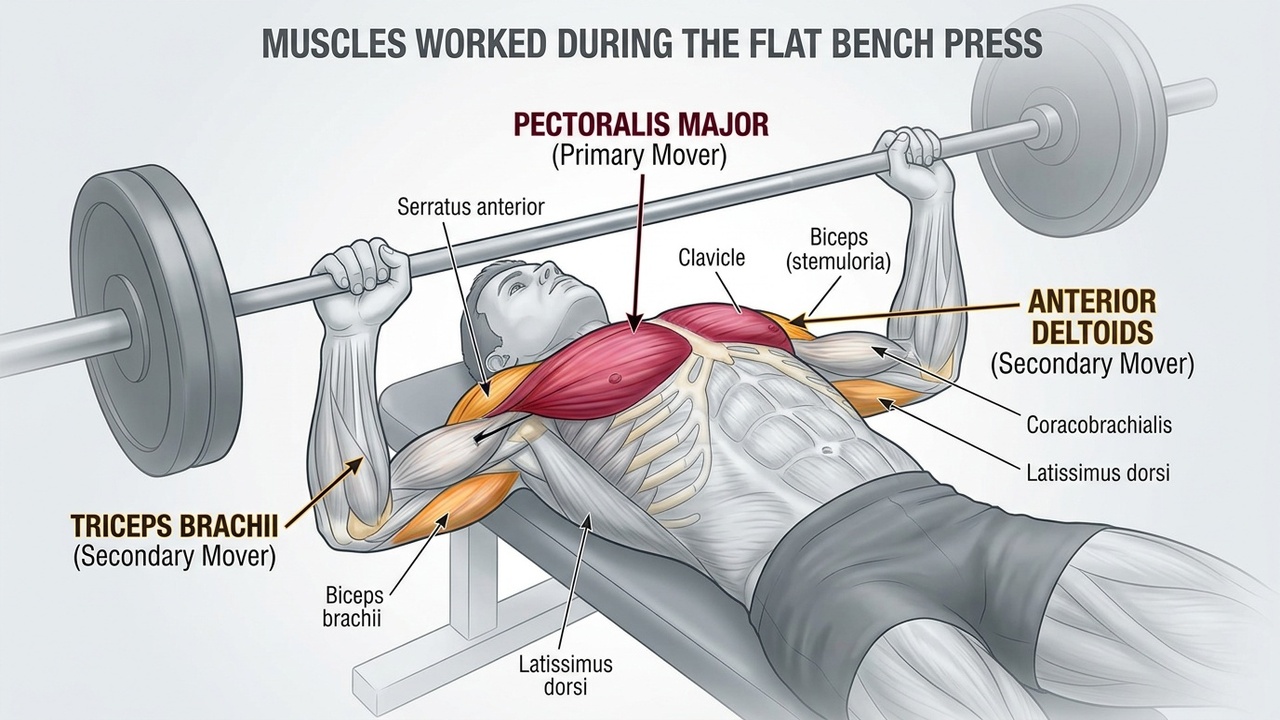
Beyond ego, the bench press is a highly effective upper body compound movement. It trains the pectoralis major (chest), anterior deltoids (front shoulders), and triceps brachii simultaneously under heavy load. Few exercises allow you to load the upper body pushing muscles as heavily.
For strength athletes, the bench press is a competition lift and a direct measure of upper body pressing power. For bodybuilders, it is a foundation for chest development. For general fitness, it builds functional pressing strength that transfers to pushing movements in daily life and sports.
It also responds extremely well to progressive overload — small, consistent weight increases over months produce dramatic strength gains.
Muscles Worked in the Bench Press
Understanding which muscles the bench press targets helps you cue the movement correctly and identify weak points.
Primary movers:
- Pectoralis major (chest): The main driver of the bench press. Both the sternal (lower) and clavicular (upper) portions contribute, with emphasis shifting based on bench angle.
- Anterior deltoid (front shoulder): Assists the chest in shoulder flexion during the press.
- Triceps brachii: Responsible for locking out the elbows at the top of the movement. Tricep weakness is the most common reason lifters fail at lockout.
Secondary/stabilizer muscles:
- Rotator cuff muscles (shoulder stability)
- Serratus anterior (shoulder blade stability)
- Core (maintaining arch and rigidity)
- Lats (controlling the bar during the descent)
The bench press is a best compound exercise precisely because it recruits so many upper body muscles in a single movement.
Step-by-Step Bench Press Form
Step 1 -- Setup and Positioning
Proper setup is the most overlooked aspect of the bench press, and it determines everything that follows.
Lie on the bench with your eyes directly under the barbell. Plant your feet flat on the floor, pushing them slightly back toward your hips. This creates tension in your legs that transfers through your body to the bar.
Retract your shoulder blades. Pull them together and down, like you are trying to put them in your back pockets. This creates a stable shelf for your upper back, protects your shoulders, and increases the range of motion at your chest. Your shoulder blades should stay retracted throughout the entire set.
Maintain a natural arch in your lower back. This is not an exaggerated powerlifting arch (unless you are a competitive powerlifter) — it is the natural curve of your spine. Your upper back and glutes stay in contact with the bench. The arch keeps your shoulders in a safer position and allows your chest to do more work.
Step 2 -- Grip Width
Grip the bar at approximately 1.5 times your shoulder width. For most people, this means your ring fingers or pinky fingers line up with the knurling rings on a standard barbell.
A grip that is too narrow shifts the work to your triceps and reduces chest involvement. A grip that is too wide increases the stretch on your shoulder joints and reduces the range of motion.
The right grip width allows your forearms to be vertical (perpendicular to the floor) when the bar touches your chest. If your forearms angle inward or outward at the bottom, adjust your grip.
Grip the bar with a full grip (thumb wrapped around the bar), not a thumbless "suicide" grip. The full grip prevents the bar from rolling out of your hands.
Step 3 -- Unracking the Bar
With your setup locked in (shoulder blades retracted, feet planted, arch maintained), press the bar off the hooks by straightening your arms. Do not shrug your shoulders forward to unrack — this undoes your shoulder blade retraction.
Lock the bar out directly above your shoulder joint, not above your face or chest. This is your starting position. Take a breath and brace before beginning the descent.
If you train alone and struggle with unracking, ask for a liftoff or adjust the hook height. A difficult unrack can ruin your setup for the entire set.
Step 4 -- The Descent (Eccentric)
Lower the bar under control to your mid-to-lower chest, roughly at nipple level. The exact touch point depends on your build and grip width, but it should never be at your neck or your stomach.
The bar should not descend in a straight vertical line. It follows a slight diagonal path from above your shoulders down to your mid-chest. This diagonal path is natural and keeps the bar balanced over your base of support.
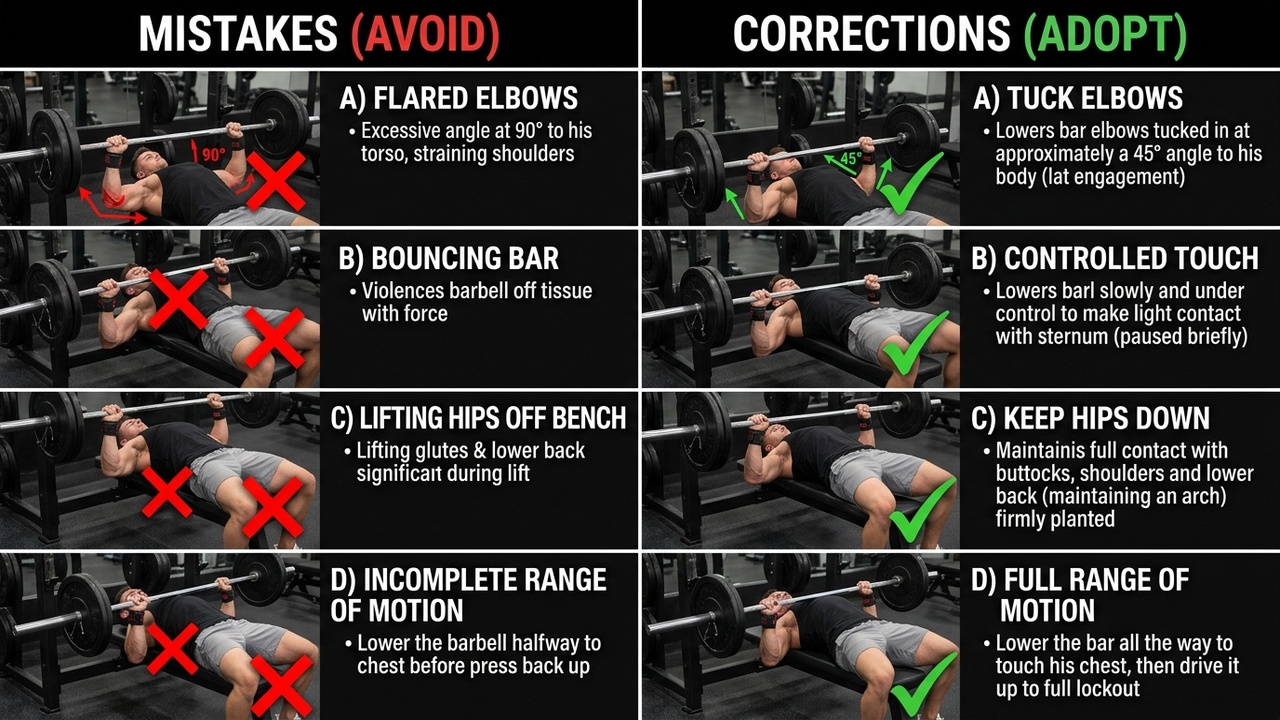
Elbow angle: Tuck your elbows to approximately 45-75 degrees relative to your torso. This is not flared out at 90 degrees (shoulder destroyer) and not tucked tight to your sides (tricep press). Think of making an arrow shape with your body, not a T.
Control the descent for about 2 seconds. Do not drop the bar or let it free-fall.
Step 5 -- The Press (Concentric)
Once the bar touches your chest (light touch, not a bounce), drive it up and slightly back toward the rack. The bar path on the way up is a slight arc, ending above your shoulders — not a straight vertical press from your chest.
Think of pressing yourself into the bench rather than pushing the bar away from you. This cue helps maintain your setup and engages your legs through leg drive.
The lockout should be complete — arms fully extended with elbows locked. Do not stop short of full lockout, and do not hyperextend or shrug your shoulders at the top.
Step 6 -- Breathing and Bracing
Breathe in at the top of the movement before you lower the bar. Fill your abdomen with air (not just your chest) and brace your core as if someone is about to punch you in the stomach. This creates intra-abdominal pressure that stabilizes your entire torso.
Hold your breath during the descent and through the sticking point of the press (usually when the bar is a few inches off your chest).
Exhale as you pass the sticking point or at lockout. Then take another breath at the top before the next rep.
This breathing pattern (called the Valsalva maneuver) is critical for heavy bench pressing. Breathing during the rep dissipates tension and makes the lift harder and less stable.
Common Bench Press Mistakes
Flaring Elbows Too Wide
When your elbows flare out to 90 degrees, forming a T shape with your body, all the stress shifts to your shoulder joint. This is the most common cause of bench press shoulder pain and impingement.
Fix: Tuck your elbows to 45-75 degrees. Think "arrow, not T." You should feel the work in your chest and triceps, not grinding in your shoulders.
Bouncing the Bar Off Your Chest
Bouncing the bar off your chest is cheating, and it is dangerous. The bounce uses the elastic rebound of your ribcage instead of muscle contraction, and it puts your sternum and ribs at risk.
Fix: Touch the bar to your chest with a brief pause. The bar should touch — not slam, not hover an inch above. A light touch ensures you are using muscle, not momentum.
Flat Back (No Arch)
Pressing with a completely flat back puts your shoulders in a vulnerable position by allowing them to roll forward under load. It also reduces the range of motion and chest engagement.
Fix: Maintain a natural arch. Your upper back and glutes stay on the bench. The arch comes from your thoracic spine, not your lower back. Even a small arch makes a significant difference in shoulder safety.
Uneven Lockout
If one arm locks out before the other, you have a strength imbalance or a setup issue. This becomes dangerous at heavy weights when the bar tilts.
Fix: Practice with moderate weight, focusing on pressing both arms evenly. Use dumbbell bench press to identify and correct left-right imbalances. If the issue persists, it may be a setup problem — check that you are centered on the bench.
Bench Press Variations
Incline Bench Press
Set the bench to 30-45 degrees. The incline shifts emphasis to the upper chest (clavicular head of the pec major) and front delts. Use a slightly narrower grip than flat bench and touch the bar to your upper chest, just below your collarbone. View the incline bench press.
The incline bench press is the best compound exercise for upper chest development and should be a staple in any chest-focused program.
Close-Grip Bench Press
Use a grip about shoulder width or slightly narrower. This shifts the primary workload to the triceps while still training the chest. The close-grip bench press is one of the best tricep builders available and doubles as an excellent bench press accessory for improving lockout strength.
Dumbbell Bench Press
Dumbbells allow a greater range of motion and independent arm movement. Each arm works independently, which helps correct strength imbalances. The stretch at the bottom is deeper than with a barbell, and you can rotate your wrists for a more natural pressing angle. View the dumbbell bench press. Read our dumbbell chest workout guide for complete dumbbell pressing routines.
Floor Press
Lie on the floor instead of a bench and press from the ground. Your upper arms contact the floor at the bottom, limiting the range of motion. This eliminates the stretch reflex and overloads the lockout portion of the bench press. Excellent for lifters who struggle with the top half of the lift.
Bench Press Programming for Strength
If your goal is to increase your bench press one-rep max, focus on lower rep ranges with heavier weight:
| Week | Sets x Reps | Intensity (%1RM) |
|---|---|---|
| 1 | 5 x 5 | 75% |
| 2 | 5 x 4 | 80% |
| 3 | 5 x 3 | 85% |
| 4 | Deload: 3 x 5 | 65% |
Progress by adding 2.5 kg (5 lbs) to your working weight each cycle. Rest 3-5 minutes between sets for full recovery. Supplement with close-grip bench press and overhead pressing for accessory work.
Bench Press Programming for Hypertrophy
For chest growth, use moderate weight with higher volume:
| Exercise | Sets x Reps | Rest |
|---|---|---|
| Flat Barbell Bench Press | 4 x 8-10 | 2-3 min |
| Incline Dumbbell Press | 3 x 10-12 | 2 min |
| Cable Fly | 3 x 12-15 | 90 sec |
| Push-Ups (to failure) | 2 sets | 60 sec |
The bench press serves as your heavy compound movement, followed by accessory work that targets the chest from different angles. For more chest exercises, check out the 15 most effective chest exercises.
How to Increase Your Bench Press
Plateaus happen. Here are the most effective strategies to break through them:
Get your bodyweight up. More muscle mass supports more strength. If you have been dieting and your bench is stalled, gaining a few pounds will likely help.
Increase training frequency. Bench pressing 2-3 times per week (with varying intensity) exposes the movement pattern to more practice and more volume than benching once per week.
Address weak points. If you fail at lockout, add close-grip bench press and tricep work. If you fail off the chest, add paused bench press and more chest volume. If you fail in the mid-range, add pin press or board press.
Improve your setup. Many lifters leave pounds on the bar by benching with a poor setup. Retract your shoulder blades harder, arch more, plant your feet, and use leg drive. Setup improvements produce instant strength gains.
Be patient with progression. Adding 2.5 kg to your bench every month is 30 kg per year. That is significant. Small, consistent progress beats chasing massive jumps.
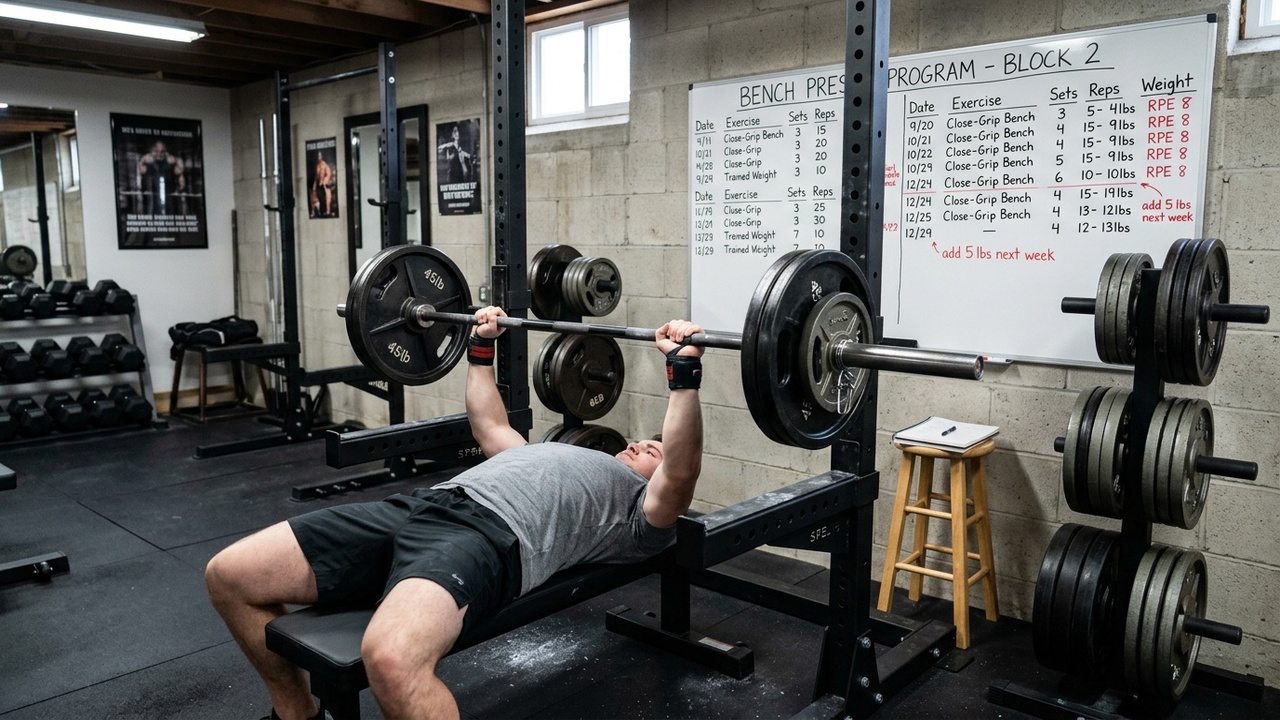
Build a program designed to increase your bench press using the free workout planner, or find bench press in our exercise library for detailed video demonstrations. Download Load Muscle to track your bench press progress over time.
FAQ
How wide should my grip be for bench press?
Grip the bar at approximately 1.5 times your shoulder width. Your forearms should be vertical when the bar touches your chest. For most lifters, this means the ring finger or pinky lines up with the knurling rings. A grip that is too wide stresses your shoulders, and a grip that is too narrow turns it into a tricep exercise.
Should I arch my back when bench pressing?
Yes, maintain a natural arch in your thoracic spine. This is not an extreme powerlifting arch — it is the natural curvature of your spine that protects your shoulders and increases chest engagement. Your upper back and glutes should stay in contact with the bench at all times.
How often should I bench press?
Most lifters benefit from bench pressing 2-3 times per week with varying intensity. One heavy day (3-5 reps), one moderate day (6-10 reps), and optionally one light day (10-15 reps or a variation). Higher frequency provides more practice and volume for faster progress.
Why does my shoulder hurt when I bench press?
Shoulder pain during bench pressing is almost always caused by one of three issues: flared elbows (fix by tucking to 45-75 degrees), flat back (fix by retracting shoulder blades and maintaining an arch), or excessive weight (reduce load and fix form first). If pain persists after correcting form, see a sports medicine professional.
Is bench press enough for chest development?
The bench press is an excellent chest builder but not sufficient alone for complete chest development. The flat bench emphasizes the mid-to-lower chest. Add incline pressing for upper chest and cable flies or dumbbell flies for isolation work. A well-rounded program includes 2-3 chest exercises from different angles.
How much should I be able to bench press?
Strength standards vary by body weight, age, and training experience. General benchmarks for adult males: bodyweight bench press is intermediate, 1.5x bodyweight is advanced, and 2x bodyweight is elite. For females, 0.5x bodyweight is intermediate, 0.75x is advanced, and 1x is elite. Focus on progressive improvement rather than arbitrary numbers.
Ready to grow your bench? Run it inside a structured plan from our strength workout routines.