If you are over 40 and looking for a workout plan that actually fits your body, your schedule, and your goals, you are in the right place. Training after 40 is not about slowing down or giving up on strength. It is about training smarter so you can keep building muscle, stay lean, protect your joints, and feel better than you did at 30.
The reality is that a well-designed workout plan for men over 40 can deliver impressive results. You can absolutely build muscle, increase strength, and transform your physique at this stage of life. The key is understanding how your body has changed and programming accordingly. That means prioritizing joint health, managing recovery, warming up properly, and choosing exercises that give you the most benefit with the least wear and tear.
This guide gives you everything you need: the science behind training after 40, complete workout plans you can start this week, exercise recommendations, recovery strategies, and practical tips for long-term progress. Please consult a healthcare professional before starting any new exercise program, especially if you have been inactive or have pre-existing health conditions.
TL;DR
- Training after 40 requires adjustments to volume, intensity, and exercise selection, but you can absolutely build muscle and strength at any age.
- Focus on compound movements with controlled tempos, proper warm-ups, and adequate mobility work.
- Follow a 4-day upper/lower split or a 3-day full body program depending on your schedule and recovery capacity.
- Prioritize joint health and recovery — sleep, nutrition, and deload weeks matter more than ever.
- Use the free workout planner to generate a personalized program tailored to your fitness level.
Why Training Changes After 40
Your body at 40 is not the same body you had at 25. That is not a limitation — it is simply a fact that should inform how you train. Understanding these changes helps you design a program that works with your physiology instead of against it.
Hormonal Changes
Testosterone levels in men begin to decline gradually around age 30, dropping roughly 1-2% per year. By the time you reach 40, this cumulative decline can affect muscle protein synthesis, recovery speed, and body composition. You may notice it takes a bit longer to recover from hard sessions and that staying lean requires more effort than it used to.
The good news is that resistance training is one of the most effective ways to support healthy testosterone levels naturally. Heavy compound lifts, adequate sleep, and proper nutrition all contribute to maintaining hormonal health. You do not need to accept decline as inevitable — consistent strength training significantly slows and can partially reverse age-related muscle loss.
Growth hormone output also decreases with age, which affects your ability to recover and build new tissue. This is why recovery strategies that you could ignore in your 20s — sleep quality, stress management, nutrition timing — become non-negotiable after 40.
Joint and Tendon Considerations
This is where the biggest practical changes happen. After decades of use, your joints have accumulated wear. Cartilage thins, synovial fluid production decreases, and tendons lose some of their elasticity. You may notice stiffness in the morning, aching knees after heavy squats, or shoulder discomfort during pressing movements.
None of this means you cannot train hard. It means you need to warm up thoroughly, choose joint-friendly exercise variations, and pay attention to pain signals rather than pushing through them. A little discomfort during a warm-up set that fades as you get moving is normal. Sharp pain that gets worse as you continue is a warning sign.
Tendon adaptation also happens more slowly than muscle adaptation as you age. Your muscles might be ready to handle heavier loads before your tendons are. This is why gradual progressive overload is especially important after 40 — give your connective tissue time to catch up with your muscular strength.
Recovery Capacity
Recovery is the single biggest difference between training at 25 and training at 45. Your muscles still respond to the same stimulus — progressive resistance — but they take longer to repair and rebuild. A training session that left you slightly sore for a day in your 20s might leave you sore for two or three days now.
This does not mean you need to train less frequently. It means you need to manage training stress more carefully. That involves controlling volume (total sets per workout), intensity (how close you train to failure), and ensuring you are prioritizing sleep and nutrition. For a deeper dive into optimizing your time between sessions, read our rest days and recovery guide.
The athletes who stay strong into their 50s, 60s, and beyond are not the ones who trained the hardest every single day. They are the ones who trained consistently, recovered well, and avoided injuries that forced them to stop.

Training Principles for Men Over 40
Before jumping into the specific workout plan for men over 40, let us establish the principles that should guide every training decision you make. These principles separate a program that builds you up from one that breaks you down.
Prioritize Compound Movements
Compound exercises — movements that work multiple joints and muscle groups simultaneously — should form the foundation of your training. Squats, deadlifts, presses, rows, and pull-ups give you the most muscle-building stimulus per exercise, which is important when you want to keep total training volume manageable.
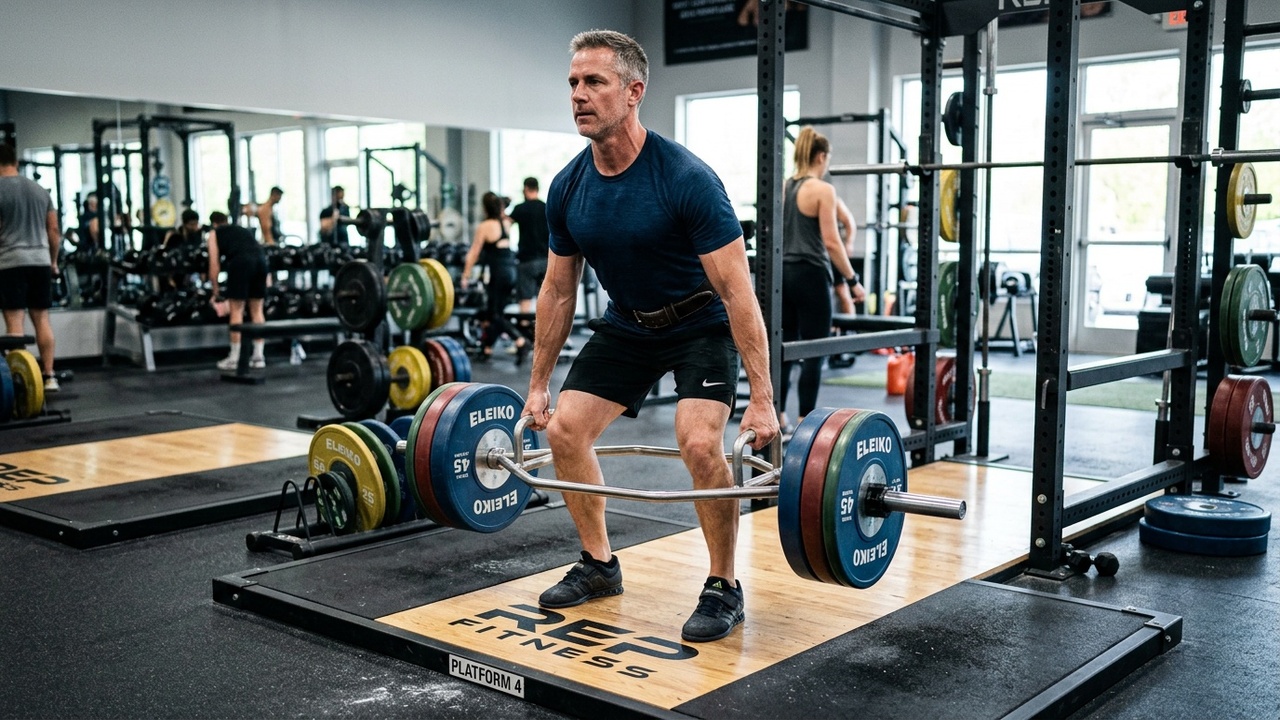
Compound movements are also more functional than isolation exercises. They train your body to work as a coordinated unit, which translates directly to real-life activities like carrying heavy objects, playing sports, or keeping up with your kids. That said, you do not need to perform the most aggressive version of every compound lift. A trap bar deadlift is just as effective as a conventional deadlift with far less lower back stress. A dumbbell bench press may be kinder to your shoulders than a barbell version. Choose the variation that lets you train hard without joint pain.
Warm Up Properly
If you are over 40 and still walking into the gym and immediately loading the bar, you are asking for trouble. A proper warm-up is no longer optional — it is essential for performance and injury prevention.
Start with 5-10 minutes of light cardio to raise your core temperature and increase blood flow to your muscles. Follow that with dynamic stretches and mobility drills targeting the joints you are about to train. Then perform 2-3 progressively heavier warm-up sets before your working weight. Your stretching and mobility routine should be treated with the same importance as the main workout itself.
A good warm-up adds 10-15 minutes to your session. That investment pays for itself many times over in injury prevention, better performance during your working sets, and reduced post-workout soreness.
Manage Volume and Intensity
Volume (total sets and reps) and intensity (how heavy you lift relative to your max) are the two primary training variables to manage. After 40, the sweet spot shifts slightly compared to your younger years.
Volume: Aim for 10-16 hard sets per muscle group per week. This is enough to stimulate growth without exceeding your recovery capacity. If you are coming back to training after a break, start at the lower end (8-10 sets per muscle group) and increase gradually over several weeks.
Intensity: Train most sets to within 2-3 reps of failure rather than to absolute failure. Going to failure on every set dramatically increases recovery demands and injury risk. Save true failure for the last set of isolation exercises, not for heavy compound lifts.
Rep ranges: A mix of moderate (8-12 reps) and higher (12-15 reps) rep ranges tends to work best for men over 40. You can still include lower rep strength work (5-6 reps) on compound lifts, but limit this to 1-2 exercises per session and keep form strict.
Include Mobility Work
Mobility is not the same as flexibility. Flexibility is the ability to reach a position passively. Mobility is the ability to actively control your body through a full range of motion under load. Both matter, but mobility is more directly relevant to your training.
Dedicate 10-15 minutes after each session to mobility work targeting your hips, thoracic spine, shoulders, and ankles. These areas tend to tighten with age and desk-bound lifestyles, and restricted mobility in any of them will limit your exercise performance and increase injury risk.
Yoga, foam rolling, and targeted mobility drills all work. The best approach is the one you will actually do consistently. Even 5 minutes of hip and shoulder mobility after every session is better than a 30-minute routine you skip because you are in a hurry.
4-Day Workout Plan for Men Over 40
This is the core workout plan for men over 40 who can train four days per week. It follows an upper/lower split with each muscle group trained twice per week. Rest days are built in for recovery. Keep rest periods consistent and control the tempo on every rep — a 2-second lowering phase on each exercise protects your joints and increases time under tension.
Day 1 -- Upper Body Push
| Exercise | Sets | Reps | Rest |
|---|---|---|---|
| Dumbbell Bench Press | 4 | 8-10 | 90 sec |
| Incline Dumbbell Press | 3 | 10-12 | 90 sec |
| Seated Overhead Press (Dumbbells) | 3 | 10-12 | 90 sec |
| Cable Lateral Raises | 3 | 12-15 | 60 sec |
| Tricep Rope Pushdowns | 3 | 12-15 | 60 sec |
| Overhead Tricep Extension (Cable) | 2 | 12-15 | 60 sec |
Notes: Dumbbell presses allow a more natural range of motion than barbell variations, reducing shoulder stress. If overhead pressing bothers your shoulders, substitute a high-incline press (about 60-70 degrees) instead.
Day 2 -- Lower Body
| Exercise | Sets | Reps | Rest |
|---|---|---|---|
| Goblet Squat or Leg Press | 4 | 8-10 | 2 min |
| Romanian Deadlift | 3 | 10-12 | 90 sec |
| Walking Lunges | 3 | 10 each leg | 90 sec |
| Leg Curl (Machine) | 3 | 12-15 | 60 sec |
| Calf Raises (Seated or Standing) | 3 | 15-20 | 60 sec |
| Plank (Weighted if needed) | 3 | 30-45 sec | 60 sec |
Notes: The goblet squat is an excellent alternative to barbell back squats for lifters with knee or lower back concerns. If you can back squat pain-free, a barbell squat works well here too. Romanian deadlifts target the hamstrings and glutes with less spinal loading than conventional deadlifts.
Day 3 -- Upper Body Pull
| Exercise | Sets | Reps | Rest |
|---|---|---|---|
| Lat Pulldown or Pull-Ups | 4 | 8-10 | 90 sec |
| Seated Cable Row | 3 | 10-12 | 90 sec |
| Chest-Supported Dumbbell Row | 3 | 10-12 | 90 sec |
| Face Pulls | 3 | 15-20 | 60 sec |
| Dumbbell Bicep Curls | 3 | 10-12 | 60 sec |
| Hammer Curls | 2 | 12-15 | 60 sec |
Notes: Chest-supported rows remove lower back stress entirely while still training the lats and mid-back effectively. Face pulls are essential for shoulder health — they strengthen the rear delts and rotator cuff, counteracting the forward-rounded posture many men develop with age and desk work.
Day 4 -- Full Body / Conditioning
| Exercise | Sets | Reps | Rest |
|---|---|---|---|
| Trap Bar Deadlift | 4 | 6-8 | 2 min |
| Dumbbell Floor Press | 3 | 10-12 | 90 sec |
| Bulgarian Split Squat | 3 | 10 each leg | 90 sec |
| Single-Arm Cable Row | 3 | 10-12 each | 60 sec |
| Farmer's Walk | 3 | 40-50 meters | 90 sec |
| Dead Bug | 3 | 10 each side | 60 sec |
Notes: Day 4 combines strength and conditioning. The trap bar deadlift is one of the best overall exercises for men over 40 — it trains the entire posterior chain with a more joint-friendly pulling position than conventional deadlifts. Farmer's walks build grip strength, core stability, and conditioning simultaneously.
Weekly schedule example: Monday (Day 1), Tuesday (Day 2), Thursday (Day 3), Friday (Day 4). Wednesday, Saturday, and Sunday are rest or light activity days.
3-Day Full Body Alternative
If four training days feels like too much for your schedule or recovery, a 3-day full body program is an excellent alternative. Full body training has been shown to produce equivalent muscle growth to split routines when total weekly volume is matched. This format works especially well for men over 40 because it spreads the training stimulus across the week with more recovery days built in.
Train on Monday, Wednesday, and Friday (or any three non-consecutive days). Alternate between Workout A and Workout B each session.
Workout A:
| Exercise | Sets | Reps | Rest |
|---|---|---|---|
| Barbell Squat or Goblet Squat | 3 | 8-10 | 2 min |
| Dumbbell Bench Press | 3 | 8-10 | 90 sec |
| Barbell Row or Cable Row | 3 | 10-12 | 90 sec |
| Romanian Deadlift | 3 | 10-12 | 90 sec |
| Face Pulls | 2 | 15-20 | 60 sec |
Workout B:
| Exercise | Sets | Reps | Rest |
|---|---|---|---|
| Trap Bar Deadlift | 3 | 6-8 | 2 min |
| Overhead Press (Dumbbells) | 3 | 8-10 | 90 sec |
| Lat Pulldown or Pull-Ups | 3 | 8-10 | 90 sec |
| Leg Press or Lunges | 3 | 10-12 | 90 sec |
| Plank | 2 | 30-45 sec | 60 sec |
This gives you 6-9 sets per muscle group per week, which falls within the evidence-based range for hypertrophy. If you want to build a custom program tailored to your available equipment and schedule, the free workout planner can generate one in seconds. For those new to strength training entirely, our beginner strength training guide covers the foundational concepts in more detail.
Best Exercises for Men Over 40
Not all exercises are created equal when longevity and joint health are priorities. Here are the exercises that deliver the best results with the most favorable risk-to-reward ratio for men over 40.
Trap Bar Deadlift. The best overall strength exercise for older lifters. The neutral grip and more upright torso position reduce stress on the lower back and shoulders compared to a conventional barbell deadlift. It trains the quads, glutes, hamstrings, back, and grip in a single movement.
Dumbbell Bench Press. Dumbbells allow your shoulders to rotate naturally through the pressing motion, which reduces impingement risk. You also get a deeper stretch at the bottom and can adjust your grip angle to whatever feels most comfortable.
Goblet Squat. The front-loaded position encourages an upright torso, which is easier on the lower back than a barbell back squat. Goblet squats also serve as a built-in mobility exercise — holding the weight in front forces your thoracic spine to stay extended.
Romanian Deadlift. Targets the hamstrings and glutes with controlled eccentrics, building posterior chain strength and flexibility simultaneously. The partial range of motion is easier on the lower back than pulling from the floor.
Face Pulls. A non-negotiable exercise for shoulder health. They strengthen the external rotators and rear delts, which are chronically weak in most men and are essential for pain-free pressing.
Farmer's Walks. Build grip strength (which declines significantly with age), core stability, and cardiovascular conditioning. They also train postural muscles and are virtually impossible to perform with bad form.
Bulgarian Split Squats. Single-leg training corrects strength imbalances, improves balance, and reduces total spinal loading compared to bilateral squats. They are hard, but they are among the most effective lower body exercises available.
Explore our full exercise library to find variations that suit your equipment and comfort level.
Exercises to Approach with Caution
These exercises are not inherently dangerous, but they carry a higher risk-to-reward ratio for men over 40, especially those with pre-existing joint issues. If you can perform them pain-free with good form, there is no reason to avoid them entirely. But if they cause discomfort, swap them for the alternatives listed.
Behind-the-neck press. Places the shoulder in an externally rotated, abducted, and loaded position — a recipe for impingement. Substitute with a standard seated overhead press or a landmine press.
Heavy barbell back squats. The compressive loading on the spine and the mobility demands on the hips, knees, and ankles make this exercise problematic for many older lifters. Goblet squats, leg press, or front squats are effective alternatives.
Conventional barbell deadlift from the floor. The hip hinge mobility required and the lower back stress can be issues. A trap bar deadlift or rack pull from knee height provides the same stimulus with less risk.
Upright rows. This movement internally rotates the shoulder under load, which can irritate the supraspinatus tendon. Cable lateral raises and face pulls train the same muscles more safely.
Skull crushers. Heavy elbow loading in a stretched position can aggravate elbow tendonitis, which becomes increasingly common after 40. Cable pushdowns and overhead cable extensions are gentler alternatives.
The point is not to fear these exercises. It is to have smart alternatives ready so that a minor joint issue does not derail your entire training program.
Recovery and Nutrition After 40
Training provides the stimulus for muscle growth, but recovery is where growth actually happens. After 40, recovery is your biggest competitive advantage — the lifters who prioritize it progress faster and stay healthier long-term.
Sleep. Aim for 7-9 hours of quality sleep per night. Growth hormone is released primarily during deep sleep, and sleep deprivation directly impairs muscle protein synthesis and increases cortisol. If your training is on point but your results are stalling, poor sleep is the most likely culprit.
Protein intake. Men over 40 need more protein per meal to maximize muscle protein synthesis compared to younger men. This is called "anabolic resistance" — your muscles need a stronger protein signal to initiate the repair process. Aim for 1.6-2.2 grams of protein per kilogram of body weight per day, spread across 3-4 meals with at least 30-40 grams per serving.
Hydration. Joint cartilage is roughly 80% water. Chronic mild dehydration — which is common in older adults — reduces joint lubrication and increases stiffness. Drink enough water throughout the day that your urine is pale yellow.
Deload weeks. Every 4-6 weeks, reduce your training volume and intensity by 40-50% for a full week. Deloads allow your joints, tendons, and nervous system to fully recover, and most lifters find they come back stronger after a deload. Skipping deloads is a mistake many experienced lifters make, and it catches up with you faster after 40.
Anti-inflammatory nutrition. Include omega-3 fatty acids (fatty fish, fish oil), fruits, vegetables, and whole grains in your diet. Chronic low-grade inflammation increases with age and contributes to joint pain and slower recovery. A diet rich in whole foods helps keep inflammation in check.
Cardio Recommendations
Cardiovascular health becomes increasingly important after 40. Heart disease risk rises with age, and regular cardio exercise is one of the strongest protective factors. The good news is that you do not need to become a marathon runner — moderate, consistent cardio alongside your strength training is enough.
Low-intensity steady state (LISS): 2-3 sessions per week of 20-30 minutes. Walking, cycling, swimming, or elliptical at a pace where you can hold a conversation. LISS improves cardiovascular health, aids recovery from strength training, and is easy on the joints.
High-intensity interval training (HIIT): 1-2 sessions per week maximum. Short bursts of hard effort (20-30 seconds) followed by recovery periods (60-90 seconds). HIIT is time-efficient and highly effective for cardiovascular fitness, but it is also demanding on your recovery. Keep HIIT sessions separate from your leg training days by at least 24 hours.
Daily movement. Aim for 7,000-10,000 steps per day on top of your structured exercise. Daily walking is one of the most underrated health interventions — it improves cardiovascular health, aids digestion, reduces stress, and supports recovery without adding training fatigue.
The combination of strength training and regular cardiovascular exercise is the most powerful health intervention available to men over 40. It reduces risk of heart disease, type 2 diabetes, certain cancers, and all-cause mortality. Browse our workout routines to find programs that integrate strength and conditioning effectively.

Build Your Over-40 Plan with Load Muscle
A workout plan for men over 40 does not need to be complicated. It needs to be consistent, progressive, and adapted to your body. The programs in this guide give you a proven framework, but the best plan is one that is customized to your specific goals, equipment, and fitness level.
Load Muscle makes that process simple. Our free workout planner generates a personalized training program based on your experience level, available equipment, and training preferences. It selects exercises that match your needs and structures them into a balanced weekly program you can follow immediately.
You can also explore our library of workout routines for ready-made programs across every training split and goal. Whether you prefer a 3-day full body program, a 4-day upper/lower split, or something more specialized, you will find a structured plan that fits.
Training after 40 is not about limitations. It is about training with purpose, recovering with intention, and staying in the game for decades to come. Start with the plan above, adjust as you learn what your body responds to, and stay consistent. The results will follow.
FAQ
Is it safe to lift heavy weights after 40? Yes, lifting heavy is safe and beneficial for men over 40, provided you use proper form, warm up thoroughly, and progress gradually. Heavy compound movements support bone density, hormonal health, and functional strength. The key is to increase loads slowly and listen to your body — avoid pushing through sharp pain.
How many days per week should a man over 40 work out? Three to four days of strength training per week is ideal for most men over 40. This frequency provides enough stimulus for muscle growth while allowing adequate recovery between sessions. If you are new to training or returning after a long break, start with three days and add a fourth once you are recovering well.
Can you still build muscle after 40? Absolutely. Research consistently shows that men can build significant muscle mass well into their 40s, 50s, 60s, and beyond. The rate of muscle gain may be slightly slower than in your 20s due to hormonal changes and recovery capacity, but the principles of progressive overload and adequate protein intake still drive muscle growth at any age.
What is the best type of exercise for men over 40? Compound resistance training exercises like squats, deadlifts, presses, and rows provide the best return on your training investment. They train multiple muscle groups simultaneously, support bone and joint health, and improve functional strength. Supplement these with mobility work and moderate cardio for a complete fitness program.
How important is stretching for men over 40? Stretching and mobility work become increasingly important as you age. Reduced flexibility and joint mobility can limit your exercise performance and increase injury risk. Dedicate 10-15 minutes after each training session to targeted stretching and mobility drills, focusing on the hips, shoulders, and thoracic spine. Our stretching routine guide covers effective routines you can follow.
Should I change my diet after 40? Your nutritional needs do shift after 40. Protein requirements increase slightly due to anabolic resistance — aim for at least 1.6 grams per kilogram of body weight daily. Focus on whole foods rich in anti-inflammatory nutrients, prioritize hydration, and ensure you are getting adequate calcium and vitamin D for bone health. Caloric needs may decrease if your activity level drops, so adjust portions accordingly to maintain a healthy body composition.