Both Load Muscle and Fitbod promise the same thing: an AI that builds your workout for you. But the way they deliver on that promise — and what it costs — could not be more different. If you are comparing Load Muscle vs Fitbod, this guide covers every angle that matters.
We tested both apps across AI programming, exercise libraries, tracking, pricing, and usability. The goal is simple: help you pick the AI workout app that actually fits your goals and budget.
TL;DR
- Both are AI-powered workout planners, but they differ significantly in exercise library size, pricing, and personalization approach.
- Load Muscle offers 4,000+ exercises, a free AI workout planner, and deeper customization for goals, equipment, and schedule.
- Fitbod has a mature AI engine with Apple Watch integration, but costs $12.99/mo ($79.99/yr) and has a smaller exercise library.
- If budget matters, Load Muscle's free tier gives you full AI planning. Fitbod only offers a limited free trial.
- Read our AI workout planner guide for a deeper look at how AI fitness programming works.
Load Muscle vs Fitbod at a Glance
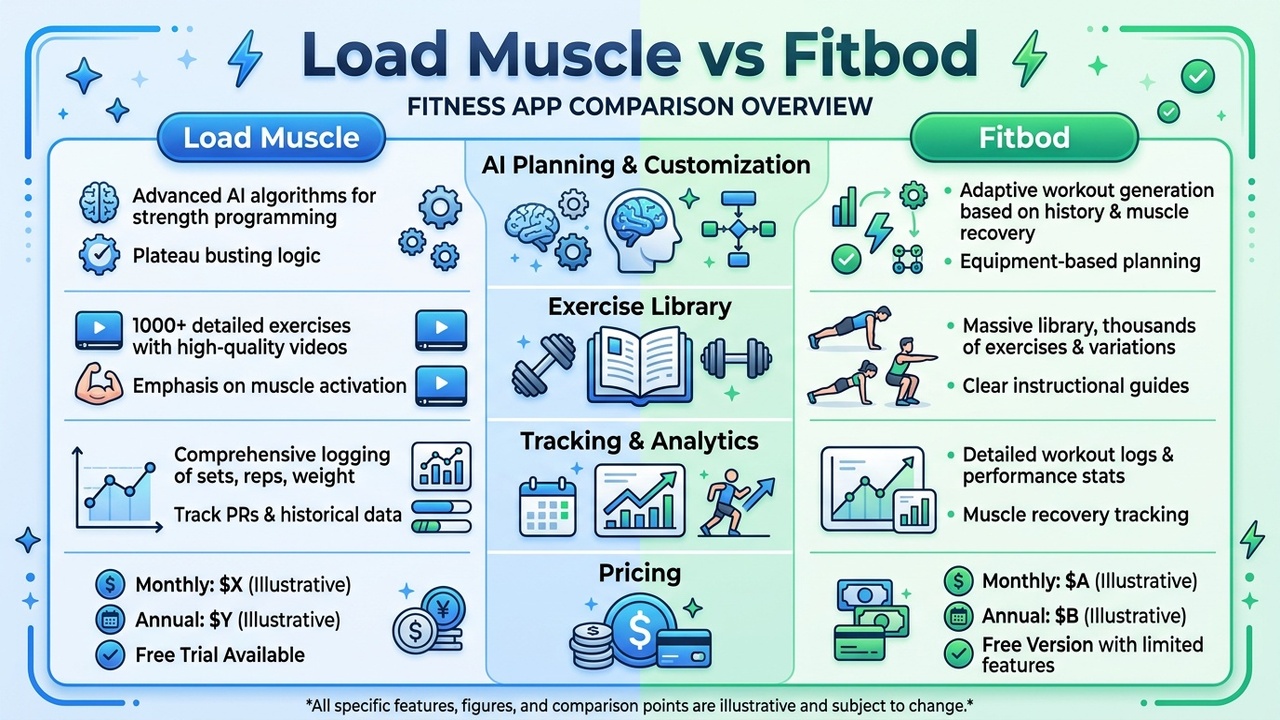
Both apps use AI to generate personalized workouts, but they come from different philosophies. Fitbod has been in the market since 2015 and built its AI around muscle group recovery tracking. It monitors which muscles are fresh and which are fatigued, then builds each workout accordingly.
Load Muscle takes a broader approach. Its AI considers your goals, experience level, available equipment, preferred training style, and schedule to build complete training programs — not just individual workouts. The difference is subtle but important: Fitbod builds one workout at a time based on recovery state, while Load Muscle builds structured multi-week programs.
Both approaches have merit. Fitbod's session-by-session generation is great for variety and flexibility. Load Muscle's program-level planning is better for progressive overload and long-term periodization.
Side-by-Side Feature Comparison Table
| Feature | Load Muscle | Fitbod |
|---|---|---|
| AI Workout Generation | Program-level AI planner | Session-by-session AI |
| Exercise Library | 4,000+ with video demos | 600+ with animations |
| Muscle Recovery Tracking | Via AI programming | Yes (core feature) |
| Progressive Overload | Built into program design | Per-session suggestions |
| Workout Logging | Yes | Yes |
| Apple Watch | Coming soon | Yes |
| Free Plan | Yes (full AI planner) | Free trial only |
| Premium Price | Competitive | $12.99/mo or $79.99/yr |
| Platforms | iOS, Android, Web | iOS, Android |
| Best For | Structured programming | Flexible daily workouts |
AI Workout Programming
This is the core selling point for both apps. Here is how they actually compare.
How Load Muscle Generates Plans
Load Muscle's AI builds complete workout programs based on your input profile. You specify your training goal (hypertrophy, strength, fat loss), experience level, how many days per week you can train, session length preferences, and available equipment.
The AI then generates a structured program with exercise selection, set and rep schemes, rest periods, and progression guidelines. It draws from a database of over 4,000 exercises to pick movements that match your equipment and goals. You get a real program — not a random assortment of exercises.
If your situation changes (you switch from a home gym to a commercial gym, or your schedule opens up from 3 to 5 days), you can regenerate your program and the AI adapts everything. You can try this for free with the Load Muscle workout planner.
How Fitbod Generates Plans
Fitbod generates one workout at a time. Before each session, the AI looks at your training history, identifies which muscles are recovered and which are still fatigued, and builds a workout that targets the freshest muscle groups.
This approach works well for lifters who want variety and do not like following rigid programs. Every workout is slightly different, which keeps things interesting. The AI also adjusts weight recommendations based on your logged performance.
The downside is that you lose some of the structure that comes with a planned program. There is no overarching periodization — the AI optimizes each session independently rather than designing a multi-week progression arc.
Personalization Depth
Both apps personalize workouts, but Load Muscle offers more granularity in the initial setup. You can specify training style preferences, target muscle emphasis, and equipment availability down to specific machines. Fitbod's personalization focuses more on recovery state and available equipment, with less emphasis on programming style preferences.
Load Muscle also allows you to indicate preferences for compound vs. isolation balance, which is valuable for lifters who want control over their programming philosophy. For a broader look at how AI fitness planning works, check out our guide to AI workout planning.
Exercise Library Comparison
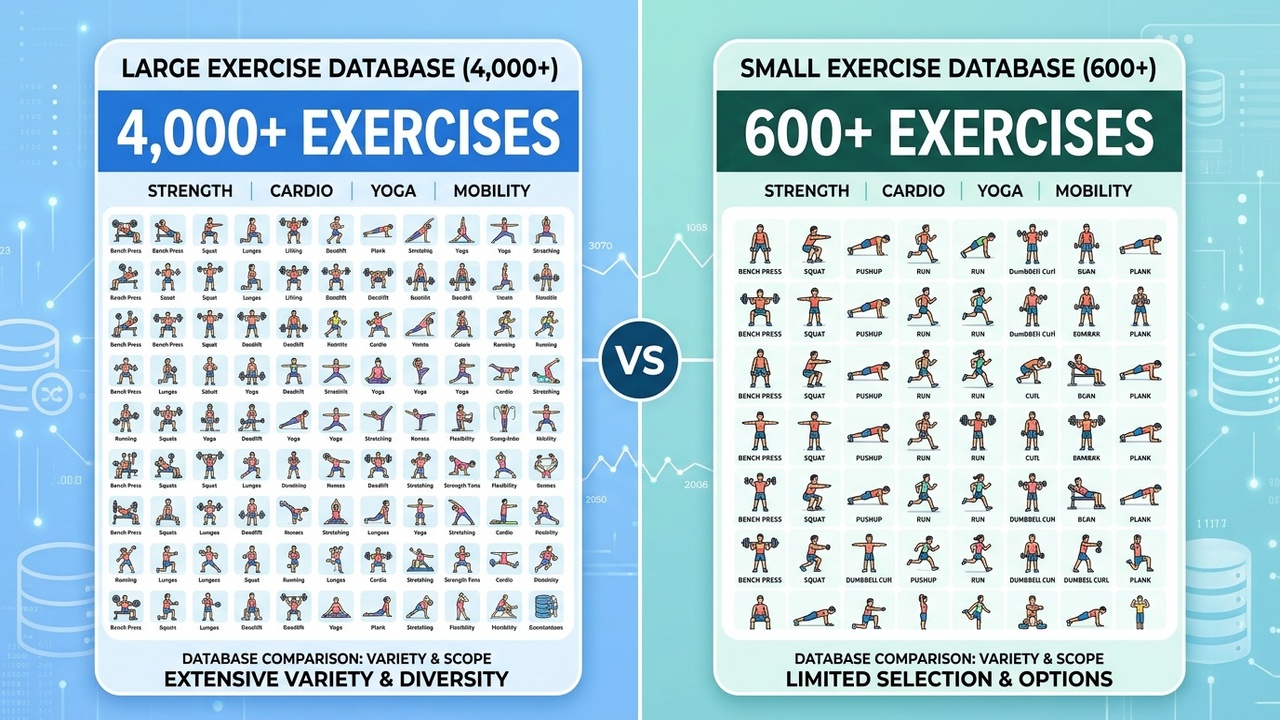
Load Muscle's library includes over 4,000 exercises — one of the largest in any workout app. Each exercise has video demonstrations, muscle group targeting data, and detailed form instructions. Whether you are looking for a specific cable angle, a dumbbell alternative, or an unusual machine variation, the library likely has it. You can browse the exercise library on the website.
Fitbod offers around 600+ exercises with animated demonstrations. The library covers all major movements and most common variations. For standard gym training, it is sufficient. But if you train with specialty equipment, want unusual variations, or want to explore beyond the basics, you will hit the ceiling faster than with Load Muscle.
The size of the exercise library also affects AI programming quality. A larger library gives the AI more options for exercise substitutions and variation, which leads to better-tailored programs.
Progressive Overload Tracking
Progressive overload — gradually increasing the challenge on your muscles — is the single most important principle for long-term progress. Both apps handle it, but differently.
Load Muscle builds progressive overload into its program design. When the AI generates your plan, it includes progression guidelines: when to add weight, when to add reps, and when to deload. Your logged workouts feed into this system, so the AI can see whether you are hitting targets or need adjustments.
Fitbod suggests weight increases based on your recent performance. If you completed all your sets at a given weight, it bumps the recommendation up slightly for your next session. This per-exercise approach works but lacks the programmatic structure of planned progression.
For beginners who are not sure how to progress, Load Muscle's structured approach is more supportive. For experienced lifters who intuitively manage their own progression, Fitbod's lighter touch may feel less restrictive.
Workout Logging Experience
Both apps provide solid workout logging. You can log sets, reps, weight, and rest periods during your session. Both show your previous performance so you know what to beat. Both support supersets and custom exercises.
Fitbod's logging integrates tightly with its Apple Watch app, which is a genuine advantage for lifters who prefer wrist-based logging. You can start a set, log it, and check your rest timer without pulling out your phone.
Load Muscle's logging is designed to work alongside the AI-generated plan. You see your target performance for each set and can compare your actual results in real time. The experience is smooth and fast, with the added benefit of plan context on every screen.
Both apps handle the core logging experience well. The differentiator is whether you want the plan-integrated experience (Load Muscle) or the watch-first experience (Fitbod).
Pricing and Value
This is where the Load Muscle vs Fitbod comparison gets interesting.
Load Muscle Plans
Load Muscle offers a free plan that includes access to the full AI workout planner, the complete 4,000+ exercise library, and workout logging. This is not a time-limited trial — it is a permanent free tier with genuinely useful features. Premium plans add advanced features at competitive pricing.
The fact that you can access AI-generated plans for free is a significant differentiator. Most AI workout apps lock their core feature behind a paywall.
Fitbod Plans ($12.99/mo or $79.99/yr)
Fitbod offers a limited free trial (typically 3 workouts), after which you need to subscribe. The pricing is $12.99/mo or $79.99/yr — roughly $6.67/mo on the annual plan.
This makes Fitbod one of the more expensive workout apps on the market. The AI quality is good, but you are paying a premium compared to alternatives. Over a year, the cost adds up to $80-$156 depending on your billing cycle.
Bottom line: If you want AI workout planning without upfront cost, Load Muscle's free tier is the obvious choice. If you are willing to pay for Fitbod's recovery-based AI and Apple Watch integration, it is a solid product — but the price difference is significant.
Platform Availability
Load Muscle is available on iOS, Android, and the web. The web platform means you can plan your workouts on a desktop and sync to your phone, which is useful for detailed program setup.
Fitbod is available on iOS and Android with strong Apple Watch integration. There is no web interface, so all planning and setup happens on your phone.
For Apple ecosystem users, Fitbod's Watch integration is a genuine plus. For users who want flexibility across devices including desktop, Load Muscle has the edge.
Best For: Beginners vs Advanced Lifters
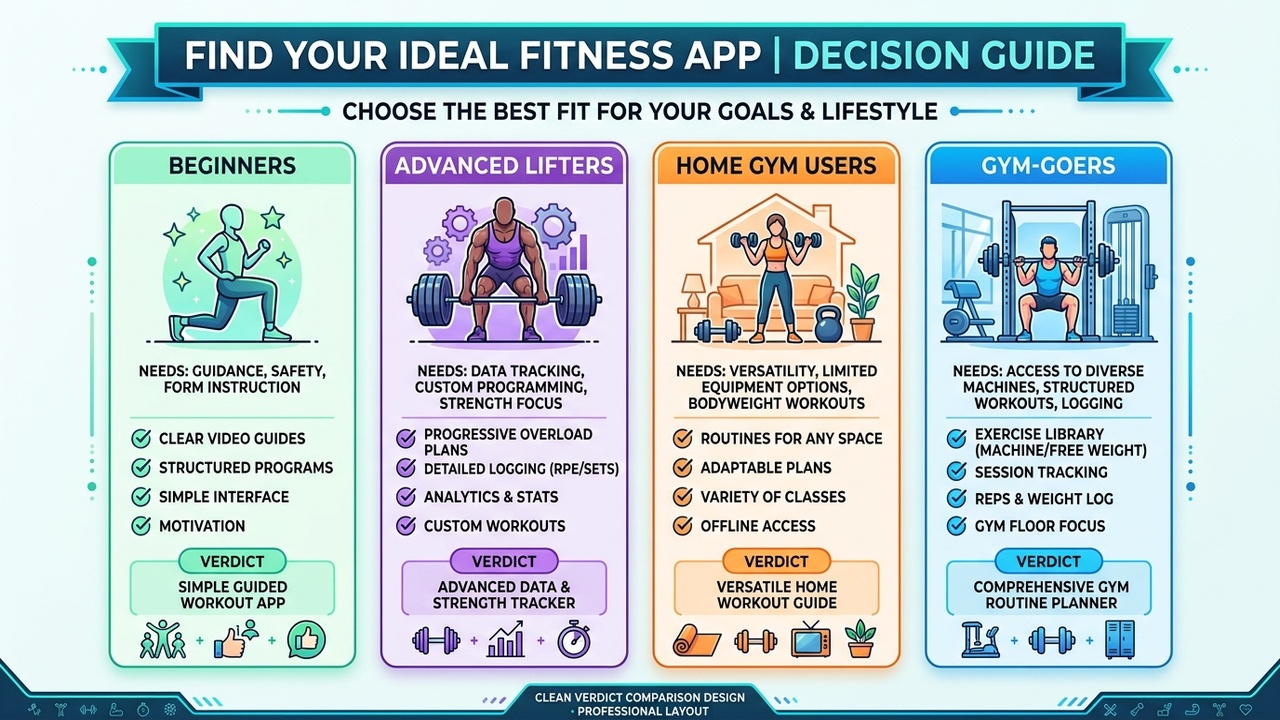
Beginners generally do better with Load Muscle. The AI builds a complete program, which solves the biggest beginner problem: not knowing what to do. You do not need to understand programming concepts, exercise selection, or periodization. The AI handles it. If you are just starting out, also check our best workout planner for beginners.
Intermediate lifters can thrive with either app. If you want structured long-term programming, Load Muscle delivers. If you prefer daily variety and recovery-based training, Fitbod keeps things fresh.
Advanced lifters often have specific programming needs. Load Muscle's large exercise library and customizable AI planning work well for advanced trainees who want to fine-tune their approach. Fitbod's session-by-session model can feel limiting for lifters who need specific periodization schemes.
Final Verdict
Load Muscle vs Fitbod is a comparison between two AI workout apps with different strengths.
Choose Load Muscle if:
- You want a complete training program, not just daily workouts
- You value a massive exercise library (4,000+ exercises)
- Budget matters — the free tier includes full AI planning
- You want to plan on the web and train on your phone
Choose Fitbod if:
- You prefer daily workout variety driven by muscle recovery tracking
- Apple Watch integration is essential to your workflow
- You do not mind paying $12.99/mo for an established AI engine
- You prefer session-by-session planning over structured programs
For most lifters, Load Muscle offers more value — especially at the free tier. The combination of program-level AI planning, a massive exercise library, and zero upfront cost is hard to beat. Download Load Muscle to see how it works, or generate a free workout plan right now.
FAQ
Is Load Muscle or Fitbod better for building muscle?
Both apps can support muscle building effectively. Load Muscle's program-level AI planning is better for structured hypertrophy periodization, and its 4,000+ exercise library gives the AI more options. Fitbod's recovery-based approach ensures you are training fresh muscles each session, which also supports growth.
Is Fitbod worth the price?
Fitbod is a quality app with a mature AI engine, but at $12.99/mo ($79.99/yr) it is expensive compared to alternatives. Load Muscle offers AI-generated workout plans for free, which makes Fitbod's pricing harder to justify unless you specifically value its recovery tracking and Apple Watch features.
Can I use Fitbod for free?
Fitbod offers a limited free trial (typically 3 workouts), after which a subscription is required. There is no permanent free tier. In contrast, Load Muscle offers a free plan with full access to the AI workout planner and exercise library without time limits.
Which app has better AI?
Both have capable AI systems that approach programming differently. Load Muscle builds structured multi-week programs optimized for progressive overload. Fitbod builds daily workouts optimized for muscle recovery. Neither is objectively better — the right choice depends on whether you prefer structured programs or daily variety.
Does Fitbod work without equipment?
Yes, both Fitbod and Load Muscle can generate bodyweight-only or home workout programs. Load Muscle's larger exercise library includes more bodyweight and home-equipment variations, giving the AI more options when building equipment-limited plans.
Which app is better for experienced lifters?
Experienced lifters who want precise control over their programming tend to prefer Load Muscle because of its larger exercise library and program-level customization. Fitbod works well for experienced lifters who enjoy daily variety and trust the AI to manage their recovery and volume.
Want to see LoadMuscle's programming before installing anything? Browse our free workout routines on the web.