Choosing between Load Muscle vs Hevy comes down to one question: do you want an app that builds your workouts for you, or one that lets you log what you already know? Both apps are solid, both have free tiers, and both have loyal user bases. But they solve different problems.
This comparison breaks down every feature that matters so you can pick the right tool for your training. No fluff, no bias — just an honest look at what each app does well and where it falls short.
TL;DR
- Load Muscle is the better choice if you want AI-generated, personalized workout plans and access to a library of 4,000+ exercises. It plans and tracks.
- Hevy is the better choice if you already know your program and want a clean, social workout logger with a strong community.
- Both have free tiers. Load Muscle's free plan includes the AI workout planner. Hevy's free plan includes unlimited routines and social features.
- For a broader comparison of top apps, see our best workout apps of 2026 guide.
Why Compare Load Muscle and Hevy?
Load Muscle and Hevy are two of the fastest-growing workout apps in 2026. They show up in the same app store searches, get recommended in the same Reddit threads, and target a similar audience: people who lift weights and want a tool to support their training.
But they take fundamentally different approaches. Load Muscle is built around AI-powered workout planning. You tell it your goals, equipment, and schedule, and it generates a complete training program. Hevy is built around workout logging and community. You bring your own program and use Hevy to track it and share your progress.
This distinction matters more than any individual feature. The right app depends on where you are in your fitness journey and what kind of support you need.
Quick Comparison Table
| Feature | Load Muscle | Hevy |
|---|---|---|
| AI Workout Generation | Yes — full AI planner | No |
| Exercise Library | 4,000+ with video demos | 300+ with animations |
| Workout Logging | Yes | Yes |
| Progress Charts | Yes | Yes |
| Social/Community | Growing | Strong, established |
| Apple Watch | Coming soon | Yes |
| Free Plan | Yes (includes AI planner) | Yes (unlimited routines) |
| Premium Price | Competitive | $2.99/mo or $49.99/yr |
| Best For | Planning + tracking | Logging + social |
AI Workout Generation
This is the biggest difference between Load Muscle and Hevy, and it is worth understanding in detail.
Load Muscle's AI Planner
Load Muscle uses AI to generate complete, personalized workout plans. You answer questions about your goals (muscle building, fat loss, strength), experience level, available equipment, training days per week, and session length. The AI then builds a structured program drawn from a database of over 4,000 exercises.
The plans are not generic templates with your name slapped on top. The AI considers exercise selection, volume distribution, progressive overload, and muscle group balance. If you only have dumbbells and a bench at home, it builds around that equipment. If you have access to a full gym, it takes advantage of cables, machines, and barbells.
You can regenerate plans whenever your goals change, and the app tracks your progress against the plan. This is the kind of personalization that used to require a fitness app or personal trainer. Now it is built into the app.
Hevy's Approach
Hevy does not generate workouts for you. It is a workout logger first and foremost. You create your own routines or copy them from other Hevy users in the community. Once you have a routine saved, you log your sets, reps, and weight during your session.
This works great if you already have a program you like — maybe you run a PPL split you found online or follow a program from a coach. Hevy makes it easy to log that work and see your history. But if you do not know what program to follow, Hevy leaves that decision to you.
There are community-shared routines you can browse, but their quality varies. Some are excellent programs shared by experienced lifters. Others are random workouts thrown together by beginners. There is no curation or AI quality filter.
Exercise Library and Database
Load Muscle's exercise library includes over 4,000 exercises with video demonstrations, muscle group targeting information, and detailed instructions. Whether you are looking for a specific cable variation or a bodyweight alternative, the chances are high that it is in the database. You can browse the full exercise library on the website.
Hevy offers around 300+ exercises with animated demonstrations. The library covers the most common movements and is sufficient for standard training. However, if you train with specialty equipment, use unusual variations, or want to explore new exercises, you may find the selection limited compared to Load Muscle.
For most lifters, both libraries cover the basics. The difference becomes noticeable when you want specificity — a particular grip variation, a machine-specific exercise, or an uncommon movement pattern.
Workout Tracking and Logging
Both apps handle workout logging well, but the experience differs.
Hevy is arguably the more polished workout logger. The interface is clean, logging a set takes two taps, and the rest timer is well-implemented. You can reorder exercises mid-workout, add notes, and quickly reference what you lifted last time. It is fast and frictionless, which matters when you are between sets.
Load Muscle's logging interface is equally functional but includes additional context from your AI-generated plan. You can see the target sets, reps, and weight for each exercise, making it easy to follow your program. The logging itself is smooth, and the app displays your previous performance for each exercise so you know what to beat.
Both apps support supersets, and both let you track rest periods. The main difference is that Load Muscle integrates logging with planning — your logged workouts feed back into the AI's understanding of your progress.
Progress Analytics and Reporting
Tracking progress over time is essential for long-term results, and both apps offer progress analytics.
Hevy provides clean progress charts that show your estimated one-rep max, total volume, and personal records for each exercise. The graphs are easy to read and give you a quick snapshot of whether you are getting stronger. You can also see body measurements and body weight trends if you log them.
Load Muscle offers similar progress tracking with exercise-level analytics. You can see your volume trends, strength progression, and workout consistency. The AI planner uses this data to adjust future programming recommendations, creating a feedback loop between tracking and planning.
Both apps track personal records and notify you when you hit a new PR. For pure analytics depth, they are comparable. The differentiator is what happens with that data — in Hevy it informs you, in Load Muscle it also informs the AI that programs your next workout.
User Experience and Interface
Hevy's design is clean, modern, and focused. The app does not try to do too much, and the result is a UI that feels fast and intuitive. Navigation is straightforward, and most actions are within one or two taps. The dark mode is well-executed, and the overall aesthetic is polished.
Load Muscle's interface is also modern and well-designed, with a focus on guiding you through the workout planning and execution process. The app handles more complexity (AI planning, large exercise library, personalization) while keeping the UI accessible. The exercise detail pages with video demos and muscle targeting info are a highlight.
Both apps are responsive and rarely crash. Neither has intrusive ads on their free tiers. In terms of pure logging speed, Hevy has a slight edge because that is its entire focus. In terms of overall functionality per tap, Load Muscle packs more value into each screen.
Pricing Breakdown
Load Muscle Pricing
Load Muscle offers a free plan that includes access to the AI workout planner, the full exercise library, and basic tracking. Premium plans unlock additional features at competitive pricing. The free tier is genuinely usable — it is not a crippled trial designed to force an upgrade.
Hevy Pricing (Free Tier, Pro at $2.99/mo)
Hevy's free plan is generous. You get unlimited custom routines, full workout logging, progress charts, and access to the community. The Pro plan ($2.99/mo or $49.99/yr) adds features like advanced analytics, workout comparison, and additional customization options.
At $2.99/mo, Hevy Pro is one of the most affordable premium workout apps on the market. However, you are paying for enhanced logging and analytics, not for AI-generated programming. The core logging experience on the free plan is already strong.
Both apps offer good value on their free tiers. The pricing question is less about cost and more about what you are paying for: personalized AI programming (Load Muscle) or enhanced logging and social features (Hevy).
Community and Social Features
This is where Hevy has a clear advantage. The app was built with social features as a core pillar. You can follow friends, share workouts, comment on each other's sessions, and compete on leaderboards. The community is active and engaged, with millions of users sharing routines and celebrating PRs.
Hevy's social feed works like a fitness-focused Instagram. You see your friends' workouts in your feed, complete with exercises, volume, and duration. It adds a layer of accountability that pure tracking apps lack.
Load Muscle's community features are growing but not yet at Hevy's level. The app focuses more on the individual training experience — AI planning, execution, and tracking. Social features are on the roadmap, but if community interaction is a top priority for you right now, Hevy has the edge.
Who Should Choose Load Muscle?
Choose Load Muscle if you want your app to think for you. Specifically:
- You are a beginner or intermediate lifter who does not have a training program yet
- You want AI-generated, personalized workout plans based on your goals and equipment
- You value a massive exercise library (4,000+) with video demonstrations
- You want a planner and a tracker in one app
- You prefer data-driven programming that adapts to your progress
If you are tired of searching the internet for workout programs and want a system that builds one for you, try Load Muscle. The free workout planner is available without a subscription.
Who Should Choose Hevy?
Choose Hevy if you already know what you want to do and just need a place to log it. Specifically:
- You are an experienced lifter with a training program you already follow
- You want the fastest, cleanest logging experience possible
- Community and social features matter to you — you want to train "with" friends
- You want a strong Apple Watch companion app
- You want an affordable premium tier ($2.99/mo)
Hevy is excellent at what it does. If you do not need AI planning and you value the social layer, it is one of the best workout apps of 2026.
The Verdict
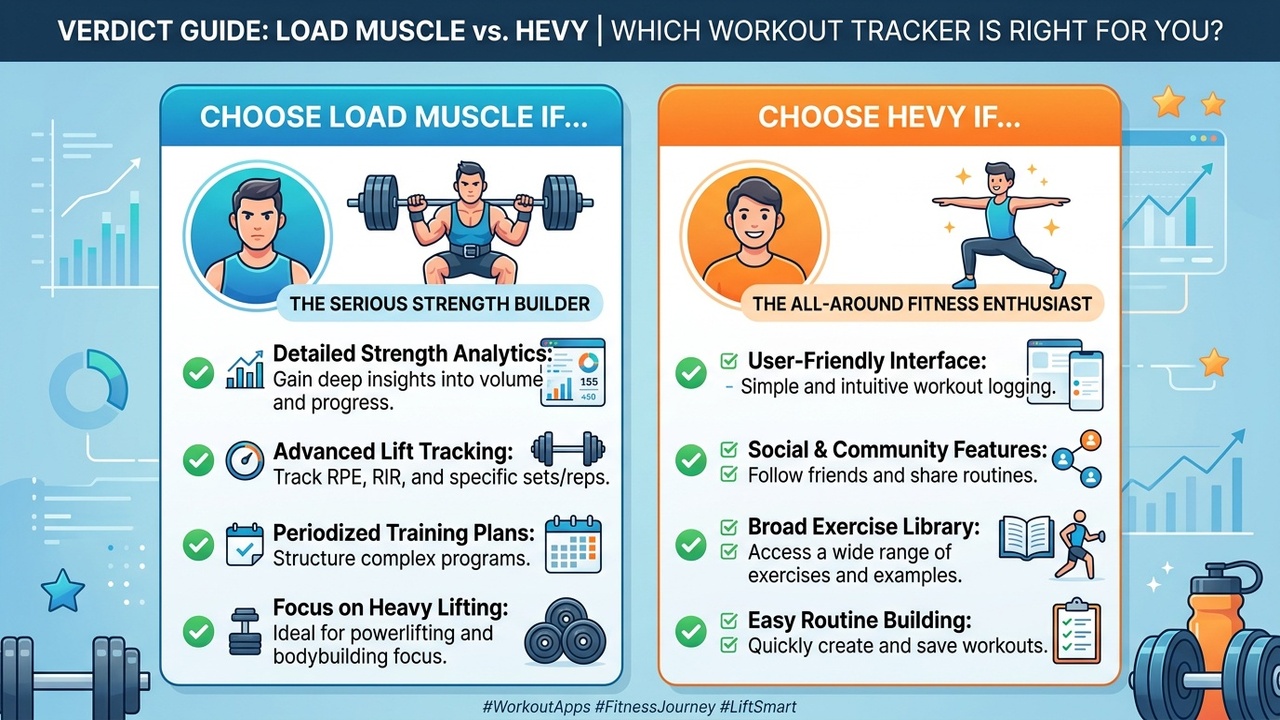
Load Muscle vs Hevy is not about which app is objectively better. It is about which app matches how you train.
If you need guidance — a system that analyzes your goals, picks exercises from a library of 4,000+, and builds a structured plan — Load Muscle is the clear choice. It combines planning and tracking in a way that Hevy does not attempt.
If you have your programming dialed in and want a fast, social, affordable place to log your work, Hevy delivers. Its community is a genuine strength, and the logging experience is top-tier.
Many lifters actually use both: Load Muscle for planning and periodization, Hevy for quick logging on the go. But if you are picking one, the deciding factor is simple: do you need a plan, or do you need a log?
FAQ
Is Load Muscle better than Hevy?
It depends on what you need. Load Muscle is better for AI-powered workout planning and has a much larger exercise library (4,000+ vs 300+). Hevy is better for fast workout logging and social features. If you need a program built for you, Load Muscle wins. If you already have a program, Hevy is an excellent logger.
Does Hevy have an AI workout planner?
No, Hevy does not generate workout plans using AI. You create your own routines or copy them from other users in the community. If you want an AI-generated training plan, you would need to use an app like Load Muscle that offers a free AI workout planner.
Is Hevy completely free?
Hevy has a generous free tier that includes unlimited routines, full workout logging, and community access. The Pro plan at $2.99/mo adds advanced analytics and additional features. For most users, the free plan covers everything they need for basic tracking.
Can I use Load Muscle and Hevy together?
Yes, some lifters use Load Muscle's AI planner to generate their program and then log individual sessions in Hevy for the social features. However, Load Muscle includes full workout logging, so using both is not necessary unless you specifically want Hevy's community layer.
Which app has a better exercise library?
Load Muscle has a significantly larger exercise library with over 4,000 exercises including video demonstrations and detailed muscle targeting information. Hevy's library covers 300+ common exercises with animated demos. For most standard movements, both are sufficient, but Load Muscle offers far more variety and specificity.
Which app is better for beginners?
Load Muscle is generally better for beginners because it generates a personalized workout plan for you. Beginners often do not know what exercises to do or how to structure a program, and Load Muscle's AI handles that. Hevy requires you to already know what program to follow, which can be a barrier for newcomers.
Whichever app you pick, you can preview LoadMuscle's programming style through our free workout routines — no download needed.