Choosing the right workout app can feel like picking a gym -- there are too many options and not enough honest information. If you have narrowed your search down to Load Muscle vs JEFIT, you are already looking at two solid contenders with very different philosophies. One leans on AI to build personalized plans from scratch. The other relies on one of the largest user communities in fitness to share and discover routines.
This comparison breaks down every feature that matters so you can decide which app actually fits the way you train. No fluff, no hype -- just an honest side-by-side look at what each app does well and where it falls short.
TL;DR
- Load Muscle wins on AI-powered personalization, modern UI, and a massive 4,000+ exercise library with video demos.
- JEFIT wins on community size (10M+ users), user-shared routines, and a mature free tier.
- If you want a plan built for you without hiring a coach, go with Load Muscle.
- If you prefer browsing community-created routines and tracking workouts with a large social network, JEFIT is a strong choice.
- Already compared other apps? Check out our Load Muscle vs Hevy breakdown too.
Load Muscle vs JEFIT Overview
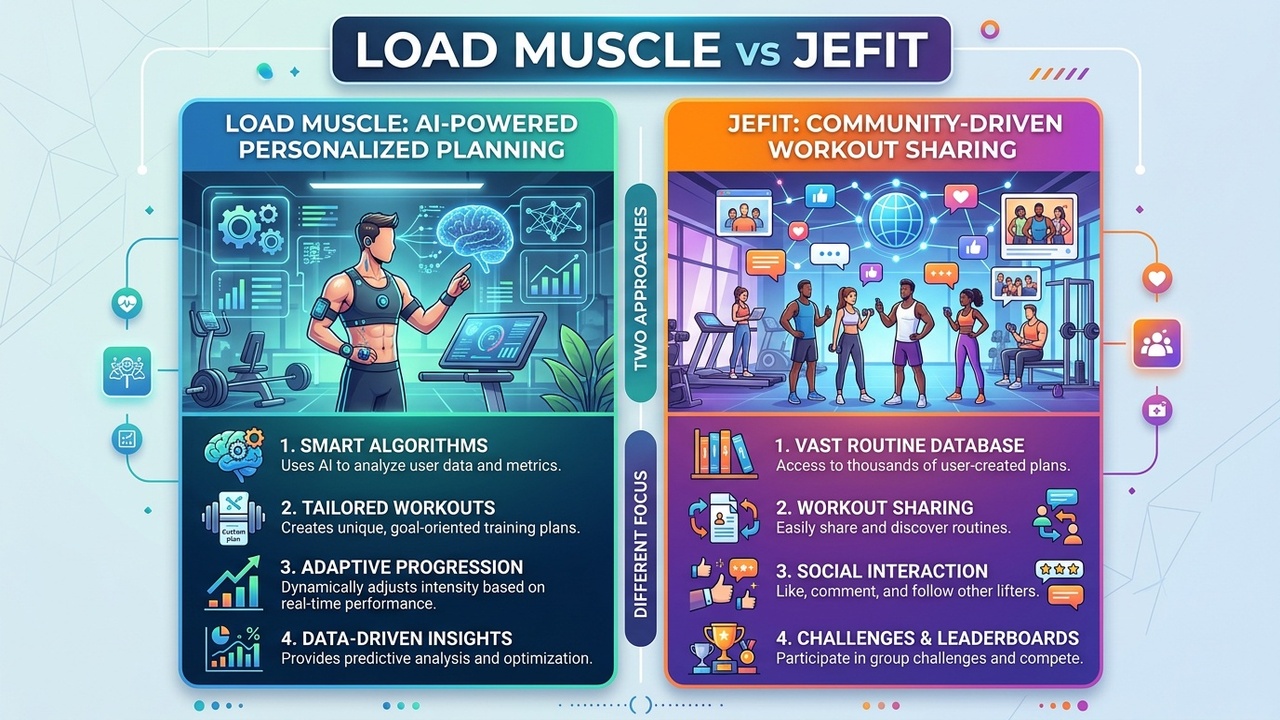
Load Muscle and JEFIT approach workout planning from different angles. Understanding those differences up front will save you time.
Load Muscle is an AI-powered workout planner and tracker. You tell it your goals, experience level, available equipment, and how many days you can train. The AI then generates a complete, personalized program pulled from a library of over 4,000 exercises. Every exercise comes with video demonstrations and muscle-targeting details. You can also use the free workout planner directly on the web without downloading anything.
JEFIT has been around since 2010 and has built one of the largest fitness communities online, with over 10 million users. Its core model is template-based: you browse workout routines created by other users or build your own from a large exercise database. The app tracks your sets, reps, and weights, and lets you share progress with friends.
Both apps work on iOS and Android. Both offer free tiers. But the experience of using them day to day is quite different, as you will see in the sections below.
Quick Feature Comparison Table
| Feature | Load Muscle | JEFIT |
|---|---|---|
| AI Workout Plans | Yes -- personalized to your goals | No |
| Exercise Library | 4,000+ with video demos | 1,300+ with animations |
| Community Size | Growing | 10M+ users |
| Shared Routines | Coming soon | Yes -- thousands available |
| Progress Tracking | Sets, reps, weight, trends | Sets, reps, weight, body stats |
| Workout Logging | Yes | Yes |
| Rest Timer | Yes | Yes |
| Apple Watch / Wear OS | In development | Apple Watch supported |
| Free Tier | Yes -- includes AI planner | Yes -- generous free features |
| Offline Mode | Yes | Partial |
| Platforms | iOS, Android, Web | iOS, Android, Web |
This table captures the highlights, but the details matter. Let's dig into each category.
Workout Planning and Generation
This is where the two apps diverge the most. How you get your workout program is fundamentally different on each platform.
Load Muscle's AI-Powered Plans
Load Muscle uses AI to generate workout plans tailored specifically to you. During setup, you answer questions about your training experience, fitness goals (muscle gain, fat loss, strength, general fitness), available equipment, preferred workout split, and weekly schedule. The AI then builds a structured program that accounts for all of those variables.
This is not a generic template with your name slapped on top. The plan selects exercises from a database of 4,000+ movements, balances muscle groups appropriately, and adjusts volume based on your experience level. If you only have dumbbells at home, you get a dumbbell-focused plan. If you have a full gym, the program takes advantage of that. You can try it yourself with the free workout planner before committing to the app.
The result is something closer to what a personal trainer would design -- except it takes seconds instead of an hour-long consultation. For a deeper look at how this technology works, read our AI Workout Planner Guide.
JEFIT's Template-Based System
JEFIT takes a community-driven approach. Instead of generating plans, it lets you browse thousands of workout routines created and shared by other users. You can filter by goal, experience level, or muscle group, then save a routine and start following it.
The advantage here is variety. With 10 million users contributing routines, there is something for almost every goal and style. Some routines are well-designed programs from experienced lifters. Others are basic templates that may not be optimal for your specific situation.
The downside is quality control. There is no AI or coach verifying that a community routine is well-balanced or appropriate for your level. You need enough knowledge to evaluate whether a plan makes sense for you. If you are a beginner, this can be a real challenge -- and picking the wrong routine can lead to imbalances or stalled progress. If you are new to structured training, our guide on how to start working out can help you understand what to look for in a program.
Exercise Database
Both apps offer extensive exercise libraries, but the scale and presentation differ.
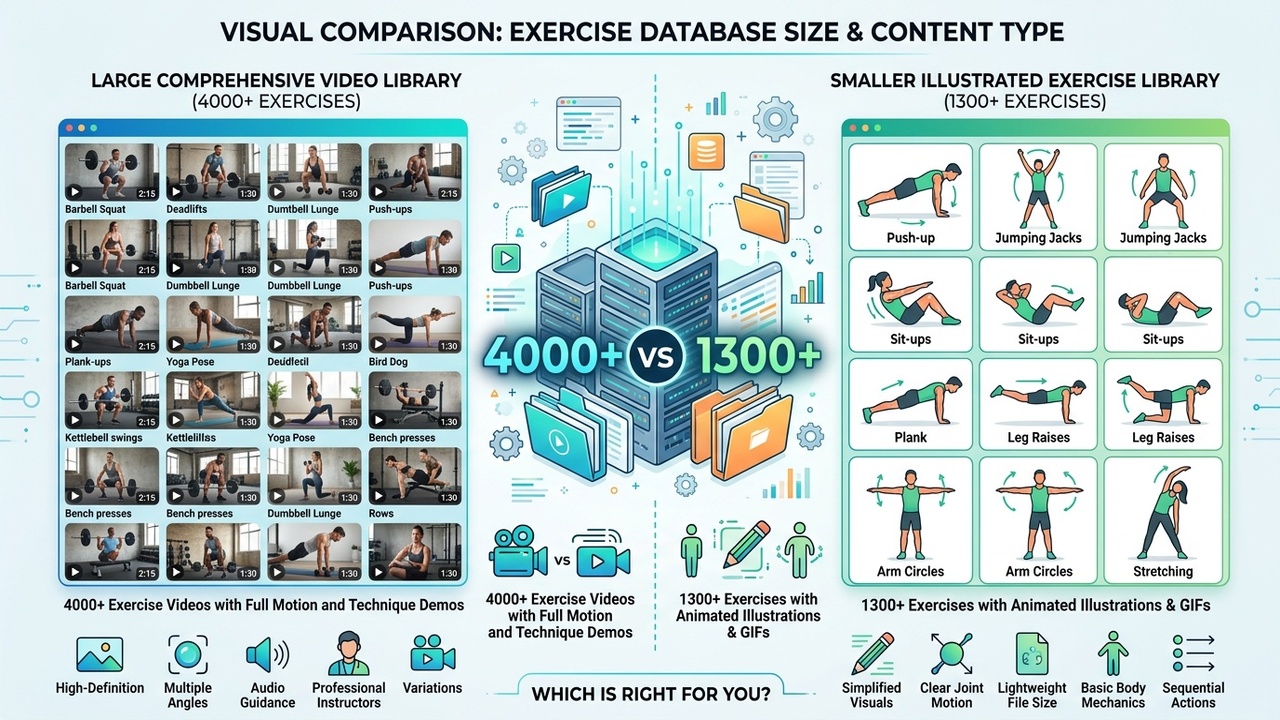
Load Muscle provides 4,000+ exercises, each with video demonstrations, written instructions, and detailed muscle-targeting information. You can filter by body part, equipment type, and difficulty level. The library covers everything from barbell and dumbbell movements to cables, machines, bodyweight, and resistance bands. The depth here is hard to beat -- whether you are looking for a standard bench press variation or a niche cable movement, it is almost certainly in the database.
JEFIT offers around 1,300+ exercises with animated GIFs showing the movement pattern. The animations are helpful for getting the general idea of an exercise, but they lack the detail of full video demonstrations. JEFIT also allows users to add custom exercises, which partially compensates for the smaller library.
For most people, either library is large enough. But if you want maximum variety, especially for isolation exercises or equipment-specific alternatives, Load Muscle's database gives you significantly more options. You can browse the full exercise collection on the exercises page to see what is available.
Progress Tracking and Analytics
Tracking your workouts only matters if you can actually see whether you are improving. Both apps handle this, but with different levels of detail.
Load Muscle tracks your sets, reps, and weights for every exercise. You can view your history for individual movements, see trends over time, and monitor your overall training volume. The interface makes it easy to compare current performance against previous sessions so you can apply progressive overload consistently.
JEFIT also tracks sets, reps, and weights, and adds body measurement tracking (weight, body fat percentage, muscle measurements). It offers workout statistics like total volume lifted per session and training frequency charts. JEFIT's analytics dashboard has had years of refinement and provides a solid snapshot of your training history.
Both apps get the job done for tracking. JEFIT has a slight edge in body measurement tracking, while Load Muscle focuses more on exercise-level progress and AI-driven insights. If detailed body composition tracking is a priority, JEFIT covers that well. If you care more about workout-level analytics and intelligent plan adjustments, Load Muscle is the better fit.
Community and Social
This is where JEFIT has a clear head start. With over 10 million registered users, JEFIT has one of the largest fitness communities attached to any workout app. You can follow other users, share workouts, compare stats on leaderboards, and browse routines created by the community. The social element adds accountability, which many people find motivating.
JEFIT also features workout challenges and group activities that keep users engaged. If the social side of fitness matters to you -- seeing what others are doing, competing on leaderboards, or sharing your own routines -- JEFIT delivers a mature, well-developed experience.
Load Muscle is a newer app, and its community is still growing. The current focus is on delivering the best possible individual training experience through AI personalization rather than social features. Community features are on the roadmap, but as of 2026, JEFIT is the clear winner if social interaction is a deciding factor for you.
That said, many lifters prefer to train without the social noise. If you just want a great plan, a solid exercise library, and clean tracking, the community size difference will not affect your day-to-day experience.
User Interface and Ease of Use
The look and feel of an app matters more than most people admit. If logging a set takes too many taps, you will eventually stop logging.
Load Muscle has a modern, clean interface designed with current UI standards. Navigation is intuitive, workout logging is fast, and exercise demos load quickly. The design feels polished without being cluttered. Starting a workout, swapping exercises, and reviewing your history are all straightforward.
JEFIT's interface is functional but shows its age. The app has been around since 2010, and while it has received updates over the years, the overall design language feels dated compared to newer apps. Some screens have dense layouts with small text and crowded menus. It works, but it is not as pleasant to use daily as a more modern alternative.
For new users especially, Load Muscle's onboarding is smoother. The AI handles most of the setup decisions, so you are training within minutes. JEFIT requires more browsing and manual setup before you have a routine ready to go. If you want a deeper look at what makes a workout app easy to use, our best fitness app features guide covers the key criteria.
Pricing
Both apps offer free tiers, which is great for testing before you commit.
Load Muscle provides a free plan that includes access to the AI workout planner, the full exercise database, and basic tracking. Premium plans unlock additional features like advanced analytics and extra AI plan generations. You can start with the free workout planner on the web to test the AI before downloading the app.
JEFIT has a generous free tier that includes workout logging, the exercise database, and access to community routines. JEFIT Elite (the premium plan) removes ads, unlocks advanced analytics, adds HD exercise videos, and provides priority support. JEFIT Elite is priced competitively and often runs promotions.
Neither app forces you into a paid plan to get a useful experience. Both free tiers are functional enough for serious training. The premium upgrades on both sides add convenience and depth rather than gating essential features.
For the best value, consider what you actually need. If you want AI-generated plans and a massive exercise library, Load Muscle's free tier already delivers that. If you want community routines and social features, JEFIT's free tier covers those well.
Who Should Use Load Muscle?
Load Muscle is the better choice if you want a personalized workout plan without the guesswork. It is ideal for:
- Beginners who do not know how to structure a program and want intelligent guidance from day one. Instead of scrolling through hundreds of community routines hoping to find a good one, you get a plan built for your specific situation.
- Intermediate lifters who want periodized programming that adapts to their equipment and schedule. The AI handles the planning so you can focus on training.
- Home gym users who need plans tailored to limited equipment. Load Muscle's AI accounts for what you have available and builds around it.
- Anyone who values a modern, fast UI and wants to spend less time navigating menus and more time lifting.
If any of those describe you, download Load Muscle and try the free plan. You can also explore the best workout app 2026 roundup to see how it stacks up against other options.
Who Should Use JEFIT?
JEFIT is the better choice if you value community and social accountability. It is ideal for:
- Social lifters who want to share workouts, compete on leaderboards, and follow other users' progress. JEFIT's community is one of the largest in the fitness app space.
- Experienced lifters who know what they want and prefer browsing proven routines rather than having an AI decide for them. The community library has thousands of options.
- Users who want body measurement tracking built into their workout app. JEFIT handles weight, body fat, and circumference measurements natively.
- Budget-conscious users who want a feature-rich free tier with optional premium upgrades.
JEFIT has earned its place as one of the most popular workout apps for good reason. If community features and routine discovery are priorities, it remains a strong option.
Final Verdict
The Load Muscle vs JEFIT decision comes down to what you prioritize in a workout app.
Choose Load Muscle if you want AI-powered personalization, a 4,000+ exercise library with video demos, and a modern interface that gets out of your way. It is the better option for anyone who wants a structured, customized plan without spending hours researching routines. The free tier includes the AI planner, which makes it easy to test before committing.
Choose JEFIT if you thrive on community interaction, want access to thousands of user-created routines, and prefer browsing over AI-generated plans. JEFIT's decade-plus track record and 10 million users speak to its reliability and depth.
Both apps will help you train consistently. The right choice depends on whether you want your plan built for you by AI or curated by you from a community library. If you are still deciding, try both free tiers and see which workflow clicks. You can start with Load Muscle's free workout planner right now without downloading anything.
For more app comparisons, check out our Load Muscle vs Hevy breakdown and the full best workout app 2026 guide.
FAQ
Is JEFIT still worth using in 2026?
Yes, JEFIT remains a solid workout tracker with a large community and a well-developed feature set. Its strengths in social features and community-shared routines have not diminished. However, if you want AI-generated personalized plans, you will need to look elsewhere since JEFIT does not offer that functionality.
Can I switch from JEFIT to Load Muscle easily?
Switching is straightforward since both apps let you start fresh with a new plan. With Load Muscle, you answer a few questions and the AI builds your program in seconds, so there is no need to manually recreate your old routine. You will lose your JEFIT workout history, but your progress in the gym carries over regardless of which app you use.
Does Load Muscle have a community like JEFIT?
Load Muscle's community is still growing since it is a newer app. The current focus is on delivering the best AI-powered planning and tracking experience. Community and social features are planned for future updates. If a large social network is a must-have right now, JEFIT has the edge.
Which app has a better free tier?
Both apps offer genuinely useful free plans. Load Muscle's free tier includes access to the AI workout planner and the full 4,000+ exercise database. JEFIT's free tier includes workout logging, community routines, and the exercise library with ads. Neither app locks essential training features behind a paywall, so you can train effectively on either free plan.
Is Load Muscle better than JEFIT for beginners?
For most beginners, Load Muscle is the better choice. The AI handles program design so you do not need to know which exercises to pick, how to structure a split, or how much volume is appropriate. JEFIT requires you to evaluate community routines yourself, which can be overwhelming if you are new to lifting. For more beginner guidance, check out our beginner gym workout plan.
You can also preview LoadMuscle-style programming through our free workout routines before downloading either app.