Standard straight sets — do a set, rest, repeat — are the foundation of any good program. But when progress slows, when time is limited, or when you need a new stimulus to force adaptation, supersets and drop sets are two of the most effective advanced techniques you can add.
Both techniques increase training density (more work in less time), create novel metabolic stress, and push muscles past the point where straight sets alone stop working. But they work differently, serve different purposes, and should be programmed thoughtfully — not thrown in randomly because you saw someone do them on social media.
This guide covers the science behind both techniques, how to program them correctly, when to use each one, and complete sample workouts you can start this week.
TL;DR
- Supersets: Two exercises performed back-to-back with no rest between them. Save time, increase metabolic stress, and maintain intensity.
- Drop sets: One exercise where you reduce the weight and continue performing reps without rest. Push a muscle past failure for maximum volume in minimal time.
- Use supersets for time efficiency and training opposing muscle groups (e.g., bicep curl + tricep pushdown).
- Use drop sets as finishers to exhaust a muscle after your main work is done.
- Both techniques complement straight sets — they do not replace them.
- Build a program with these techniques using the free workout planner.
What Are Supersets?
A superset is two exercises performed consecutively with no rest between them. You complete a set of exercise A, immediately perform a set of exercise B, then rest before repeating.
The term is simple, but there are several variations that serve different purposes.
Antagonist Supersets
Pair exercises that train opposing muscle groups:
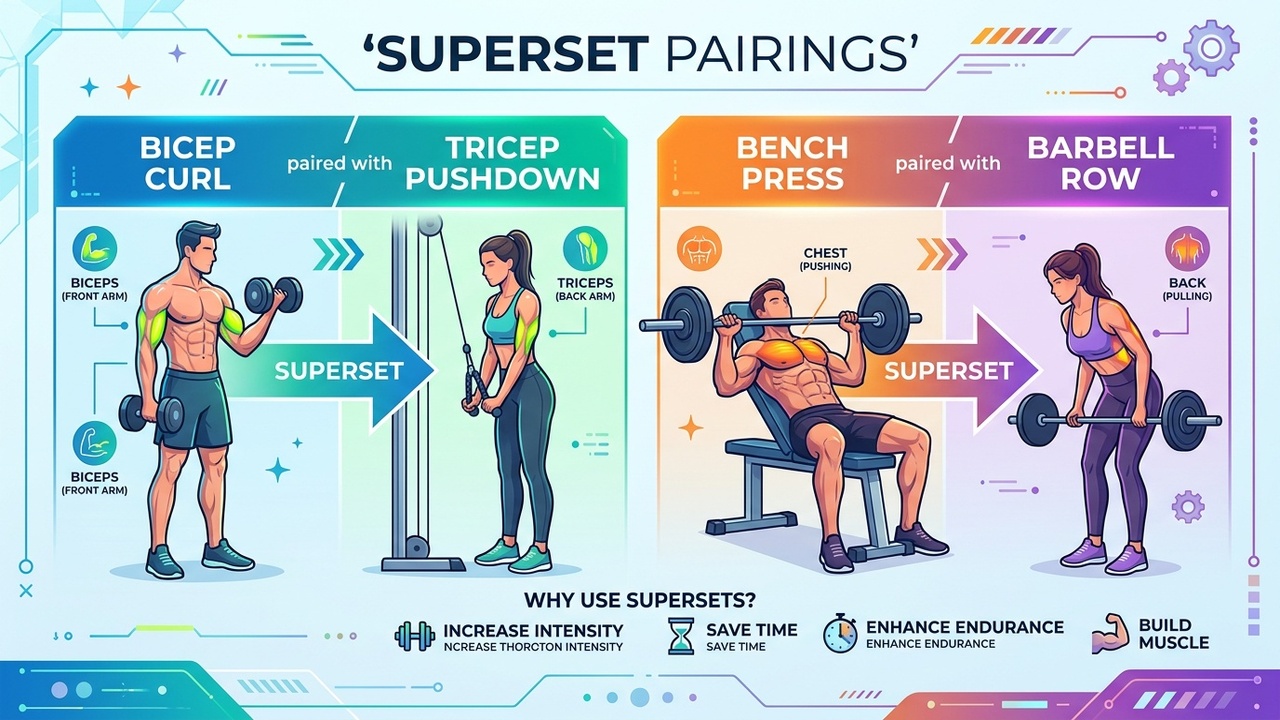
- Bench press + barbell row (chest + back)
- Bicep curl + tricep pushdown (biceps + triceps)
- Leg extension + leg curl (quads + hamstrings)
Why they work: While one muscle works, the opposing muscle rests. This allows you to maintain near-full performance on both exercises while cutting your workout time almost in half. Research shows that antagonist supersets produce comparable strength and hypertrophy to straight sets — with significantly shorter workouts.
This is the most practical superset type for most lifters.
Agonist Supersets
Pair two exercises that train the same muscle group:
- Bench press + dumbbell fly (both chest)
- Barbell curl + hammer curl (both biceps)
- Squat + leg extension (both quads)
Why they work: The first exercise pre-fatigues the muscle with a compound movement, and the second exercise continues the stimulus with an isolation movement. This creates extreme metabolic stress and muscular fatigue, producing a significant growth signal.
Caution: Agonist supersets are very demanding. Your performance on the second exercise will be significantly reduced, which is expected and by design.
Pre-Exhaustion Supersets
An isolation exercise followed by a compound exercise for the same muscle:
- Dumbbell fly → bench press (chest)
- Leg extension → squat (quads)
- Lateral raise → overhead press (shoulders)
Why they work: The isolation exercise fatigues the target muscle, ensuring it reaches failure during the compound movement rather than a synergist muscle failing first. For example, if your triceps always fail before your chest on bench press, doing a chest fly first ensures your chest is the limiting factor.
Post-Exhaustion Supersets
A compound exercise followed by an isolation exercise for the same muscle:
- Bench press → cable fly (chest)
- Barbell row → straight arm pulldown (back)
- Squat → leg extension (quads)
Why they work: You perform the compound movement when fresh (maximizing load) and then push the target muscle to complete failure with an isolation movement. This is the most common and generally most effective agonist superset format.
Benefits of Supersets
Time efficiency. Antagonist supersets can cut workout time by 30-40% while maintaining the same total volume. If a 60-minute workout becomes 40 minutes with identical results, that is a significant advantage for busy lifters.
Increased metabolic stress. The reduced rest creates greater metabolite accumulation (lactate, hydrogen ions), which is one of the three drivers of hypertrophy. This is especially valuable for agonist supersets.
Higher training density. More sets per unit of time means greater work capacity development. Over time, this improves your ability to handle higher training volumes.
Cardiovascular benefit. The continuous work with minimal rest elevates heart rate, providing a modest cardiovascular training effect on top of the resistance training stimulus.
Mental engagement. Supersets keep the workout moving and reduce boredom. The constant exercise switching maintains focus and intensity.
What Are Drop Sets?
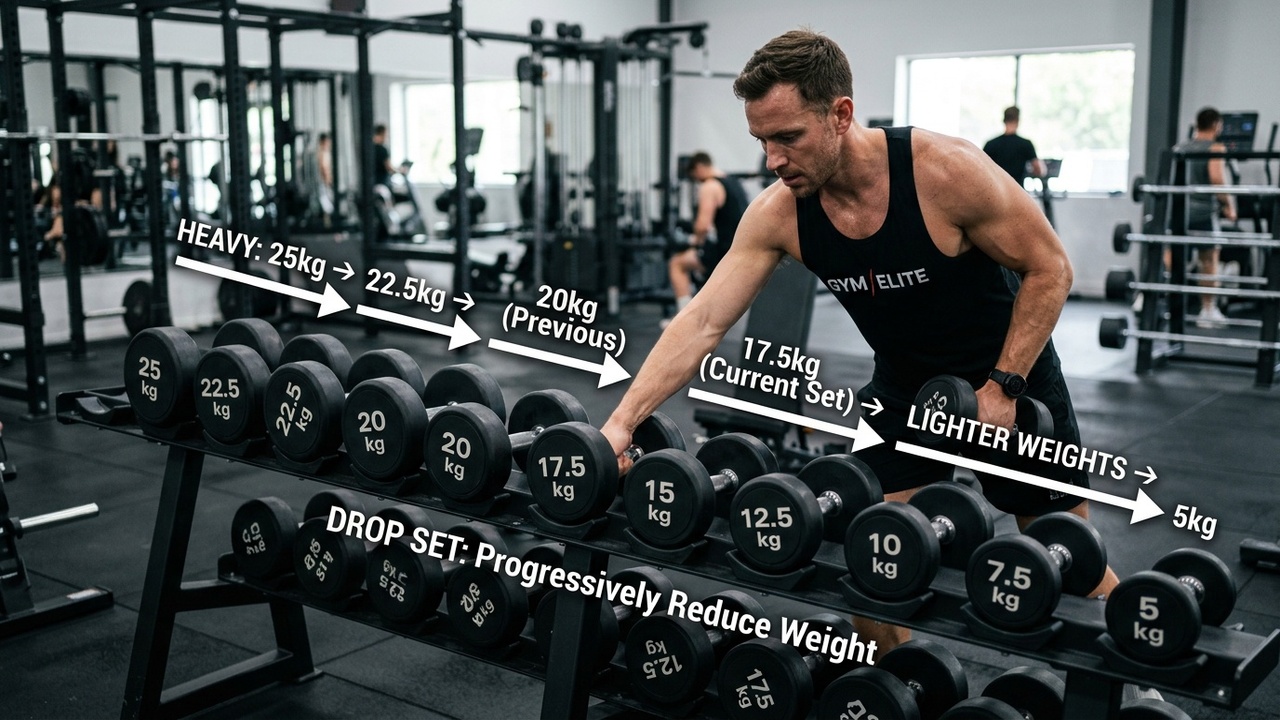
A drop set is a technique where you perform an exercise to failure (or near failure), immediately reduce the weight by 20-30%, and continue performing reps without rest. You can "drop" the weight once, twice, or three times within a single extended set.
Example: Dumbbell lateral raise
- 15 kg x 10 reps (near failure)
- Drop to 10 kg x 8 reps (near failure)
- Drop to 5 kg x 12 reps (failure)
That is one drop set with two drops. The entire sequence counts as one extended set.
Standard Drop Sets
Reduce the weight by 20-30% with each drop. Perform 2-3 drops total. This is the most common and well-researched drop set method.
Mechanical Drop Sets
Instead of reducing weight, you change the exercise variation to a mechanically advantageous position:
- Incline dumbbell curl → standing dumbbell curl → hammer curl
- Close-grip bench press → standard bench press → wide-grip bench press
Each variation is progressively "easier" due to better leverage, allowing you to continue with the same weight. These are advanced and require pre-planning.
Rest-Pause Drop Sets
Perform a set to failure, rest 10-15 seconds (just long enough to partially recover your ATP-CP system), then continue with the same weight for additional reps. This is technically a rest-pause set, but it functions similarly to a drop set by extending the set beyond initial failure.
Benefits of Drop Sets
Maximum muscle fiber recruitment. As you fatigue and drop weight, your body recruits additional motor units to continue producing force. By the end of a drop set, you have activated nearly every available muscle fiber — far more than a single straight set.
Time-efficient volume. A single drop set can provide the metabolic stress and volume of 2-3 straight sets in less time.
Extreme metabolic stress. The continuous work without rest creates massive metabolite accumulation. The pump from drop sets is legendary and represents genuine cellular stress that contributes to hypertrophy.
Plateau-breaking stimulus. When straight sets stop producing results, drop sets introduce a novel stimulus that can restart adaptation. Read more about breaking through plateaus in our breaking strength plateaus guide.
Supersets vs Drop Sets: When to Use Each
| Factor | Supersets | Drop Sets |
|---|---|---|
| Best for | Time efficiency, opposing muscles | Maximum fatigue on one muscle |
| Fatigue level | Moderate (antagonist) to High (agonist) | Very high |
| Recovery demand | Moderate | High |
| Position in workout | Throughout | End of workout (finisher) |
| Frequency | Can use every session | 1-2x per muscle per week |
| Best exercises for | Compound + compound or compound + isolation | Isolation and machine exercises |
Use supersets when:
- You are short on time and need to fit more work into less time
- You want to train opposing muscle groups efficiently
- You want moderate metabolic stress without extreme fatigue
Use drop sets when:
- You want to completely exhaust a muscle after your main work
- You need a plateau-breaking stimulus
- You are doing a finisher on the last exercise for a muscle group
Do not use either when:
- You are a complete beginner (master straight sets first)
- You are training for maximal strength (where full recovery between sets is critical)
- You are deep in a calorie deficit with limited recovery capacity
How to Program Supersets
Best Superset Pairings
| Superset Pair | Type | Muscles |
|---|---|---|
| Bench Press + Barbell Row | Antagonist | Chest + Back |
| Overhead Press + Pull-Ups | Antagonist | Shoulders + Lats |
| Bicep Curl + Tricep Pushdown | Antagonist | Biceps + Triceps |
| Leg Extension + Leg Curl | Antagonist | Quads + Hamstrings |
| Dumbbell Fly + Dumbbell Row | Antagonist | Chest + Upper Back |
| Bench Press + Cable Fly | Post-exhaustion | Chest + Chest |
| Lateral Raise + Overhead Press | Pre-exhaustion | Side Delts + All Delts |
| Squat + Leg Extension | Post-exhaustion | Quads + Quads |
Sets, Reps, and Rest
Antagonist supersets:
- 3-4 supersets (3-4 sets of each exercise)
- 8-12 reps per exercise
- Rest 60-90 seconds after completing both exercises
Agonist supersets:
- 2-3 supersets
- 8-12 reps on the first exercise, 10-15 reps on the second
- Rest 90-120 seconds after completing both exercises
Do not superset heavy compound movements that require maximum concentration and stability (e.g., do not superset heavy squats with heavy deadlifts). Save supersets for moderate-intensity work or pair a heavy compound with a lighter isolation exercise.
How to Program Drop Sets
How Many Drops per Set
2-3 drops is the sweet spot. Research shows diminishing returns beyond 3 drops. A single set with 2 drops (3 total mini-sets) provides excellent stimulus without excessive fatigue.
- Conservative: 1 drop (2 mini-sets total) — good starting point
- Standard: 2 drops (3 mini-sets total) — most common and well-researched
- Aggressive: 3 drops (4 mini-sets total) — advanced only, very fatiguing
Weight Reduction Guidelines
Reduce weight by 20-30% with each drop.
Example (dumbbell curl):
- Start: 15 kg → Drop 1: 10 kg (33% reduction) → Drop 2: 7.5 kg (25% reduction)
On machines, the weight stack makes drops easy and precise. With dumbbells, you need to pre-select your weights or have them ready. With barbells, you need a partner to strip plates or use pre-loaded bars.
Tip: Drop sets work best on machines and dumbbells because the weight changes are fast. Stripping plates from a barbell during a drop set wastes time and breaks the intensity.
Use drop sets as finishers. Place them on the last set of the last exercise for a muscle group. Do not drop-set every exercise — the fatigue cost is too high.
Sample Superset Workout (Full Body)
This antagonist superset workout trains the full body in approximately 45 minutes:
| Superset | Exercise A | Exercise B | Sets x Reps | Rest |
|---|---|---|---|---|
| 1 | Barbell Bench Press | Barbell Row | 4 x 8-10 | 90 sec |
| 2 | Overhead Press | Lat Pulldown | 3 x 10-12 | 90 sec |
| 3 | Leg Extension | Leg Curl | 3 x 12-15 | 60 sec |
| 4 | Dumbbell Curl | Tricep Pushdown | 3 x 10-12 | 60 sec |
| 5 | Lateral Raise | Face Pull | 2 x 15 | 60 sec |
Total time: ~45 minutes. Total sets: 30 (15 pairs). This workout would take 70-80 minutes with straight sets and traditional rest periods.
Sample Drop Set Workout (Push Day)
This push workout uses straight sets for compounds and drop sets for finishers:
| Exercise | Protocol | Sets x Reps | Rest |
|---|---|---|---|
| Barbell Bench Press | Straight sets | 4 x 6-8 | 3 min |
| Incline Dumbbell Press | Straight sets | 3 x 8-10 | 2 min |
| Cable Fly | Drop set (last set only) | 2 straight + 1 drop set | 90 sec |
| Overhead Press | Straight sets | 3 x 8-10 | 2 min |
| Lateral Raise | Drop set (last set only) | 2 straight + 1 drop set | 60 sec |
| Tricep Pushdown | Drop set (last set only) | 2 straight + 1 drop set | 60 sec |
The drop sets are finishers only — one drop set on the last exercise for each muscle group. This adds volume and metabolic stress without overwhelming recovery.
For more training principles that drive muscle growth, read our hypertrophy training guide and progressive overload guide.
Common Mistakes to Avoid
Using supersets and drop sets on every exercise. These are intensity techniques, not the foundation of your program. Straight sets with progressive overload should still comprise 70-80% of your training. Supersets and drop sets are additions, not replacements.
Supersetting exercises that require the same equipment. Supersetting bench press with dumbbell rows works because they use different equipment. Supersetting two cable exercises on the same cable station does not work in a busy gym — someone will take your station.
Dropping weight too much or too little on drop sets. A 50% drop makes the weight too easy and the reps too high. A 10% drop means you only get 1-2 additional reps. Aim for 20-30% drops that allow 6-10 additional reps per drop.
Using drop sets on heavy compound lifts. Drop-setting squats or deadlifts is dangerous. Form breaks down rapidly after failure on these movements. Save drop sets for isolation and machine exercises where form degradation is safer.
Ignoring recovery. Both techniques create more fatigue than straight sets. If you add them to your program, you may need to reduce total training volume slightly or ensure adequate sleep and nutrition.
Generate a program that integrates these advanced techniques using the free workout planner. The AI can build structured workouts that include supersets for time efficiency and drop sets for targeted muscle fatigue. Browse individual exercises in the exercise library. Download Load Muscle to track your performance with these techniques.
FAQ
Are supersets better than straight sets for muscle growth?
Research shows that supersets and straight sets produce comparable muscle growth when total volume is equal. The advantage of supersets is time efficiency — you can achieve the same results in 30-40% less time using antagonist supersets. For agonist supersets, the additional metabolic stress may provide a slight hypertrophy advantage, but the evidence is not conclusive.
How many drop sets should I do per workout?
Limit drop sets to 1-3 per workout, typically as finishers on the last exercise for a muscle group. Using drop sets on every exercise creates excessive fatigue, impairs recovery, and can lead to overtraining. One well-placed drop set at the end of your chest, shoulder, or arm work is more effective than multiple drop sets throughout.
Can beginners use supersets and drop sets?
Beginners should master straight sets and proper form before adding intensity techniques. After 3-6 months of consistent training, simple antagonist supersets can be introduced for time efficiency. Drop sets should wait until you have at least 6-12 months of training experience and a solid foundation of strength and form.
What exercises are best for drop sets?
Machine exercises and dumbbell isolation exercises work best for drop sets because weight changes are quick and form is easier to maintain under fatigue. Leg extensions, cable flyes, lateral raises, leg curls, and machine presses are all excellent drop set exercises. Avoid drop sets on barbell squats, deadlifts, and other complex compound movements.
Should I use supersets when training for strength?
Generally no. Strength training requires full recovery between sets (3-5 minutes) to maintain maximum force production. Supersets reduce rest time and can impair performance on heavy sets. The exception is pairing a heavy compound lift with a light, non-competing exercise (e.g., heavy bench press with band pull-aparts for shoulder health).
Can I combine supersets and drop sets in the same workout?
Yes. A common approach is to use antagonist supersets for your main compound work (saving time) and then finish with a drop set on the last isolation exercise for each muscle group (maximum fatigue). For example: superset bench press with barbell rows for 4 sets, then finish with a drop set on cable flyes.
Want programs that already use these intensity techniques? Browse our quick workout routines — supersets and density blocks are built into many of them.