You do not need to live in the gym to build a great physique. A well-designed 3 day split can build muscle, increase strength, and improve body composition — even for lifters who think three days is not enough.
The key is efficiency. When you only train three days per week, every exercise, every set, and every rep needs to earn its place. No junk volume, no redundant movements, no wasted time. The programs in this guide are built for maximum results in minimum time.
Whether you are busy with work, family, travel, or just prefer fewer gym days, a 3-day split is a legitimate long-term training strategy — not a compromise.
TL;DR
- A 3-day split trains your full body across three weekly sessions with at least one rest day between workouts.
- Best options: Full Body x3, Push/Pull/Legs, or Upper/Lower/Full Body.
- Full Body 3x is the best choice for most lifters — it provides the highest training frequency per muscle group (3x/week).
- Each muscle group gets sufficient weekly volume (10-15 sets) spread across multiple sessions.
- Best for: Busy lifters, beginners, intermediates, and anyone who values training efficiency.
- Generate a custom 3-day plan with the free workout planner.
Why Train 3 Days Per Week?
Three days per week is the minimum effective training frequency for meaningful muscle and strength gains. Research supports this — multiple studies show that training a muscle group 2-3 times per week produces equal or greater hypertrophy compared to once-per-week training, even when total weekly volume is matched.
Practical advantages of 3-day training:
- Recovery: Four rest days per week means excellent recovery, lower injury risk, and the ability to bring maximum intensity to every session.
- Sustainability: Three gym sessions fit into virtually any schedule. This makes the program sustainable for months and years, which is what actually produces results.
- Life balance: Training is important, but it is not your entire life. Three days leaves room for sports, hobbies, family, and other physical activities.
- Beginner-friendly: New lifters do not need (and often cannot recover from) 5-6 training days. Three days builds the habit without overwhelming the body.
The lifters who make the best long-term progress are not the ones who train 6 days per week for 3 months and burn out. They are the ones who train consistently for years. A 3-day schedule for busy people is one of the most sustainable approaches available.
Best 3-Day Split Options
Option 1 -- Push / Pull / Legs
| Day | Focus | Muscles |
|---|---|---|
| Monday | Push | Chest, shoulders, triceps |
| Wednesday | Pull | Back, biceps, rear delts |
| Friday | Legs | Quads, hamstrings, glutes, calves |
The 3-day PPL is a compressed version of the popular push/pull/legs routine. Each muscle group is trained once per week with high volume per session. This is the least ideal 3-day option for frequency (1x/week per muscle), but it works well for intermediate lifters who prefer focused training days.
Option 2 -- Upper / Lower / Full Body
| Day | Focus | Muscles |
|---|---|---|
| Monday | Upper Body | Chest, back, shoulders, arms |
| Wednesday | Lower Body | Quads, hamstrings, glutes, calves |
| Friday | Full Body | All muscle groups |
This hybrid approach gives every muscle group at least two touches per week — upper body gets hit Monday and Friday, lower body gets hit Wednesday and Friday. It balances the volume-per-session of a split with the frequency benefit of full body. Read more about this approach in our upper/lower split guide.
Option 3 -- Full Body x3
| Day | Focus | Muscles |
|---|---|---|
| Monday | Full Body A | All muscle groups |
| Wednesday | Full Body B | All muscle groups |
| Friday | Full Body C | All muscle groups |
This is the best 3-day split for most lifters. Every muscle group is trained three times per week, which maximizes the frequency advantage. Each session includes lower volume per muscle (3-5 sets) but the weekly total adds up to 9-15 sets per muscle group — well within the productive range.
Full body training is particularly effective because each session stimulates muscle protein synthesis across the entire body, and protein synthesis remains elevated for 24-48 hours. Training three times per week keeps the growth signal consistently elevated.
Option 4 -- Chest+Back / Shoulders+Arms / Legs
| Day | Focus | Muscles |
|---|---|---|
| Monday | Chest + Back | Pecs, lats, traps, rhomboids |
| Wednesday | Shoulders + Arms | All three delt heads, biceps, triceps |
| Friday | Legs | Quads, hamstrings, glutes, calves |
This is a bro-split-style approach in 3 days. Each muscle gets hit once per week with moderate volume per session. Not optimal for frequency, but some lifters prefer the dedicated focus. Pairing chest and back (antagonist muscles) allows supersets for time efficiency.
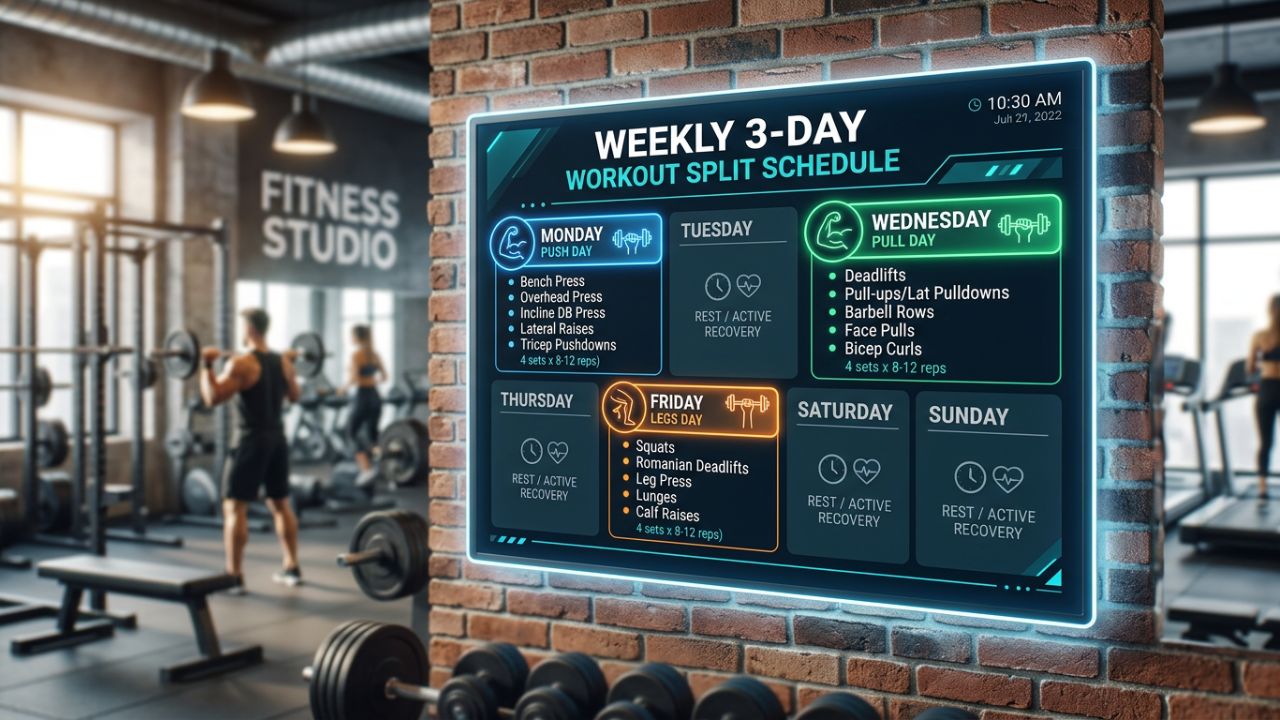
3-Day PPL Workout Plan (Full Workouts)
Day 1: Push
| Exercise | Sets x Reps | Rest |
|---|---|---|
| Barbell Bench Press | 4 x 6-8 | 3 min |
| Overhead Press | 3 x 8-10 | 2 min |
| Incline Dumbbell Press | 3 x 10-12 | 2 min |
| Lateral Raise | 3 x 12-15 | 60 sec |
| Cable Tricep Pushdown | 3 x 10-12 | 60 sec |
| Overhead Tricep Extension | 2 x 12-15 | 60 sec |
Day 2: Pull
| Exercise | Sets x Reps | Rest |
|---|---|---|
| Barbell Row | 4 x 6-8 | 3 min |
| Pull-Ups or Lat Pulldown | 3 x 8-10 | 2 min |
| Seated Cable Row | 3 x 10-12 | 2 min |
| Face Pull | 3 x 12-15 | 60 sec |
| Barbell Curl | 3 x 10-12 | 60 sec |
| Hammer Curl | 2 x 12-15 | 60 sec |
Day 3: Legs
| Exercise | Sets x Reps | Rest |
|---|---|---|
| Barbell Back Squat | 4 x 6-8 | 3 min |
| Romanian Deadlift | 3 x 8-10 | 2 min |
| Leg Press | 3 x 10-12 | 2 min |
| Leg Curl | 3 x 10-12 | 90 sec |
| Calf Raise | 4 x 12-15 | 60 sec |
| Plank | 3 x 30-45 sec | 60 sec |
3-Day Full Body Workout Plan (Full Workouts)
Day 1: Full Body A (Strength Focus)
| Exercise | Sets x Reps | Rest |
|---|---|---|
| Barbell Back Squat | 4 x 5 | 3 min |
| Barbell Bench Press | 4 x 5 | 3 min |
| Barbell Row | 3 x 6-8 | 2 min |
| Dumbbell Lateral Raise | 3 x 12-15 | 60 sec |
| Barbell Curl | 2 x 10-12 | 60 sec |
Day 2: Full Body B (Hypertrophy Focus)
| Exercise | Sets x Reps | Rest |
|---|---|---|
| Romanian Deadlift | 3 x 8-10 | 2 min |
| Dumbbell Bench Press | 3 x 10-12 | 2 min |
| Pull-Ups or Lat Pulldown | 3 x 8-10 | 2 min |
| Overhead Press | 3 x 8-10 | 2 min |
| Leg Curl | 3 x 10-12 | 90 sec |
| Cable Tricep Pushdown | 2 x 12-15 | 60 sec |
Day 3: Full Body C (Volume Focus)
| Exercise | Sets x Reps | Rest |
|---|---|---|
| Leg Press | 3 x 12-15 | 2 min |
| Incline Dumbbell Press | 3 x 10-12 | 2 min |
| Seated Cable Row | 3 x 10-12 | 2 min |
| Bulgarian Split Squat | 3 x 10 each | 90 sec |
| Face Pull | 3 x 15 | 60 sec |
| Hammer Curl | 2 x 12-15 | 60 sec |
3-Day Split for Beginners
Beginners should start with the Full Body x3 approach. Here is why:
- Frequency: Practicing compound movements three times per week accelerates skill development. Squatting once per week means 52 squat sessions per year. Squatting three times per week means 156. More practice equals faster technique improvement.
- Volume tolerance: Beginners do not need (and cannot recover from) high per-session volume. 3-5 sets per muscle per session is sufficient when you are new.
- Simplicity: One program, three identical training days with slight variations. No complex periodization needed.
Beginner 3-Day Full Body:
| Exercise | Sets x Reps |
|---|---|
| Goblet Squat (progress to Barbell Squat) | 3 x 8-10 |
| Dumbbell Bench Press (progress to Barbell) | 3 x 8-10 |
| Dumbbell Row | 3 x 8-10 |
| Overhead Press | 3 x 8-10 |
| Romanian Deadlift | 3 x 8-10 |
| Plank | 3 x 30 sec |
Add weight when you can complete all sets at the top of the rep range with good form. This linear progression works for 3-6 months for most beginners. For more beginner options, read our full body workout plan.
3-Day Split for Intermediate Lifters
Intermediate lifters (6+ months of consistent training) benefit from slightly more volume and exercise variety than beginners. The Full Body x3 approach with A/B/C variation is ideal — it provides enough variety to target muscles from different angles while maintaining the frequency advantage.
The full body workout plan above (A/B/C) is designed for intermediates. Key differences from beginner programming:
- More total sets (15-18 per session vs 10-12)
- More exercise variety (5-6 exercises per session vs 4-5)
- Periodized intensity (strength day, hypertrophy day, volume day)
- Isolation work added (curls, lateral raises, face pulls)
Intermediate lifters should also consider adding one accessory exercise per session for their weakest body part.
How to Progress on a 3-Day Split
Progressive overload drives results on any split. Here is how to apply it on a 3-day program:
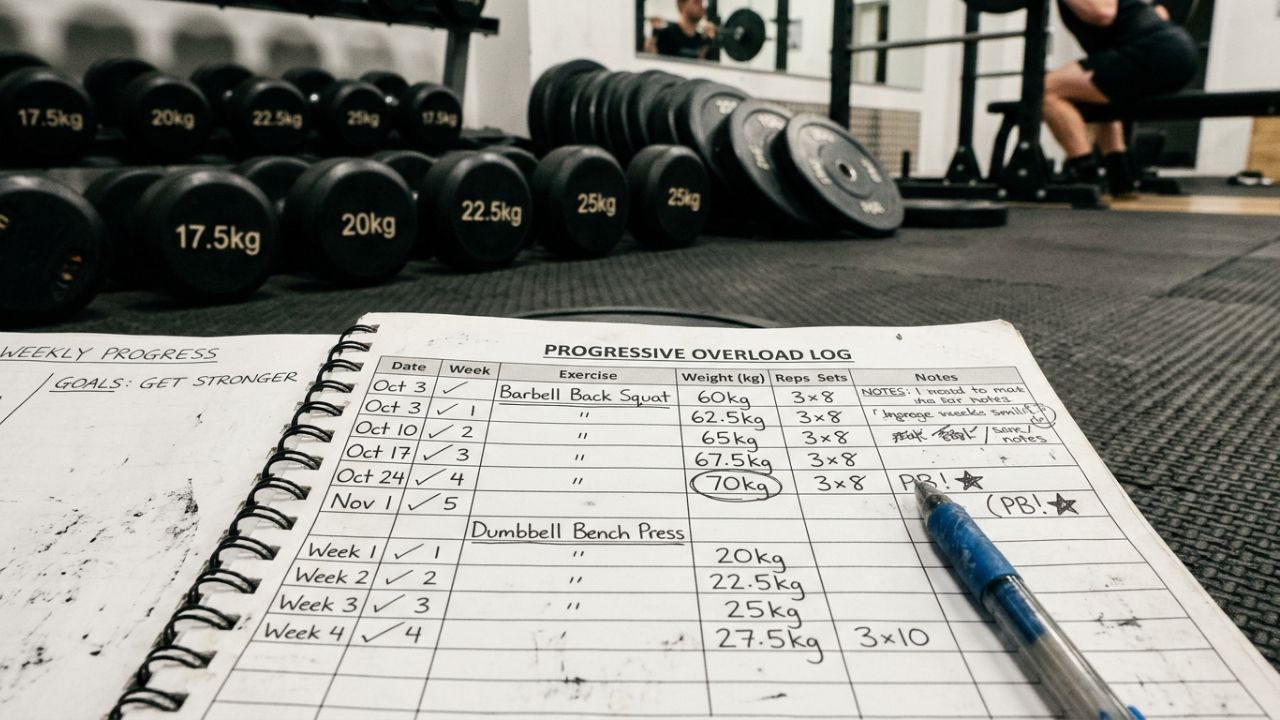
Double progression: Pick a rep range (e.g., 8-10). Start at the bottom (8 reps). Add reps each session until you hit the top (10 reps across all sets). Then increase weight by the smallest increment available and start back at 8 reps.
Weekly weight increases: For beginners, add 2.5 kg to upper body lifts and 5 kg to lower body lifts each week. For intermediates, aim for bi-weekly or monthly increases.
Volume progression: Add one set per muscle group every 2-3 weeks until you reach your maximum recoverable volume, then deload and restart with lower volume.
Track your progress with a workout app. Seeing your numbers improve week over week is both motivating and informative. The free workout planner builds progression into your program automatically.
3-Day Split vs 4-Day Split vs 5-Day Split
| Factor | 3-Day Split | 4-Day Split | 5-Day Split |
|---|---|---|---|
| Training frequency per muscle | 2-3x/week (full body) | 2x/week (U/L) | 1-2x/week |
| Recovery days | 4 | 3 | 2 |
| Volume per session | Moderate | Moderate-high | High |
| Time commitment | Low | Moderate | High |
| Best for | Beginners, busy lifters | Intermediates | Advanced, bodybuilders |
| Sustainability | Very high | High | Moderate |
The 3-day split is not "worse" than 4 or 5-day splits — it is different. Research shows that total weekly volume matters more than how it is distributed. If you can hit 10-15 sets per muscle per week across 3 sessions, you will grow just as well as someone doing the same volume across 5 sessions.
The advantage of more training days is the ability to do more total volume. If you need 20+ sets per muscle per week to grow (which typically only applies to advanced lifters), a 3-day split makes that difficult.
For a complete comparison of all split options, see our best workout split guide.
Rest Day Scheduling
The most common 3-day schedule:
- Monday / Wednesday / Friday — One rest day between each session, two rest days on the weekend.
- Tuesday / Thursday / Saturday — Same structure, shifted one day.
- Sunday / Tuesday / Thursday — Avoids Monday gym crowds.
The specific days do not matter. What matters is at least one rest day between sessions. This is especially important for full body training, where the same muscles are trained each session. Back-to-back full body days impair recovery and reduce performance.
On rest days, light activity (walking, stretching, easy cycling) supports recovery better than total inactivity. Read our full body workout plan for more scheduling options.
Build Your 3-Day Split with Load Muscle
Load Muscle's AI planner is designed to build efficient programs for any training frequency, including 3-day splits. When you set your available days to 3, the AI optimizes:
- Exercise selection for maximum muscle coverage per session
- Volume distribution across sessions
- Progressive overload progression
- Equipment-specific exercise choices
Generate your custom 3-day program with the free workout planner. The AI considers your goals, experience, and equipment to build the most effective 3-day split for your situation. Download Load Muscle to start training with a plan built for your schedule.
Browse more structured programs in our workout routines collection.
FAQ
Is a 3-day split enough to build muscle?
Yes. Research shows that muscle growth depends primarily on total weekly volume and progressive overload, not training frequency. A well-designed 3-day split providing 10-15 sets per muscle per week is sufficient for most lifters to build significant muscle. Many natural lifters have built impressive physiques training only three days per week.
What is the best 3-day split for beginners?
Full Body x3 is the best 3-day split for beginners. It provides the highest training frequency per muscle group (3x/week), which accelerates skill development on compound lifts. Beginners also respond well to lower per-session volume, making full body training ideal. Start with 3 sets per exercise, 4-5 compound exercises per session.
Can I do cardio on rest days?
Yes, and it is recommended. Light to moderate cardio on rest days (walking, cycling, swimming) improves recovery, cardiovascular health, and overall fitness. Avoid high-intensity cardio that would impair recovery for your next lifting session. 20-30 minutes of moderate cardio on rest days is a good target.
Is a 3-day or 5-day split better?
Neither is inherently better. The 3-day split provides more recovery and is more sustainable for busy lifters. The 5-day split allows more volume and exercise variety. If you can train 5 days consistently without burnout, you may see slightly faster progress. But a 3-day split followed consistently will always beat a 5-day split followed inconsistently.
Should I do the same workout all three days?
You can, but rotating between A/B/C variations is more effective for intermediate and advanced lifters. Different exercises on each day target muscles from different angles, prevent monotony, and allow for periodized intensity (one heavy day, one moderate day, one light day). Beginners can do the same workout all three days and progress just fine.
How long should each workout be on a 3-day split?
Most effective 3-day split workouts take 45-75 minutes. Full body sessions with 5-6 exercises at 3-4 sets each, including warm-up and rest periods, fit comfortably in this timeframe. If your sessions regularly exceed 90 minutes, you are likely doing too many exercises or resting too long between sets.