The bro split has been declared dead more times than any other training program. Every few years, a new study or fitness influencer proclaims that training each muscle once per week is suboptimal, outdated, and inferior to higher-frequency splits.
And yet, the bro split refuses to die. Gyms around the world are full of lifters running chest Monday, back Tuesday, shoulders Wednesday — and plenty of them are making excellent progress.
So what is the truth? Is the bro split an effective training approach, or are you leaving gains on the table? This guide breaks it all down: how to structure a bro split, the real pros and cons, sample workout plans, and how it compares to popular alternatives like push/pull/legs and upper/lower splits.
TL;DR
- A bro split trains one muscle group per day across 5 days, hitting each muscle once per week.
- Pros: High volume per muscle per session, simple to follow, great for advanced lifters who need significant volume.
- Cons: Each muscle is only trained once per week. Research suggests 2x/week frequency may be superior for hypertrophy in most people.
- Best for: Intermediate to advanced lifters who can handle high single-session volume and prefer dedicated muscle group days.
- Not ideal for: Beginners (who benefit from higher frequency) or lifters with fewer than 4 training days per week.
- Need help choosing a split? Read our best workout split guide or generate a plan with the free workout planner.
What Is a Bro Split?
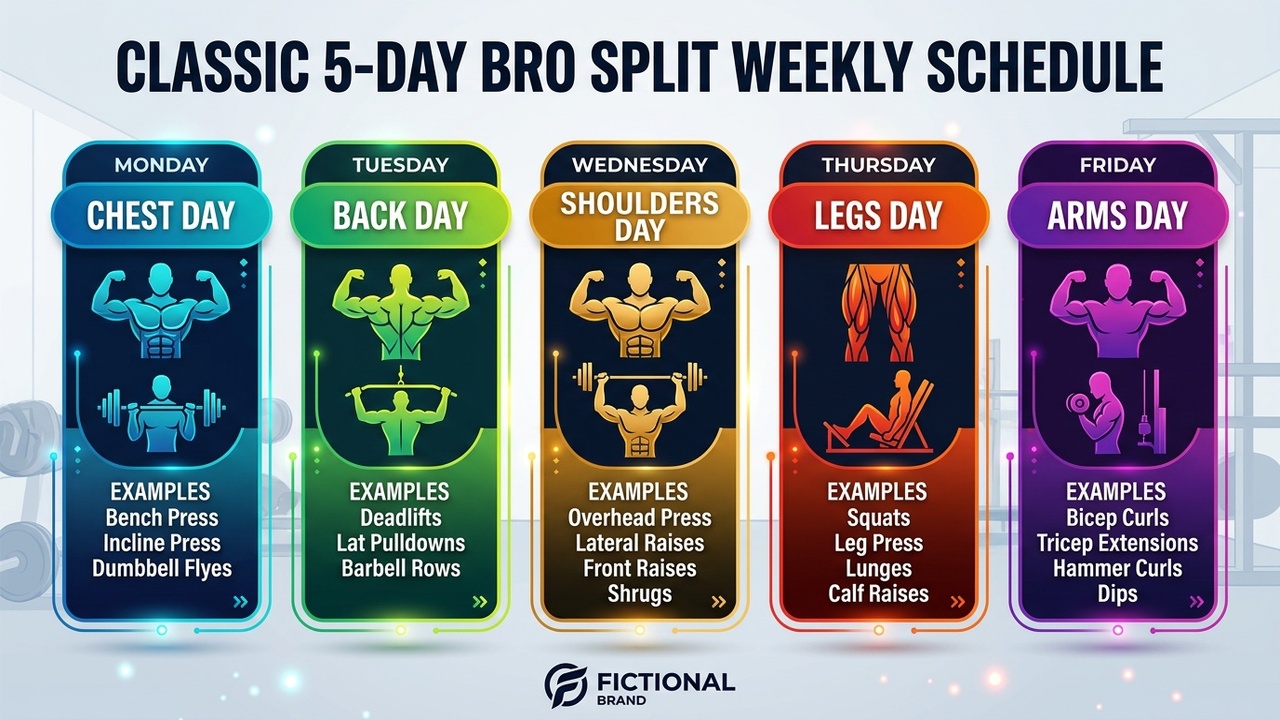
A bro split is a training program that dedicates one training day to one major muscle group. The classic version runs five days per week, with each day focused on a single body part: chest, back, shoulders, arms, and legs.
The name comes from gym culture — it is the split your "bro" at the gym taught you. It was the dominant training style in bodybuilding from the 1980s through the 2010s, popularized by professional bodybuilders who trained this way with enormous success.
The defining characteristic is low frequency, high volume per session. Each muscle group gets hit with 15-25+ sets in a single workout, then rests for a full week before being trained again. This allows maximum volume and intensity for each muscle group on its dedicated day.
Classic 5-Day Bro Split Schedule
The traditional bro split follows this weekly structure:
| Day | Focus | Rest Between |
|---|---|---|
| Monday | Chest | 7 days |
| Tuesday | Back | 7 days |
| Wednesday | Shoulders | 7 days |
| Thursday | Arms (Biceps + Triceps) | 7 days |
| Friday | Legs | 7 days |
| Saturday | Rest | — |
| Sunday | Rest | — |
Here is what a typical workout looks like for each day.
Day 1 -- Chest
| Exercise | Sets | Reps | Rest |
|---|---|---|---|
| Flat Barbell Bench Press | 4 | 6-8 | 3 min |
| Incline Dumbbell Press | 4 | 8-10 | 2 min |
| Dumbbell Fly | 3 | 10-12 | 90 sec |
| Cable Crossover | 3 | 12-15 | 90 sec |
| Machine Chest Press | 3 | 10-12 | 90 sec |
Total: 17 sets for chest in one session. This volume would be excessive if split across multiple days, but on a bro split it is the only chest stimulus for the entire week.
Day 2 -- Back
| Exercise | Sets | Reps | Rest |
|---|---|---|---|
| Barbell Deadlift | 4 | 5-6 | 3 min |
| Pull-Ups or Lat Pulldown | 4 | 8-10 | 2 min |
| Barbell Row | 4 | 8-10 | 2 min |
| Seated Cable Row | 3 | 10-12 | 90 sec |
| Face Pull | 3 | 12-15 | 90 sec |
Total: 18 sets for back. The deadlift also hits hamstrings and glutes, creating some indirect leg stimulus.
Day 3 -- Shoulders
| Exercise | Sets | Reps | Rest |
|---|---|---|---|
| Overhead Press (Barbell or Dumbbell) | 4 | 6-8 | 3 min |
| Dumbbell Lateral Raise | 4 | 12-15 | 60 sec |
| Reverse Fly (Rear Delts) | 4 | 12-15 | 60 sec |
| Cable Lateral Raise | 3 | 12-15 | 60 sec |
| Dumbbell Shrugs | 3 | 10-12 | 90 sec |
Total: 18 sets for shoulders. Note the high volume on lateral raises — side delts respond well to volume.
Day 4 -- Arms
| Exercise | Sets | Reps | Rest |
|---|---|---|---|
| Barbell Curl | 3 | 8-10 | 90 sec |
| Close-Grip Bench Press | 3 | 8-10 | 2 min |
| Dumbbell Hammer Curl | 3 | 10-12 | 90 sec |
| Cable Tricep Pushdown | 3 | 10-12 | 90 sec |
| Incline Dumbbell Curl | 3 | 10-12 | 90 sec |
| Overhead Tricep Extension | 3 | 10-12 | 90 sec |
Total: 18 sets (9 biceps, 9 triceps). Note that biceps and triceps already get indirect work on back and chest days.
Day 5 -- Legs
| Exercise | Sets | Reps | Rest |
|---|---|---|---|
| Barbell Back Squat | 4 | 6-8 | 3 min |
| Romanian Deadlift | 4 | 8-10 | 2 min |
| Leg Press | 3 | 10-12 | 2 min |
| Leg Extension | 3 | 12-15 | 90 sec |
| Lying Leg Curl | 3 | 10-12 | 90 sec |
| Standing Calf Raise | 4 | 12-15 | 60 sec |
Total: 21 sets for legs. This is a demanding session, which is why legs is often placed on Friday — you have the weekend to recover.
Bro Split Pros and Cons
Advantages of the Bro Split
Maximum volume per muscle per session. When you dedicate an entire workout to chest, you can hit it from every angle with 15-20+ sets. This creates significant mechanical tension and metabolic stress. For advanced lifters who need high volume to stimulate growth, this concentrated approach can be effective.
Simple to understand and follow. There is no confusion about which muscles to train on which day. Monday is chest. Tuesday is back. The simplicity reduces decision fatigue and makes it easy to stay consistent. You do not need a degree in exercise science to follow a bro split.
Allows full recovery between sessions for each muscle. With a full week between training sessions for each body part, there is no risk of inadequate recovery. This can be advantageous for lifters who train with extreme intensity and need more recovery time.
Proven track record. Decades of bodybuilders have built impressive physiques on bro splits. Arnold, Ronnie Coleman, Jay Cutler — many of the greatest bodybuilders trained with some variation of this approach. While anecdotal, the track record is hard to ignore.
Mental satisfaction. There is something psychologically rewarding about demolishing a single muscle group. The pump, the fatigue, the feeling of having completely worked a body part — many lifters find this more satisfying than spreading volume across multiple muscles.
Disadvantages and Limitations
Low training frequency per muscle. This is the bro split's biggest weakness according to current research. A 2016 meta-analysis by Schoenfeld et al. found that training each muscle group twice per week produced significantly greater hypertrophy than once per week. The difference was meaningful — about 3.1% muscle thickness increase for 2x frequency vs. 1.5% for 1x.
Requires 5 training days. If you can only train 3-4 days per week, a bro split does not work. You either skip a muscle group or compress the schedule, which defeats the purpose.
Redundant volume for smaller muscles. Biceps get trained directly on arm day and indirectly during back day. Triceps get hit on arm day and during chest and shoulder days. Front delts are hit on shoulder day and during chest presses. This overlap means some muscles get more total weekly volume than intended.
Long workouts. Fitting 17-21 sets for a single muscle group into one session creates long workouts, often 60-90 minutes. If time is limited, this is a disadvantage.
Not ideal for beginners. Beginners respond to training with less volume and benefit from higher frequency to develop motor patterns. A bro split gives them too much volume per session and too little practice frequency.
Bro Split vs Push Pull Legs
The push/pull/legs (PPL) split is the bro split's most direct competitor. Here is how they compare:
| Factor | Bro Split (5-day) | PPL (6-day, run 2x) |
|---|---|---|
| Frequency per muscle | 1x/week | 2x/week |
| Training days | 5 | 6 |
| Volume per session | Very high (15-20+ sets) | Moderate (8-12 sets) |
| Weekly volume | 15-20 sets/muscle | 16-24 sets/muscle |
| Best for | Advanced, high-volume tolerance | Intermediate-advanced |
| Recovery demands | Low per muscle, high per session | Moderate overall |
PPL has a clear advantage in training frequency, which research favors for hypertrophy. But PPL requires 6 training days — one more than the bro split. If you can commit to 6 days, PPL is generally the stronger choice for muscle growth. If 5 days is your limit, the bro split is a reasonable alternative.
For a deeper comparison of all split options, read our best workout split guide.
Bro Split vs Upper Lower Split
The upper/lower split trains upper body and lower body on alternating days, typically 4 days per week with each muscle hit twice.
| Factor | Bro Split (5-day) | Upper/Lower (4-day) |
|---|---|---|
| Frequency per muscle | 1x/week | 2x/week |
| Training days | 5 | 4 |
| Volume per session | Very high | Moderate-high |
| Best for | Advanced lifters | All levels |
| Time commitment | 5 days/week | 4 days/week |
Upper/lower is the more time-efficient split. You get twice the frequency in fewer training days. The tradeoff is that each session covers more muscle groups, so per-muscle volume per session is lower. For most lifters — especially beginners and intermediates — upper/lower is the more effective choice.
Who Is the Bro Split Best For?
The bro split works best for a specific type of lifter:
Advanced lifters who need high volume. If you have been training for 3+ years and your muscles require 15-20 sets per week to grow, concentrating that volume into one session can work. At this level, you have the work capacity to handle the session demands.
Bodybuilders preparing for competition. The bro split allows you to dedicate entire sessions to weak body parts with extreme isolation work. If your rear delts need extra attention, you have a full shoulder day to address that.
Lifters who can train 5 days per week consistently. The bro split falls apart if you miss a day. Skip leg day, and your legs get zero stimulus for two weeks. You need reliable 5-day availability.
People who enjoy the focused approach. If chest day is your favorite day of the week and the thought of combining chest with shoulders and triceps feels wrong, the bro split fits your training personality.
The bro split is not ideal for:
- Beginners (insufficient frequency for skill development)
- Lifters with fewer than 5 available training days
- People focused on strength rather than hypertrophy
- Anyone who frequently misses training sessions
How to Optimize a Bro Split for Hypertrophy
If you choose to run a bro split, here is how to get the most out of it:
Start compounds, finish isolations. Begin each session with heavy compound movements (bench press on chest day, squat on leg day) and finish with isolation work. This maximizes mechanical tension when you are freshest.
Control total weekly volume. Just because you have an entire session for one muscle does not mean you should do 25+ sets. Research suggests 10-20 sets per muscle per week is the productive range. Going beyond 20 sets per week shows diminishing returns. For specific guidance on volume and intensity, read our hypertrophy training guide.
Add strategic overlap. You can partially address the frequency limitation by including indirect work. For example, adding close-grip bench press on arm day provides additional chest stimulus. Adding chin-ups on arm day gives your back an extra hit.
Periodize intensity. Alternate between higher-load (6-8 rep) and higher-volume (10-15 rep) phases every 4-6 weeks. This prevents adaptation and keeps the growth stimulus fresh.
Do not skip legs. Ever.
3-Day Bro Split Variation
If you can only train 3 days per week, you can modify the bro split by combining muscle groups:
| Day | Focus | Exercises |
|---|---|---|
| Monday | Chest + Arms | Bench variations, curls, pushdowns |
| Wednesday | Back + Shoulders | Rows, pulldowns, lateral raises, OHP |
| Friday | Legs + Abs | Squats, RDLs, leg press, core work |
This is not a true bro split — it is closer to a modified full-body or push/pull/legs format. But it retains the "dedicated focus" feel while training muscles more frequently. Each muscle still gets significant volume per session.
Sample Bro Split Workout Plan (Full Week)
Here is a complete, ready-to-follow bro split with specific exercises, sets, and reps:
Day 1: Chest
| Exercise | Sets x Reps |
|---|---|
| Flat Barbell Bench Press | 4 x 6-8 |
| Incline Dumbbell Press | 3 x 8-10 |
| Cable Fly (low to high) | 3 x 12-15 |
| Pec Deck Machine | 3 x 12-15 |
| Push-Ups (to failure) | 2 sets |
Day 2: Back
| Exercise | Sets x Reps |
|---|---|
| Barbell Row | 4 x 6-8 |
| Pull-Ups (weighted if possible) | 4 x 8-10 |
| Seated Cable Row | 3 x 10-12 |
| Dumbbell Pullover | 3 x 10-12 |
| Straight Arm Cable Pulldown | 3 x 12-15 |
Day 3: Shoulders
| Exercise | Sets x Reps |
|---|---|
| Standing Overhead Press | 4 x 6-8 |
| Dumbbell Lateral Raise | 4 x 12-15 |
| Rear Delt Fly (machine or dumbbell) | 4 x 12-15 |
| Cable Front Raise | 3 x 12-15 |
| Barbell Shrugs | 3 x 10-12 |
Day 4: Arms
| Exercise | Sets x Reps |
|---|---|
| Barbell Curl | 3 x 8-10 |
| Close-Grip Bench Press | 3 x 8-10 |
| Hammer Curl | 3 x 10-12 |
| Overhead Tricep Extension | 3 x 10-12 |
| Cable Curl | 2 x 12-15 |
| Cable Tricep Pushdown | 2 x 12-15 |
Day 5: Legs
| Exercise | Sets x Reps |
|---|---|
| Barbell Back Squat | 4 x 6-8 |
| Romanian Deadlift | 3 x 8-10 |
| Leg Press | 3 x 10-12 |
| Leg Extension | 3 x 12-15 |
| Lying Leg Curl | 3 x 10-12 |
| Standing Calf Raise | 4 x 12-15 |
Browse our workout routines for more structured plans, or check out the exercise library for detailed form guides on every movement listed above.
How to Build a Bro Split with Load Muscle
If you want a personalized bro split tailored to your equipment, goals, and experience level, Load Muscle's AI can build one for you. The free workout planner lets you specify:
- Training days per week (set to 5 for a traditional bro split)
- Available equipment (home gym, commercial gym, or mixed)
- Training goal (hypertrophy, strength, or both)
- Session duration preferences
- Exercise preferences and restrictions
The AI generates a complete bro split program with exercise selection drawn from 4,000+ exercises, appropriate set and rep ranges, and progressive overload guidelines. If you want to try a different split later, you can regenerate your plan at any time. Download Load Muscle to get started.
FAQ
Is a bro split good for building muscle?
Yes, a bro split can build muscle effectively. The high volume per session creates strong hypertrophy stimulus. However, research suggests that training each muscle twice per week (as in PPL or upper/lower splits) may produce slightly greater gains. The difference is not dramatic, and many lifters build impressive physiques on bro splits.
Is a bro split better than PPL?
For most lifters, PPL is slightly better because it provides twice the training frequency per muscle group. However, PPL requires 6 training days versus 5 for a bro split. If you can only commit to 5 days, a bro split is a strong alternative. The best split is the one you can follow consistently.
Can beginners do a bro split?
Beginners can follow a bro split, but it is not the optimal choice. Beginners benefit from higher training frequency to develop motor patterns and do not need the extreme per-session volume a bro split provides. A full-body routine 3x/week or an upper/lower split 4x/week is generally better for beginners.
How many sets per muscle group on a bro split?
Most bro split programs use 15-20 sets per muscle group per session. Since each muscle is trained once per week, this is also your total weekly volume. Research suggests 10-20 sets per muscle per week is the productive range. Start at the lower end and increase only if you are recovering well and progress stalls.
Should I do cardio on a bro split?
Yes, you can and should include cardio. The two rest days (typically Saturday and Sunday) are ideal for moderate cardio, active recovery, or conditioning work. You can also add 15-20 minutes of low-intensity cardio after your lifting sessions. Just avoid high-intensity cardio that interferes with leg day recovery.
Is the bro split dead?
No. The bro split is not the most scientifically optimal split for hypertrophy based on current research, but it is far from ineffective. Many experienced lifters and professional bodybuilders continue to use bro splits successfully. The best training split is one you enjoy, follow consistently, and progressively overload over time.