Training in a calorie deficit is not the same as training in a surplus. Your body has less fuel, recovery is slower, and the margin between productive training and overtraining gets thinner. Get the balance wrong, and you lose muscle along with fat. Get it right, and you strip fat while preserving — or even building — the muscle underneath.
This guide covers exactly how to structure your exercise program when eating in a calorie deficit. You will learn which training variables to adjust, which mistakes to avoid, and how to set up a weekly plan that maximizes fat loss while protecting your hard-earned muscle.
Note: This guide provides general fitness information. For personalized nutrition advice, consult a registered dietitian or healthcare professional.
TL;DR
- Keep lifting heavy. Strength training is the most important exercise during a deficit — it signals your body to preserve muscle.
- Do not increase training volume when you start a deficit. Maintain or slightly reduce it. Your recovery capacity is lower.
- Prioritize compound lifts (squat, bench, deadlift, rows) to maximize muscle stimulation per exercise.
- Add moderate cardio for additional calorie burn, but do not rely on cardio alone. LISS (walking, cycling) is less taxing than HIIT during a deficit.
- Sleep and recovery become even more important. A deficit is a stressor — do not stack it with sleep deprivation.
- Structure your deficit training with the free workout planner.
What Is a Calorie Deficit?
A calorie deficit means consuming fewer calories than your body burns. When you eat less than you expend, your body taps into stored energy (primarily body fat) to make up the difference. Over time, this produces fat loss.
A typical moderate deficit is 300-500 calories below your total daily energy expenditure (TDEE). A TDEE of 2,500 calories minus a 400-calorie deficit means eating 2,100 calories per day. At this rate, you would lose approximately 0.35-0.5 kg (0.75-1 lb) of body fat per week.
Larger deficits (700-1,000 calories) produce faster weight loss but increase the risk of muscle loss, hormonal disruption, and training performance decline. Smaller deficits (200-300 calories) preserve muscle and performance better but produce slower results.
The goal is to find the sweet spot: enough of a deficit to lose fat at a meaningful rate, but not so large that you sacrifice muscle and performance. For a comprehensive approach to losing fat while maintaining muscle, read our body recomposition guide.
Why You Need to Exercise in a Deficit
Exercise during a calorie deficit serves two critical purposes:
1. Muscle preservation. When you eat in a deficit, your body needs to find energy somewhere. Without resistance training, it will break down muscle tissue as readily as fat tissue. Strength training sends a signal: "This muscle is being used — do not burn it for fuel." This signal is arguably more important for preserving muscle than any dietary variable.
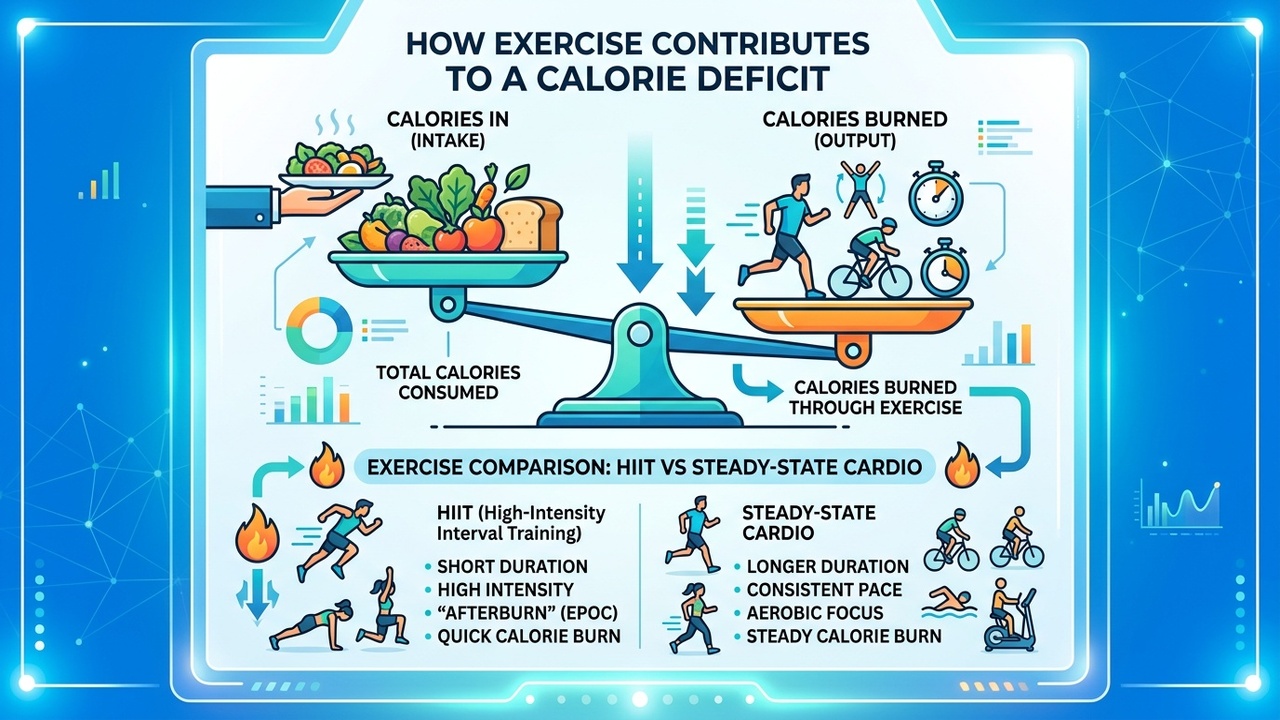
2. Increased energy expenditure. Exercise burns additional calories, which either allows you to eat more while maintaining your deficit or accelerates fat loss at the same caloric intake. A 45-minute strength training session burns 200-400 calories. A 30-minute cardio session burns 200-400 more. This added expenditure creates flexibility in your diet.
Without exercise, a calorie deficit produces weight loss — but a significant portion of that weight loss comes from muscle. With proper exercise (especially resistance training), a much larger percentage of weight loss comes from fat. The difference in body composition outcomes is dramatic.
How Exercise Changes in a Calorie Deficit
Strength Training in a Deficit
This is the most important section of this article. If you do only one type of exercise during a deficit, it should be strength training.
Key adjustments:
- Maintain intensity (weight on the bar). Do not intentionally reduce the weight you lift. Your goal is to continue lifting as heavy as possible. If you start dropping weight, you are telling your body it is okay to lose strength and muscle.
- Maintain or slightly reduce volume. You do not need to add sets during a deficit. In fact, your recovery capacity is lower, so reducing total sets by 10-20% can help maintain quality. If you normally do 16 sets for chest per week, dropping to 12-14 during a deficit is reasonable.
- Prioritize compound lifts. Squats, deadlifts, bench press, rows, and overhead press train the most muscle mass per exercise. During a deficit, you cannot afford wasted effort on low-value exercises.
- Keep rest periods adequate. Do not shorten rest periods to "burn more calories." Longer rest (2-3 minutes for compounds) maintains performance and intensity, which is what preserves muscle.
For structured training programs designed for a deficit, check out our cutting workout plan.
Cardio in a Deficit
Cardio is a tool for increasing energy expenditure during a deficit. It is not the primary driver of fat loss (your calorie deficit is), but it allows you to either eat more or lose fat faster.
The best approach during a deficit:
- Low-intensity steady-state (LISS): Walking, easy cycling, light swimming — 20-40 minutes, 3-5x/week. LISS burns calories without significantly impacting recovery from strength training. Walking is the most underrated fat loss tool.
- Moderate-intensity cardio: Jogging, cycling at moderate effort, rowing — 20-30 minutes, 2-3x/week. Burns more calories per minute than LISS but requires more recovery.
- Limit high-intensity cardio during a deficit. Your recovery capacity is already reduced. Adding intense HIIT sessions on top of strength training and a calorie deficit is a recipe for overtraining.
A good baseline: 150-200 minutes of LISS per week (e.g., 30 minutes of walking daily) plus your strength training sessions.
HIIT vs Steady-State for Fat Loss
The "HIIT burns more fat" claim is partially true but misleading in context.
HIIT produces excess post-exercise oxygen consumption (EPOC), meaning you burn additional calories after the session ends. However, the EPOC effect is modest — approximately 50-80 extra calories over 24 hours.
During a calorie deficit, the advantage of HIIT shrinks further because:
- HIIT creates significant systemic fatigue that competes with recovery from strength training
- HIIT depletes muscle glycogen, which can impair your next lifting session
- The stress of HIIT on top of a deficit can elevate cortisol, which promotes muscle breakdown
LISS and moderate cardio are generally superior to HIIT during a deficit because they burn calories without meaningfully impacting strength training recovery. Save HIIT for maintenance or surplus phases.
For a deeper comparison, read our guide on weights vs cardio for fat loss.
Can You Build Muscle in a Calorie Deficit?
Yes, under certain conditions:
- Beginners: New lifters can build muscle in a deficit because the training stimulus is novel. The body adapts to the new stress by building muscle even without a caloric surplus. This "newbie gains" window typically lasts 6-12 months.
- Returning lifters: If you previously had more muscle mass and lost it (due to a training break), you can rebuild muscle in a deficit through "muscle memory."
- Overweight individuals: People with higher body fat percentages can more easily build muscle in a deficit because they have larger energy reserves to draw from.
- Moderate deficits with high protein: A small deficit (200-300 calories) combined with high protein intake (1.6-2.2 g/kg body weight) and proper strength training gives intermediate lifters the best chance at simultaneous muscle gain and fat loss.
For advanced lifters in a significant deficit, true muscle growth is unlikely. The goal shifts to muscle preservation, which is still an excellent outcome.
How to Structure Your Workouts in a Deficit
Training Volume and Intensity
Volume: Maintain 10-15 hard sets per muscle group per week. This is enough to preserve muscle without exceeding your reduced recovery capacity. If you were doing 20 sets per muscle in a surplus, drop to 14-16 during a deficit.
Intensity (load): Keep the weight on the bar as heavy as you can manage with good form. If your 5-rep max on bench press is 100 kg, continue using 90-100 kg for your working sets. Do not voluntarily reduce load unless form degrades.
Reps: A mix of rep ranges works best. Heavy work (5-8 reps) preserves strength. Moderate work (8-12 reps) maintains muscle stimulus. Keep most of your training in the 6-12 range during a deficit.
Exercise Selection
Focus on exercises that train the most muscle mass per movement:
| Priority | Exercises |
|---|---|
| Essential | Squat, deadlift, bench press, overhead press, barbell row |
| Important | Pull-ups, dumbbell press, leg press, Romanian deadlift |
| Supplementary | Lateral raises, curls, tricep work, calf raises |
Reduce or eliminate low-value exercises that do not directly contribute to muscle preservation. Every set you do needs to justify the recovery cost.
Rest Periods
Do not shorten rest periods during a deficit. The temptation to "keep your heart rate up" by resting less is counterproductive — it reduces the weight you can lift, which reduces the muscle-preservation signal.
Rest 2-3 minutes between compound exercises and 90 seconds between isolation exercises. If you need extra rest, take it. Performance matters more than speed during a deficit.
Recovery and Sleep in a Deficit
A calorie deficit is a physiological stressor. Your body has less energy for repair and adaptation. This makes recovery variables even more important than usual.
Sleep: Aim for 7-9 hours per night. Sleep deprivation during a deficit is a recipe for muscle loss. Research shows that inadequate sleep during caloric restriction shifts the ratio of weight loss away from fat and toward lean mass. This is one of the most underappreciated facts in fat loss.
Stress management: Chronic psychological stress elevates cortisol, which promotes muscle breakdown and fat storage (especially abdominal fat). During a deficit, your body is already stress-loaded. Adding chronic stress on top makes everything worse.
Deload weeks: Plan a deload week every 4-6 weeks during a deficit. Reduce volume by 40-50% for one week. This gives your body a recovery window without completely losing training stimulus.
Signs Your Deficit Is Too Aggressive
Watch for these red flags:
- Strength dropping significantly (losing more than 5-10% on major lifts over 4 weeks)
- Constant fatigue that does not improve with adequate sleep
- Persistent irritability or mood changes
- Loss of motivation to train
- Frequent illness (suppressed immune function)
- Severe hunger that makes the diet unsustainable
- Menstrual irregularities (for women)
- Poor sleep quality despite adequate time in bed
If you experience several of these symptoms, your deficit is too large. Increase calories by 200-300 per day (reducing your deficit size) and reassess after 2 weeks. A sustainable fat loss rate is 0.5-1% of body weight per week. Anything faster than that for an extended period increases muscle loss risk.
For your training program during a deficit, our workout plan for weight loss provides a structured approach.
Sample Weekly Workout Plan for a Calorie Deficit
This 4-day upper/lower split is designed for fat loss while preserving muscle:
Day 1: Upper Body A
| Exercise | Sets x Reps | Rest |
|---|---|---|
| Barbell Bench Press | 4 x 6-8 | 3 min |
| Barbell Row | 4 x 6-8 | 3 min |
| Overhead Press | 3 x 8-10 | 2 min |
| Face Pull | 3 x 12-15 | 60 sec |
| Dumbbell Curl | 2 x 10-12 | 60 sec |
Day 2: Lower Body A
| Exercise | Sets x Reps | Rest |
|---|---|---|
| Barbell Back Squat | 4 x 6-8 | 3 min |
| Romanian Deadlift | 3 x 8-10 | 2 min |
| Leg Press | 3 x 10-12 | 2 min |
| Leg Curl | 3 x 10-12 | 90 sec |
| Calf Raise | 3 x 12-15 | 60 sec |
Day 3: Rest + LISS cardio (30 min walk)
Day 4: Upper Body B
| Exercise | Sets x Reps | Rest |
|---|---|---|
| Dumbbell Bench Press | 3 x 8-10 | 2 min |
| Pull-Ups or Lat Pulldown | 3 x 8-10 | 2 min |
| Seated Cable Row | 3 x 10-12 | 2 min |
| Lateral Raise | 3 x 12-15 | 60 sec |
| Tricep Pushdown | 2 x 10-12 | 60 sec |
Day 5: Lower Body B
| Exercise | Sets x Reps | Rest |
|---|---|---|
| Deadlift | 3 x 5 | 3 min |
| Bulgarian Split Squat | 3 x 10 each | 2 min |
| Leg Extension | 3 x 12-15 | 90 sec |
| Lying Leg Curl | 3 x 10-12 | 90 sec |
| Calf Raise | 3 x 12-15 | 60 sec |
Days 6-7: Rest + LISS cardio (30 min walk each)
Total weekly volume: ~12-14 sets per major muscle group. Compound-heavy. Adequate rest. Supplemented with daily walking. This is a sustainable deficit training structure.
Generate a personalized cutting program with the free workout planner. The AI builds deficit-appropriate training with the right volume and intensity for your level. Find more structured plans in our workout routines collection. Download Load Muscle to track your performance during your cut.

Common Mistakes
Adding excessive cardio instead of managing diet. You cannot out-exercise a bad diet. If your deficit comes entirely from exercise and you eat whatever you want, the results will be inconsistent and unsustainable. A calorie deficit should come primarily from dietary adjustments, with exercise as a supplement.
Reducing lifting intensity. Switching to "light weights, high reps" during a deficit is counterproductive. Light weights do not provide sufficient stimulus to preserve muscle. Keep the weight heavy and reduce volume if needed.
Overtraining. Adding more gym sessions, longer workouts, and extra HIIT on top of a calorie deficit is a common mistake. Your recovery capacity is reduced — doing more is not always better. Quality over quantity.
Insufficient protein. During a deficit, protein requirements increase. Aim for 1.6-2.2 g of protein per kg of body weight per day. Protein preserves muscle, increases satiety, and has a higher thermic effect than carbs or fat. For more on protein, read our protein for muscle growth guide.
Ignoring sleep. As covered above, sleep deprivation during a deficit shifts weight loss from fat to muscle. This single variable can determine whether your cut is successful or destructive.
FAQ
Can you build muscle in a calorie deficit?
Yes, particularly if you are a beginner, returning from a training break, or carrying higher body fat. A moderate deficit (300-500 calories), high protein intake (1.6-2.2 g/kg), and proper strength training give you the best chance. Advanced lifters with low body fat are unlikely to build significant muscle in a deficit — the goal shifts to preservation.
How much cardio should I do in a calorie deficit?
Aim for 150-200 minutes of low-intensity cardio per week (such as daily 30-minute walks) alongside your strength training. This adds calorie expenditure without significantly impacting recovery. Avoid excessive HIIT during a deficit — it creates too much fatigue on top of reduced recovery capacity.
Should I train differently when cutting?
Adjust volume (reduce by 10-20% from your surplus/maintenance levels) but maintain intensity (keep the weight on the bar heavy). Prioritize compound movements, maintain adequate rest periods, and focus on muscle preservation rather than chasing pump or volume records. The stimulus to keep muscle is heavy, progressive lifting.
How fast should I lose weight in a deficit?
A safe and sustainable rate is 0.5-1% of your body weight per week. For a 80 kg person, that is 0.4-0.8 kg per week. Faster rates increase muscle loss risk, hormonal disruption, and are harder to sustain. Patience during a cut produces dramatically better body composition outcomes than aggressive dieting.
Can I do my normal workout routine in a calorie deficit?
You can maintain your current routine structure but may need to reduce total volume by 10-20%. Monitor your performance — if your strength drops more than 5-10% on major lifts or you feel chronically fatigued, reduce volume further or increase your calorie intake slightly. The routine's structure (exercise selection, rep ranges) can stay mostly the same.