Compound movements build the foundation. Isolation exercises build the details. If you have been training for more than a few months and want to bring up lagging body parts, add definition, or fix muscle imbalances, the best isolation exercises are the tools you need.
This guide covers the top isolation movements for every major muscle group — chest, back, shoulders, biceps, triceps, quads, hamstrings, glutes, calves, and abs. Each exercise includes form cues, why it works, and a link to the full demonstration in our exercise library. Whether you train at a commercial gym or at home with dumbbells, you will find movements that fit your setup.
TL;DR
- Isolation exercises target a single muscle group through a single-joint movement. They complement compound lifts by addressing weak points and adding targeted volume.
- Best chest isolation: Dumbbell fly, cable fly, pec deck.
- Best back isolation: Straight arm pulldown, dumbbell pullover, rear delt raise.
- Best shoulder isolation: Lateral raise, front raise, reverse fly.
- Best arm isolation: Concentration curl, incline curl (biceps); cable pushdown, overhead extension (triceps).
- Best leg isolation: Leg extension, leg curl, hip thrust, calf raise.
- Program 2-4 isolation exercises per session after your compounds, 3 sets of 10-15 reps.
- Build a complete routine with isolation work using the free workout planner.
What Are Isolation Exercises?
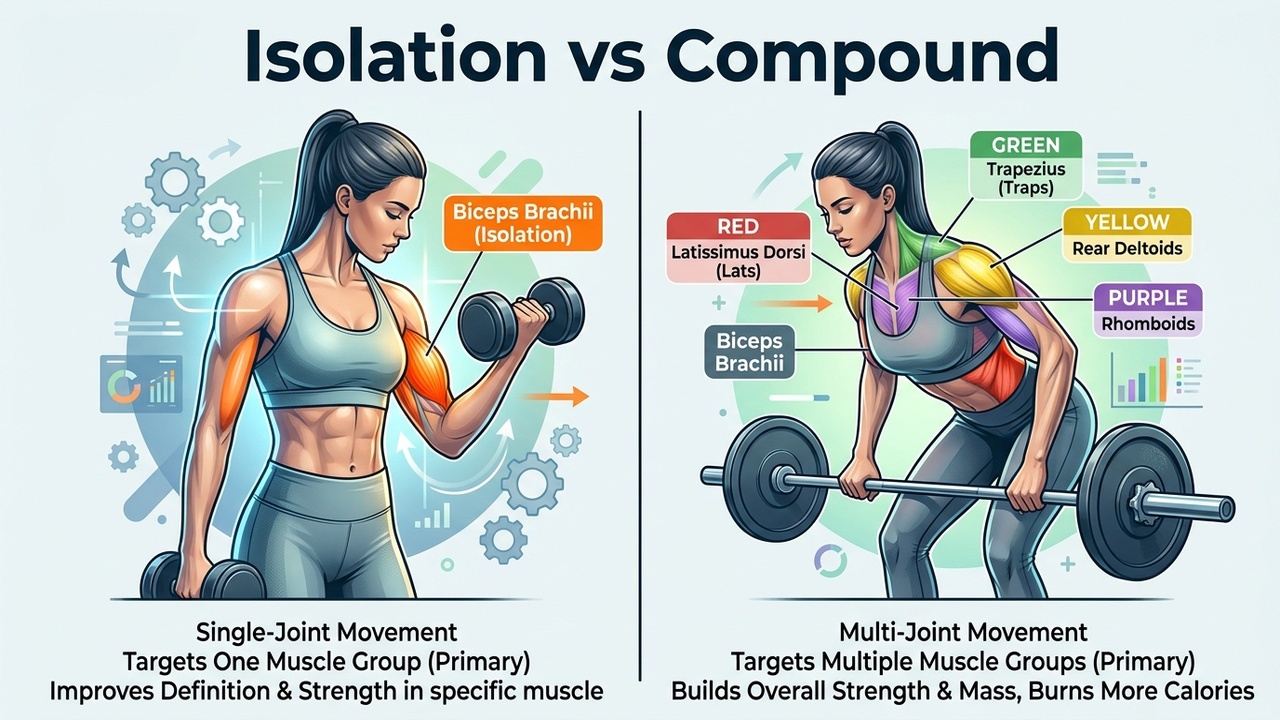
An isolation exercise moves a single joint through its range of motion to target one specific muscle group. A dumbbell lateral raise moves only the shoulder joint to target the lateral deltoid. A leg extension moves only the knee joint to target the quadriceps.
This stands in contrast to compound exercises, which move multiple joints and recruit multiple muscle groups simultaneously. A squat moves the hip, knee, and ankle joints and works quads, glutes, hamstrings, and core. A bench press moves the shoulder and elbow joints and works chest, front delts, and triceps.
Isolation exercises exist to do what compounds cannot: deliver focused, high-tension stimulus to a single muscle. When your chest grows but your side delts lag behind, lateral raises fix the imbalance. When your quads overpower your hamstrings, leg curls restore balance.
They are not a replacement for heavy compound work — they are the finishing touches.
Isolation vs Compound Exercises
This is not a competition. Compounds and isolations serve different purposes, and a well-designed program uses both.
Compound exercises should form the backbone of your training. Squats, deadlifts, bench press, rows, and overhead press build the most muscle per unit of time because they recruit multiple large muscle groups under heavy load. If you only had 30 minutes to train, you would spend it on compounds.
Isolation exercises add value in three ways:
- Targeting weak points. If your chest grows from bench pressing but your rear delts never get enough stimulus, rear delt flies fill the gap.
- Adding volume without systemic fatigue. A set of leg curls adds hamstring volume without the full-body fatigue of a set of Romanian deadlifts. This lets you accumulate more targeted volume without destroying recovery.
- Mind-muscle connection. Isolation exercises make it easier to feel the target muscle working, which can improve motor unit recruitment and muscle awareness over time.
The ideal training program starts with 2-3 compound exercises and finishes with 2-4 isolation exercises. For more on how to program both, read our hypertrophy training guide.
Best Isolation Exercises by Muscle Group
Best Chest Isolation Exercises
The chest (pectoralis major) is heavily trained during bench press and push-up variations, but isolation work adds stretch-focused and constant-tension stimulus that compounds miss.
Dumbbell Fly — The classic chest isolation movement. Lie flat on a bench with dumbbells extended above your chest, then lower them out to the sides in a wide arc until you feel a deep stretch in your pecs. The stretch at the bottom is what makes this exercise special — it loads the chest in its lengthened position, which research suggests is particularly effective for hypertrophy. View the dumbbell fly.
Cable Fly — Cables provide constant tension throughout the entire range of motion, unlike dumbbells where tension drops at the top. Set the cables at chest height and bring the handles together in front of your chest. You can adjust the cable height to target upper chest (low-to-high), mid chest (straight across), or lower chest (high-to-low). View the cable fly.
Pec Deck Machine — The pec deck removes stability requirements, letting you focus entirely on chest contraction. It is especially useful at the end of a workout when your stabilizers are fatigued. The fixed path ensures consistent tension through the movement. View the pec deck fly.
Cable Crossover — Similar to the cable fly but performed with one arm at a time or with a greater range of motion. The crossover allows your hand to travel past the midline of your body, creating a stronger peak contraction. View the cable crossover.
For a complete chest training guide, check out our article on the 15 most effective chest exercises.
Best Back Isolation Exercises
The back is a complex muscle group that includes the lats, rhomboids, traps, and rear delts. While rows and pull-ups are the primary back builders, isolation work targets specific areas that compounds may underserve.
Straight Arm Cable Pulldown — This is the best lat isolation exercise available. Stand facing a cable machine with the handle at the top, keep your arms straight, and pull the handle down in an arc to your thighs. The straight arm eliminates bicep involvement, making this a pure lat movement. View the straight arm pulldown.
Dumbbell Pullover — A unique exercise that stretches the lats through a full range of motion. Lie perpendicular on a bench, hold a dumbbell above your chest, and lower it behind your head in an arc until you feel a deep lat stretch. Pullovers also hit the serratus anterior and long head of the triceps. View the dumbbell pullover.
Dumbbell Rear Delt Raise — Technically a shoulder exercise, but the rear delts are posterior muscles that contribute to back width and shoulder health. Bend over at the hips and raise the dumbbells out to the sides, squeezing your shoulder blades together at the top. View the rear delt raise.
Best Shoulder Isolation Exercises
The deltoid has three heads — anterior (front), lateral (side), and posterior (rear). The anterior head gets plenty of work from pressing movements. The lateral and posterior heads need dedicated isolation work.
Dumbbell Lateral Raise — The king of shoulder isolation. Stand with dumbbells at your sides and raise them out to shoulder height, leading with your elbows. This is the primary exercise for building wider shoulders because it directly targets the lateral deltoid head. Keep the weight moderate — ego lifting on lateral raises leads to trap involvement and poor form. View the lateral raise.
Cable Lateral Raise — The cable version provides more consistent tension through the range of motion compared to dumbbells, which lose tension at the bottom. Performing these one arm at a time with the cable behind your body is an excellent variation. View the cable lateral raise.
Dumbbell Front Raise — Targets the anterior (front) deltoid. Most lifters get enough anterior delt work from pressing movements, but if your front delts are a weak point, front raises add direct stimulus. Raise one or both dumbbells in front of you to shoulder height. View the front raise.
For a complete shoulder training guide, read our article on the ultimate shoulder workout.
Best Bicep Isolation Exercises
The biceps respond well to variety — different curl angles target different portions of the muscle and produce different growth stimuli.
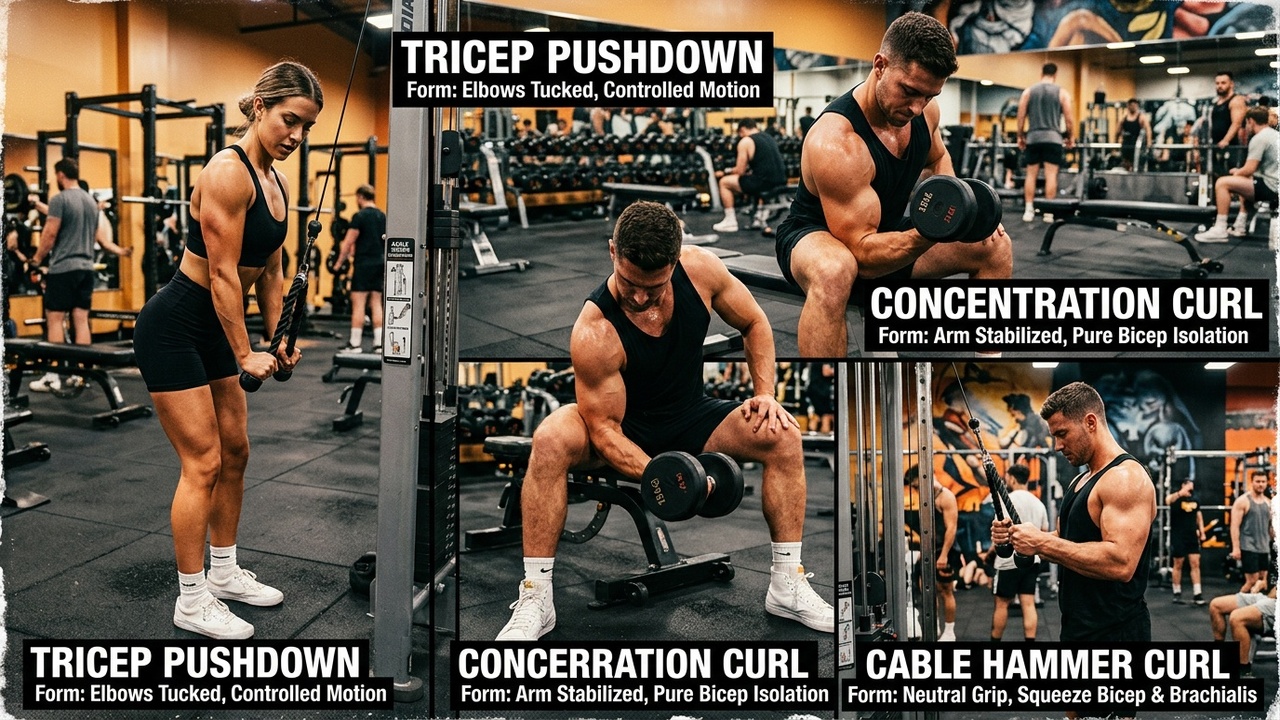
Dumbbell Concentration Curl — Sit on a bench, brace your upper arm against your inner thigh, and curl one dumbbell at a time. The bracing eliminates momentum and forces strict isolation of the bicep. EMG studies show this is one of the highest-activation bicep exercises. View the concentration curl.
Incline Dumbbell Curl — Lie back on an incline bench (30-45 degrees) and curl dumbbells from a fully stretched position. The incline puts the long head of the bicep in a stretched position at the bottom, which creates a unique growth stimulus you cannot get from standing curls. View the incline curl.
Dumbbell Hammer Curl — Curl with a neutral grip (palms facing each other). This targets the brachialis and brachioradialis in addition to the biceps, building arm thickness that standard curls miss. Hammer curls are also easier on the wrists. View the hammer curl.
Barbell Preacher Curl — Using a preacher bench eliminates all momentum and isolates the bicep through the full range of motion. The preacher pad forces strict form and is excellent for building the lower portion of the bicep near the elbow. View the barbell preacher curl.
Best Tricep Isolation Exercises
The triceps make up two-thirds of your upper arm. Three heads — long, lateral, and medial — require different angles to fully develop.
Cable Tricep Pushdown — The most popular tricep isolation exercise for good reason. Stand at a cable machine with a straight bar or rope attachment and push the handle down by extending your elbows. The cable provides constant tension, and you can use different attachments (straight bar, V-bar, rope) to vary the grip angle. View the cable pushdown.
Overhead Tricep Extension — Any overhead extension (dumbbell, cable, or EZ-bar) stretches the long head of the triceps, which is the largest of the three heads and crosses both the elbow and shoulder joints. The stretch at the bottom of the movement is the key stimulus. Use a cable or dumbbell and extend overhead. View the overhead tricep extension.
Dumbbell Kickback — Hinge at the hips, pin your upper arm to your side, and extend the dumbbell behind you. Kickbacks are often dismissed, but when performed with strict form and a full lockout, they produce excellent lateral head activation. View the dumbbell kickback.
Best Quad Isolation Exercises
Squats and leg presses are the primary quad builders, but leg extensions add direct, isolated quadricep stimulus.
Leg Extension — The only true quad isolation exercise. Sit in the machine, hook your ankles under the pad, and extend your knees. Leg extensions are particularly effective for targeting the rectus femoris (the quad head that crosses both the hip and knee joints) and for adding volume without the spinal loading of squats. View the leg extension.
Sissy Squat — A bodyweight quad isolation exercise where you lean back while bending your knees, keeping your hips extended. It is challenging and puts the quads through a deep stretch. Not for beginners, but excellent for advanced trainees. View the sissy squat.
Spanish Squat — Performed with a band around the back of your knees for a posterior pull. This shifts the load heavily onto the quads while reducing knee shear. Excellent for patellar tendon rehab and quad isolation.
Best Hamstring Isolation Exercises
The hamstrings cross both the hip and knee joints, so they benefit from isolation exercises at both joints.
Lying Leg Curl — Lie face down on the machine and curl the pad toward your glutes. The lying position puts a slight stretch on the hamstrings at the hip, making this an effective curl variation. View the lying leg curl.
Seated Leg Curl — The seated position flexes the hip, which puts the hamstrings in a more stretched position compared to lying curls. Research suggests that exercises that load a muscle in its lengthened position may produce greater hypertrophy. View the seated leg curl.
Nordic Hamstring Curl — A bodyweight exercise where you kneel and slowly lower your body forward by extending at the knee. Nordics are one of the most effective hamstring exercises available and are a staple in injury prevention programs. They require significant strength — use a band for assistance if needed. View the nordic hamstring curl.
Best Glute Isolation Exercises
While squats and deadlifts train the glutes, isolation work targets the gluteus maximus and medius more directly.
Barbell Hip Thrust — The single best glute isolation exercise based on EMG research. Sit on the floor with your upper back against a bench, place a barbell across your hips, and drive upward until your hips are fully extended. The hip thrust loads the glutes at peak contraction, which compounds like squats do not. View the hip thrust.
Cable Pull-Through — Stand facing away from a cable machine, hinge at the hips, and pull the cable between your legs by extending your hips. This provides constant tension through the hip extension pattern and is easier to set up than hip thrusts. View the cable pull-through.
Glute Kickback (Cable or Machine) — Extend one leg behind you against cable or machine resistance. This isolates the glute on one side at a time, which helps address left-right imbalances. View the glute kickback.
Best Calf Isolation Exercises
The calves (gastrocnemius and soleus) are stubborn muscles that respond to high volume and multiple angles.
Standing Calf Raise — Stand on a platform with the balls of your feet on the edge, then raise your heels as high as possible. The standing position with straight knees emphasizes the gastrocnemius (the larger, more visible calf muscle). View the standing calf raise.
Seated Calf Raise — Sit in the machine with the pad on your knees and raise your heels. The bent-knee position shifts the emphasis to the soleus, the deeper calf muscle that contributes to overall calf thickness. View the seated calf raise.
Donkey Calf Raise — A hip-flexed calf raise that puts the gastrocnemius in a stretched position. This variation is less common but highly effective when available. View the donkey calf raise.
Best Ab Isolation Exercises
Core training extends beyond crunches. The best ab isolation exercises target the rectus abdominis, obliques, and transverse abdominis through different movement patterns.
Hanging Leg Raise — Hang from a pull-up bar and raise your legs until they are parallel to the ground (or higher). This targets the lower portion of the rectus abdominis through hip flexion, which many ab exercises neglect. Control the movement — swinging defeats the purpose. View the hanging leg raise.
Cable Crunch — Kneel in front of a cable machine with a rope attachment, and crunch downward by flexing your spine against the cable resistance. Cable crunches allow progressive overload — a key advantage over bodyweight-only ab exercises. View the cable crunch.
Pallof Press — Hold a cable handle at chest height and press it straight forward, resisting the rotational pull. This is an anti-rotation exercise that targets the obliques and transverse abdominis. It builds the core stability that protects your spine during heavy compound lifts. View the pallof press.
For a complete core training guide with programming and progression tips, see our best ab exercises.
How to Program Isolation Exercises
Reps and Sets
Isolation exercises generally respond best to moderate to high rep ranges: 10-15 reps for most movements, up to 15-20 for calves and lateral raises. The reasons are practical:
- Single-joint movements are harder to load safely at low rep ranges. A 3-rep max on a lateral raise is both risky and pointless.
- Higher reps create the metabolic stress that contributes to hypertrophy alongside mechanical tension.
- The target muscles are often smaller and fatigue faster, making moderate weight at higher reps more effective.
Recommended programming:
- 2-4 isolation exercises per session
- 3 sets per exercise
- 10-15 reps per set
- 60-90 seconds rest between sets
- Focus on controlled tempo: 2 seconds up, 2-3 seconds down
When to Do Isolation Work in Your Workout
After compounds, not before. Start your workout with heavy compound movements when you are freshest and strongest. Then move to isolation exercises to add targeted volume.
A typical session structure:
- Main compound lift (3-4 sets, 6-8 reps) — e.g., bench press
- Secondary compound lift (3 sets, 8-10 reps) — e.g., incline dumbbell press
- Isolation exercise #1 (3 sets, 10-12 reps) — e.g., cable fly
- Isolation exercise #2 (3 sets, 12-15 reps) — e.g., pec deck
The exception is pre-exhaustion, where you perform an isolation exercise before a compound to pre-fatigue the target muscle. For example, doing leg extensions before squats to ensure your quads work harder during the squat. This is an advanced technique — not for everyday programming.
Common Isolation Exercise Mistakes
Using too much weight. Isolation exercises are not for ego lifting. The goal is to feel the target muscle working through a full range of motion. If you need to swing, jerk, or use momentum, the weight is too heavy. Drop it and focus on the muscle.
Cutting range of motion. Half-rep lateral raises and partial leg curls are common gym sins. The stretched portion of an exercise is often the most hypertrophic. Go through the full range of motion, especially on the eccentric (lowering) phase.
Neglecting the eccentric. Many lifters hoist the weight up and let it drop. The eccentric phase is at least as important as the concentric for muscle growth. Lower the weight under control for 2-3 seconds.
Skipping entire muscle groups. Rear delts, hamstrings, and calves are the most commonly neglected muscles because they are not visible in the mirror. A balanced physique and healthy joints require attention to every muscle group, not just the ones you can see.
Doing isolation work instead of compounds. Isolation exercises supplement compound lifts — they do not replace them. If you are doing lateral raises and cable flies but never pressing or rowing heavy, your training is unbalanced and your progress will be limited.
Build Your Custom Isolation Routine
Every lifter has different weak points, which means your isolation exercise selection should be personalized. Load Muscle's AI considers your goals, equipment, and training preferences to select the right isolation exercises for your program.
The free workout planner builds a complete routine that includes both compound and isolation work, balanced across all muscle groups. If you want to add specific isolation exercises to an existing program, browse the exercise library for detailed form guides and muscle targeting data on every movement. Download Load Muscle to get a personalized program with the right balance of compound and isolation work.
FAQ
How many isolation exercises should I do per workout?
For most lifters, 2-4 isolation exercises per session is the sweet spot. This adds targeted volume without extending your workout unnecessarily. Place them after your compound lifts, performing 3 sets of 10-15 reps each. Total weekly isolation volume per muscle group should be 6-12 sets, on top of the indirect work from compounds.
Are isolation exercises necessary for muscle growth?
Not strictly necessary, but highly beneficial. You can build significant muscle with compounds alone, especially as a beginner. However, isolation exercises become increasingly important as you advance because they allow you to target specific muscles that compounds may underserve, fix imbalances, and add volume without systemic fatigue.
Should I do isolation exercises before or after compound exercises?
After compound exercises in most cases. You want to perform heavy, multi-joint movements when you are freshest. The exception is pre-exhaustion technique, where an isolation exercise is done first to pre-fatigue a target muscle before a compound movement. This is an advanced strategy and not suitable for everyday training.
What is the difference between isolation and compound exercises?
Compound exercises move multiple joints and work multiple muscle groups (e.g., squat, bench press, deadlift). Isolation exercises move a single joint and target one muscle group (e.g., bicep curl, leg extension, lateral raise). Read our best compound exercises guide for a detailed comparison and programming recommendations.
Can I build big arms with isolation exercises alone?
You can build arm size with isolation exercises, but your results will be better if you also include compound pushing and pulling movements. Bench press and overhead press work the triceps. Rows and pull-ups work the biceps. Adding curls and extensions on top of heavy compounds is the most effective approach for arm growth.
Are cable or dumbbell isolation exercises better?
Both have advantages. Cables provide constant tension throughout the range of motion and are excellent for exercises like lateral raises, cable flies, and pushdowns. Dumbbells provide a free range of motion and work stabilizer muscles. The best approach is to use both — cables for constant-tension exercises and dumbbells for stretch-focused exercises like incline curls and dumbbell flies.
To slot these isolation movements into a complete weekly program, browse our strength workout routines for plans that balance compounds and isolation work.