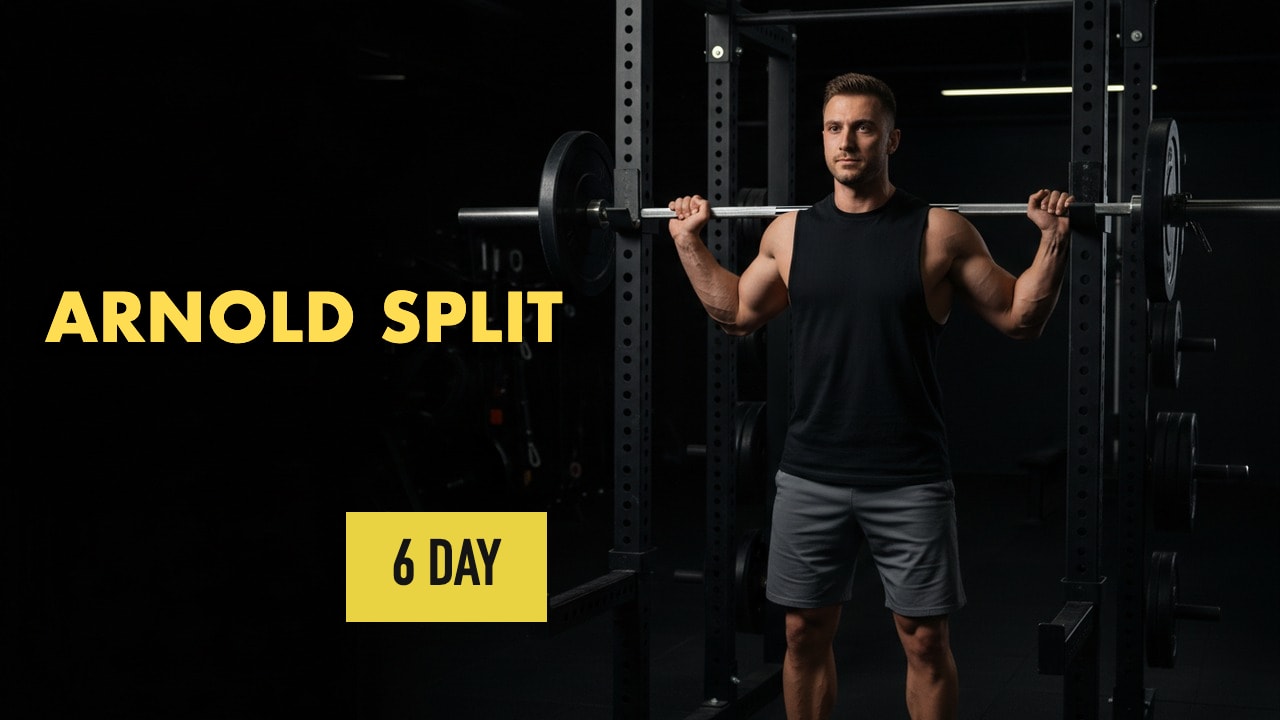
The Arnold split is a 6-day workout split built from three sessions: Chest and Back, Shoulders and Arms, and Legs. You run all three, run them again, and rest on the seventh day. Every muscle group is trained twice a week.
It is named after Arnold Schwarzenegger, who trained with this pairing in the 1970s. His version was built for a full-time competitive bodybuilder, with far more sets than most people can recover from.
The routine below keeps the structure and cuts the volume to what a natural lifter with a job can handle. You get the schedule, all six workouts, 4- and 5-day versions, and a comparison with PPL and the bro split.
TL;DR
- The Arnold split is Chest and Back, Shoulders and Arms, Legs, repeated: six training days, one rest day.
- Every muscle is trained twice a week, the same frequency as a 6-day PPL.
- Days 1 to 3 are heavy: barbell lifts, 5-8 reps, long rests. Days 4 to 6 are volume days: dumbbells, cables and machines, 8-15 reps.
- Each session has 6-7 exercises, 16-20 hard sets, and takes 60-75 minutes.
- It suits intermediate and advanced lifters with six free days and good sleep. Beginners do better on three full body days.
- Six days will not fit your week? Use the 4- or 5-day version below, or let the Free Workout Planner build a plan around the days you have.
What Is the Arnold Split?
Three workouts, each run twice a week:
- Chest and Back. Pressing and pulling in the same session.
- Shoulders and Arms. Front, side and rear delts, then biceps and triceps.
- Legs. Quads, hamstrings, glutes and calves, with abs at the end.
The unusual part is the first pairing. Most splits keep chest and back apart. Push pull legs puts chest on push day and back on pull day. A bro split gives each its own day.
The Arnold split trains them together because they do opposite jobs. While your chest rests between sets, your back works, and the other way round. That makes it easy to alternate a press with a row and keep the session moving.
The second pairing gives shoulders and arms a day of their own. On most splits they get the last few exercises of a session, after the big lifts have drained you. Here they get the whole session, twice a week.
Who Should Run the Arnold Split (and Who Should Not)
The Arnold split is a good fit if:
- You can train six days in most weeks. Six sessions of 60-75 minutes. If that only happens in a good week, pick a shorter split.
- You have trained consistently for a year or more. Your form on the bench press, row, squat and overhead press is solid.
- You want more shoulder and arm work. This is the main reason to choose it over PPL.
- Your recovery is in order. You sleep seven hours or more most nights and eat enough to grow.
Pick something else if:
- You are new to lifting. Three full body sessions a week will take you further. Start with the full body workout plan.
- You can only count on four days. Run PHUL or a plain upper lower split. Both train every muscle twice a week in four sessions.
- You have five days. The PPL upper lower split is built for exactly that.
- You prefer grouping muscles that work together. Run the 6-day version in the push pull legs routine guide.
Still choosing a structure? The best workout split guide compares them by schedule, experience and goal.
The Arnold Split Weekly Schedule
| Day | Workout | Focus |
|---|---|---|
| Monday | Chest and Back (heavy) | Chest, lats, upper back |
| Tuesday | Shoulders and Arms (heavy) | Delts, biceps, triceps |
| Wednesday | Legs (heavy) | Quads, hamstrings, glutes, calves |
| Thursday | Chest and Back (volume) | Chest, lats, upper back |
| Friday | Shoulders and Arms (volume) | Delts, biceps, triceps |
| Saturday | Legs (volume) | Quads, hamstrings, glutes, calves |
| Sunday | Rest | Recovery |
Each session type gets two full days off before it comes around again.
The catch is your arms and front delts. Monday's presses work your triceps and front delts, and Monday's rows work your biceps. Then Tuesday trains all three directly, and the pattern repeats on Thursday and Friday. This is the Arnold split's main weakness, and why the arm work below is moderate and stops short of failure.
Your lower back gets a break on Thursday. Wednesday is squats and Romanian deadlifts, so Thursday's back work uses cables and a supported row instead of a barbell.
Any day can be your rest day. Keep the order and the rhythm of six on, one off. If you miss a session, shift the rest of the week back a day. Do not train two sessions in one day to catch up.
The 6-Day Arnold Split Routine
The week has a heavy half and a volume half.
Days 1 to 3 are strength-biased. Barbell lifts come first, most work sits at 5-8 reps, and the main lifts get two to three minutes of rest.
Days 4 to 6 are volume-biased. Dumbbells, cables and machines take over, reps move up to 8-15, and rests get shorter.
Running the same heavy workout twice a week is where most copies of the Arnold split go wrong. This way every muscle gets heavy sets early in the week and higher-rep sets later.
Before each session, do five minutes of easy cardio and 2-3 lighter sets of the first exercise. Finish most sets with one or two good reps left. Each exercise name links to its page with a demo and instructions.
Day 1: Chest and Back
The heaviest upper body session of the week. Alternate pressing and pulling, starting with the two big barbell lifts.
| # | Demo | Exercise | Sets × Reps | Rest |
|---|---|---|---|---|
| 1 | Barbell Bench PressRest 3 min | 4 × 5-7 | 3 min | |
| 2 | Barbell Bent Over RowRest 2-3 min | 4 × 6-8 | 2-3 min | |
| 3 | Barbell Incline Bench PressRest 2-3 min | 3 × 6-8 | 2-3 min | |
| 4 | Pull-UpRest 2 min | 3 × 6-10 | 2 min | |
| 5 | Dumbbell FlyRest 90 sec | 2 × 10-12 | 90 sec | |
| 6 | Dumbbell PulloverRest 90 sec | 2 × 10-12 | 90 sec |


Session notes:
- To save about 10 minutes, superset the incline press with pull-ups and the fly with the pullover: one set of each, then 90 seconds of rest. Keep the bench press and row as straight sets.
- If you cannot do six clean pull-ups yet, use the lat pulldown for 3 x 6-8.
Day 2: Shoulders and Arms
Heavy overhead pressing first while your shoulders are fresh, then side and rear delts, then arms.
| # | Demo | Exercise | Sets × Reps | Rest |
|---|---|---|---|---|
| 1 | Barbell Standing Military PressRest 3 min | 4 × 5-7 | 3 min | |
| 2 | Dumbbell Lateral RaiseRest 60 sec | 3 × 12-15 | 60 sec | |
| 3 | Dumbbell Rear Delt FlyRest 60 sec | 3 × 12-15 | 60 sec | |
| 4 | Barbell Close Grip Bench PressRest 2 min | 3 × 6-8 | 2 min | |
| 5 | Barbell CurlRest 90 sec | 3 × 6-8 | 90 sec | |
| 6 | Skull CrusherRest 60 sec | 2 × 10-12 | 60 sec | |
| 7 | Dumbbell Incline CurlRest 60 sec | 2 × 10-12 | 60 sec |


Session notes:
- Your triceps and front delts worked yesterday. If the military press feels flat for the first two weeks, that is normal.
- Superset the arm work: close grip bench with barbell curls, skull crushers with incline curls.
Day 3: Legs
Squat heavy, then hinge, then machines that let your legs keep working after your back has had enough.
| # | Demo | Exercise | Sets × Reps | Rest |
|---|---|---|---|---|
| 1 | Barbell SquatRest 3 min | 4 × 5-7 | 3 min | |
| 2 | Barbell Romanian DeadliftRest 2-3 min | 3 × 6-8 | 2-3 min | |
| 3 | Leg PressRest 2 min | 3 × 8-10 | 2 min | |
| 4 | Lying Leg CurlRest 90 sec | 3 × 8-10 | 90 sec | |
| 5 | Standing Calf RaiseRest 90 sec | 4 × 8-10 | 90 sec | |
| 6 | Hanging Leg RaiseRest 60 sec | 3 × 10-15 | 60 sec |


Session notes:
- On the Romanian deadlift, push your hips back and stop when your hamstrings are fully stretched. The bar does not need to touch the floor.
- There is no conventional deadlift in this plan. Monday's rows and today's Romanian deadlifts already load your lower back twice a week. If you want to pull from the floor, replace the Romanian deadlift with a barbell deadlift for 3 x 4-6.
Day 4: Chest and Back
The second chest and back session moves to dumbbells and cables. Reps go up, rests come down.
| # | Demo | Exercise | Sets × Reps | Rest |
|---|---|---|---|---|
| 1 | Dumbbell Incline Bench PressRest 2 min | 3 × 8-12 | 2 min | |
| 2 | Lat PulldownRest 90 sec | 3 × 10-12 | 90 sec | |
| 3 | Dumbbell Bench PressRest 90 sec | 3 × 10-12 | 90 sec | |
| 4 | Cable Seated RowRest 90 sec | 3 × 10-12 | 90 sec | |
| 5 | Cable Standing FlyRest 60 sec | 2 × 12-15 | 60 sec | |
| 6 | Dumbbell One Arm RowRest 60 sec | 2 × 10-12 each arm | 60 sec |


Session notes:
- No barbell rows today on purpose. Yesterday was squats and Romanian deadlifts. The seated row and the supported one-arm row let your upper back work hard without loading your spine.
- The same superset pattern as Day 1 works here: press, then pull.
Day 5: Shoulders and Arms
Lighter pressing, more side and rear delt work, and higher-rep arm work. Chase clean reps, not heavier weights.
| # | Demo | Exercise | Sets × Reps | Rest |
|---|---|---|---|---|
| 1 | Dumbbell Arnold PressRest 2 min | 3 × 8-12 | 2 min | |
| 2 | Cable Lateral RaiseRest 60 sec | 3 × 12-15 each arm | 60 sec | |
| 3 | Cable Standing Face PullRest 60 sec | 3 × 12-15 | 60 sec | |
| 4 | Cable Triceps PushdownRest 60 sec | 3 × 10-12 | 60 sec | |
| 5 | Dumbbell Hammer CurlRest 60 sec | 3 × 10-12 | 60 sec | |
| 6 | Dumbbell Standing Triceps ExtensionRest 60 sec | 2 × 12-15 | 60 sec | |
| 7 | Dumbbell Concentration CurlRest 60 sec | 2 × 12-15 | 60 sec |


Session notes:
- The Arnold press starts with your palms facing you and rotates as you press. Start lighter than your usual dumbbell press.
- Your biceps worked yesterday on rows and pulldowns. Leave a rep or two in the tank on every curl set.
Day 6: Legs
The second leg day swaps the barbell on your back for a machine squat and walking lunges. Your legs still work hard, and your spine gets a break before your rest day.
| # | Demo | Exercise | Sets × Reps | Rest |
|---|---|---|---|---|
| 1 | Hack SquatRest 2 min | 3 × 8-12 | 2 min | |
| 2 | Dumbbell Walking LungesRest 90 sec | 3 × 10-12 each leg | 90 sec | |
| 3 | Seated Leg CurlRest 90 sec | 4 × 10-12 | 90 sec | |
| 4 | Leg ExtensionRest 60 sec | 3 × 12-15 | 60 sec | |
| 5 | Seated Calf RaiseRest 60 sec | 4 × 12-15 | 60 sec | |
| 6 | Cable Kneeling CrunchRest 60 sec | 3 × 12-15 | 60 sec |


Session notes:
- No hack squat machine? Use the leg press from Day 3 for the same sets and reps.
- Tomorrow is your only rest day, and Monday is your heaviest upper body session. Finish with something left.
How the Weekly Volume Adds Up
Here is what the six workouts total across the week. A compound lift counts toward each muscle it trains hard.
| Muscle group | Hard sets per week |
|---|---|
| Chest | 17 |
| Back | 17 |
| Shoulders (front, side, rear) | 19, plus every chest press |
| Biceps | 10, plus every row and pull-up set |
| Triceps | 10, plus every pressing set |
| Quads | 16 |
| Hamstrings | 10 |
| Glutes | 6, plus every squat and leg press set |
| Calves | 8 |
| Abs | 6 |
Chest, back, quads and shoulders sit at the high end of what most intermediate lifters recover from. Your front delts work in every chest and shoulder session, which is why there is no front raise anywhere in this plan.
A Realistic Arnold Split for Natural Lifters
Templates shared online as Arnold's routine often list four or five exercises per muscle at four to six sets each. For chest and back together, that is 40 sets or more in one session, twice a week.
| Factor | Typical online Arnold template | This routine |
|---|---|---|
| Exercises per session | 8-12 | 6-7 |
| Chest or back sets per session | 20 or more | 8-9 |
| Weekly sets per big muscle | 40 or more | 16-19 |
| Session length | Often 2 hours | 60-75 min |
| The two weekly sessions | Same workout twice | One heavy, one volume |
The structure is what makes it the Arnold split. The 1970s volume is not. These rules keep six days recoverable:
- Cap each session at about 20 hard sets. Warm-up sets do not count.
- Stop most sets with one or two reps left. Only the last set of an isolation exercise goes close to failure.
- Keep the volume days lighter. If you are grinding reps on Thursday, the weight is too heavy for that day.
- When recovery slips, take one set off every exercise that has three or more. That takes chest and back from 17 to 13 sets a week, still enough to grow for most intermediate lifters.
- If it is still too much, drop to five days. The 5-day version below keeps every muscle at twice a week.
Signs you are doing too much: your main lifts go backward two weeks in a row, your elbows or shoulders ache, or you start dreading sessions you used to enjoy. Take a deload week, then come back with the lower set counts from rule 4.
If your sleep is short or you are eating in a deficit, you will likely make more progress on four days.
4-Day and 5-Day Arnold Split Versions
Six sessions do not fit every week. Here is how to keep the Arnold pairings with fewer days.
The 5-Day Version
Keep the three heavy days and the second leg day. Merge the two volume upper days into one upper session.
| Day | Workout |
|---|---|
| Monday | Chest and Back, heavy (Day 1) |
| Tuesday | Shoulders and Arms, heavy (Day 2) |
| Wednesday | Legs, heavy (Day 3) |
| Thursday | Rest |
| Friday | Upper: dumbbell incline press, lat pulldown, cable seated row, Arnold press, cable lateral raise, triceps pushdown, hammer curl (3 sets each) |
| Saturday | Legs, volume (Day 6) |
| Sunday | Rest |
Every muscle is still trained twice a week. Shoulders and arms lose a few sets, and you gain a second rest day. This week is close to the PPL upper lower split, with the Arnold pairings on the heavy days.
The 4-Day Version
Train on four fixed days, for example Monday, Tuesday, Thursday and Friday. Run the six workouts in order and pick up where you left off.
| Week | Mon | Tue | Thu | Fri |
|---|---|---|---|---|
| 1 | Day 1 | Day 2 | Day 3 | Day 4 |
| 2 | Day 5 | Day 6 | Day 1 | Day 2 |
| 3 | Day 3 | Day 4 | Day 5 | Day 6 |
Each muscle gets four sessions every three weeks, about 1.3 times a week. It works, but it is a compromise. For twice a week on four days, run PHUL instead: heavy days early in the week, volume days later.
How to Progress on the Arnold Split
Use double progression on every exercise.
- Start at the bottom of the rep range. Pick a weight you can lift for the lowest number on every set, with a rep or two to spare.
- Add reps before you add weight. Each week, try to get one more rep on at least one set.
- When every set reaches the top of the range, add weight.
- Drop back down and build again. With the heavier weight, your reps fall toward the bottom of the range.
Here is how that looks on the bench press, with a target of 4 x 5-7:
| Week | Weight | Reps on each set |
|---|---|---|
| 1 | 80 kg | 6, 5, 5, 5 |
| 2 | 80 kg | 7, 6, 6, 5 |
| 3 | 80 kg | 7, 7, 6, 6 |
| 4 | 80 kg | 7, 7, 7, 7 |
| 5 | 82.5 kg | 6, 5, 5, 5 |
How much weight to add. Use the smallest jump your gym allows. That is usually 2.5 kg (5 lb) on presses, rows and curls, and 5 kg (10 lb) on squats and Romanian deadlifts. With dumbbells, take the next pair up.
Go slower on small lifts. On lateral raises, curls and triceps work, hit the top of the range two weeks in a row before you move up.
When a lift stalls. Look at sleep and food first. If one exercise has not moved for three weeks, swap it for a close variation. If everything stalls at once, take a deload week and cut your sets roughly in half.
Run the routine as written for 8 to 12 weeks before you change exercises. The progressive overload guide covers more ways to keep the numbers moving.
Arnold Split vs PPL vs Bro Split
| Factor | Arnold split | Push pull legs (6 days) | Bro split (5 days) |
|---|---|---|---|
| Training days | 6 | 6 | 5 |
| Frequency per muscle | 2x per week | 2x per week | 1x per week |
| How muscles are grouped | Opposites: chest with back | Movement: push, pull, legs | One body part per day |
| Arm and shoulder work | A session of their own, twice a week | End of push and pull days | One arm day, one shoulder day |
| Overlap between days | Arms work two days in a row, twice a week | Low | Low |
| Best for | Intermediates who want more arm and shoulder work | Intermediates who want clean recovery between days | Lifters who like one muscle per session |
Arnold split vs PPL. Same days, same frequency. The difference is how the muscles are grouped. PPL groups muscles that work together: your triceps train with your chest on push day, then rest completely on pull day. The Arnold split groups opposites, so chest and back pair well for supersets and arms get a session where they are not the afterthought. The cost is overlap: the muscles you train on Tuesday already worked on Monday.
Neither builds more muscle by default. If your arms and shoulders lag, the Arnold split gives them more attention. If you want the simplest recovery, run PPL. The upper lower vs PPL comparison covers the frequency and volume math.
Arnold split vs bro split. A bro split gives every muscle a whole session but trains it only once a week. The Arnold split trains each muscle twice with fewer sets per session. For most natural lifters, twice a week is the better use of the same weekly volume.
Common Arnold Split Mistakes
Copying the 1970s volume. Twenty sets of chest followed by twenty sets of back is a program for a full-time athlete. Keep each session around 20 hard sets.
Making all six days heavy. Six heavy barbell sessions a week is more than most lifters can recover from. The volume days are lighter by design.
Taking every arm set to failure. Your arms work on Monday, then again on Tuesday. Leave a rep or two in reserve, or Thursday's rows and presses suffer.
Adding front raises. Your front delts already get the bench press, the incline press and two overhead presses. Spend those sets on side and rear delts.
Skipping the second leg day. It is the session people drop first, and without it your legs get trained once a week.
Not writing anything down. Double progression only works if you know what you lifted last week. Log the weight and reps for every set.
FAQ
What is the Arnold split?
It is a 6-day workout split that runs Chest and Back, Shoulders and Arms, and Legs, then repeats all three before a rest day. Every muscle group is trained twice a week. It is named after Arnold Schwarzenegger, who trained with this pairing during his bodybuilding career in the 1970s.
Is the Arnold split good for natural lifters?
Yes, if you cut the volume. Templates shared online as Arnold's routine often list 20 or more sets for chest and again for back in one session, which few people can recover from six days a week. Keep each session to about 16 to 20 hard sets, make the second half of the week lighter than the first, and stop most sets one or two reps short of failure.
Is the Arnold split better than PPL?
Neither builds more muscle by default. Both use six training days and hit every muscle twice a week. The Arnold split gives shoulders and arms a session of their own and pairs chest with back, which makes supersets easy. PPL groups muscles that work together, so recovery between days is cleaner. Pick the one you will keep running for months.
Can beginners do the Arnold split?
They can, but it is a poor use of their time. A beginner gets stronger quickly on three full body sessions a week and recovers better between them. The Arnold split fits after a year or more of consistent training, once you can commit to six sessions in most weeks.
Can you do the Arnold split 4 or 5 days a week?
Yes. On five days, keep the three heavy sessions and the second leg day, and merge the two lighter upper body days into one upper session. On four days, run the six workouts in order and pick up where you left off, which trains each muscle about 1.3 times a week. If you want every muscle twice a week on four days, an upper/lower program such as PHUL fits better.
Get Your Arnold Split Plan
You have the full Arnold split routine: six workouts, a schedule, a version you can recover from, and a way to progress.
Option 1: Build your own version. The AI workout planner creates a plan around your goal, the days you can train and the equipment you have. It takes about a minute, needs no signup, and you can download the plan as a PDF.
Option 2: Start from a ready-made plan. The workout routines library has plans you can follow as they are. If six days is too many, the Push - Pull - Legs plan and the other strength routines are good places to start.
Option 3: Take it to the gym on your phone. The LoadMuscle app builds a personalized plan with AI, has ready-made plans you can start right away, shows demos for 4,000+ exercises, and tracks your progress. It is free on iPhone and Android.
Pick your rest day, start with Chest and Back, and write down every set.